The quiet infrastructure deciding which card sits at the top of your wallet - at Netflix, Amazon, PayPal, and a few hundred merchants you forgot you signed up for.
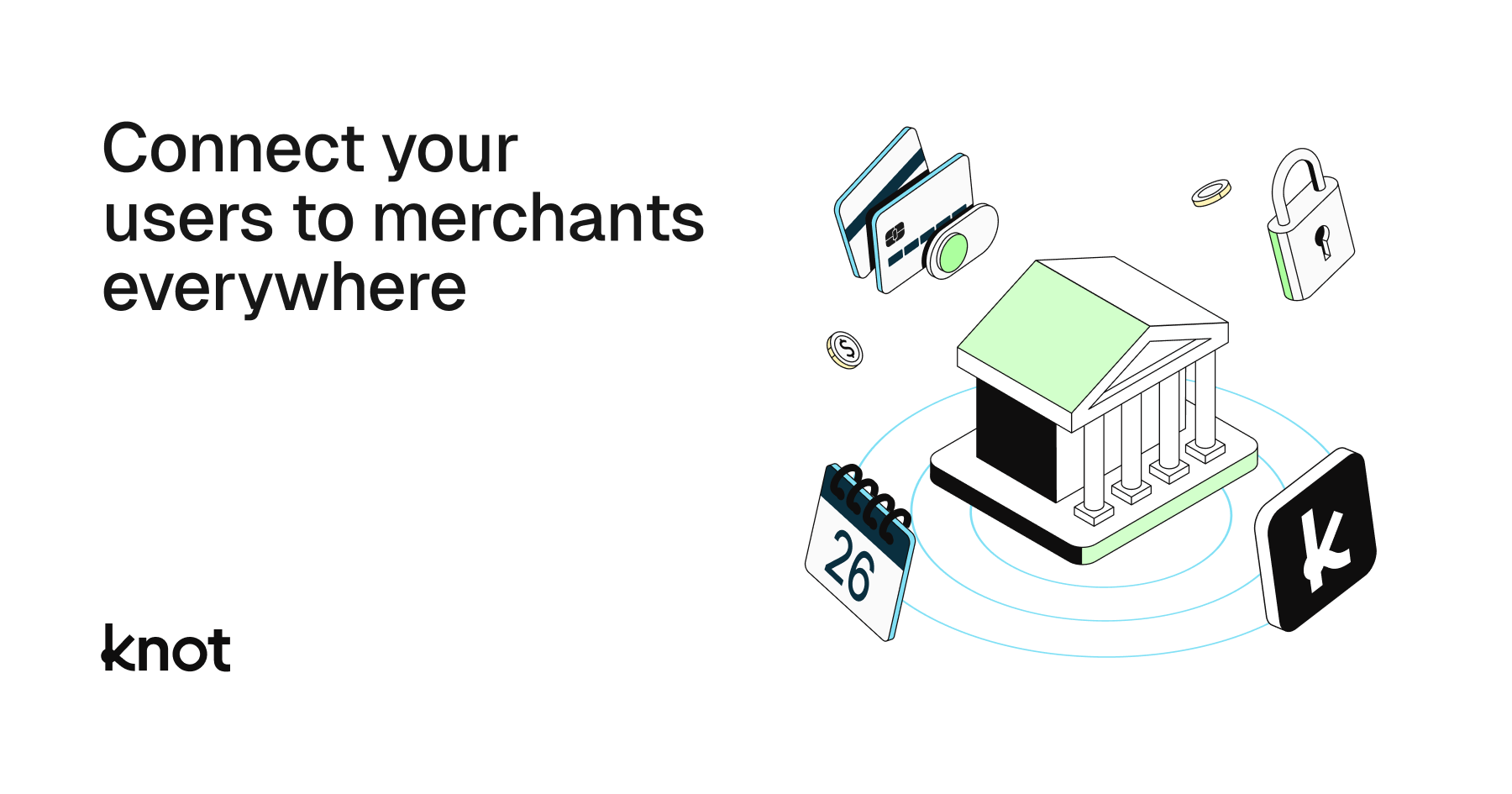
Knot's calling card: a bank, a padlock, a calendar that says "26," and a card that updates itself. The whole company, basically, in one isometric drawing.
You get a new debit card in the mail. The old one expired, or got skimmed, or the bank just felt like reissuing it. Somewhere in a New York office, this is the entire reason Knot exists - and the company would very much like you to never think about it again.
Because here is what is supposed to happen next: nothing. Your Spotify keeps playing. Your Amazon order goes through. The fifteen merchants holding your card on file quietly update themselves, and you remain blissfully unaware that anything happened at all. That invisible hand-off is Knot's product. The company sells the absence of an annoyance.
Knot is a merchant connectivity platform. Stripped of the jargon: it is the wiring that lets a bank or fintech reach into hundreds of online merchant accounts and swap, update, or read a customer's payment details - on the customer's behalf, with the customer's permission. It is plumbing. Glorious, well-funded, deeply unglamorous plumbing.
The dirty secret of modern payments is that the "card on file" - that saved little Visa logo at every checkout - is a mess held together by hope. When a card expires or changes, the merchant's saved copy goes stale. Payments fail. Subscriptions lapse. Customers churn, often without knowing why.
Card networks built patchwork tools to push updates downstream, but coverage was spotty and the experience landed on the user: log in, find settings, retype sixteen digits, repeat across every service you own. It is the kind of chore that sounds trivial until you multiply it by every American with a streaming habit and a reissued card.
Banks and card issuers had a sharper motive than mere convenience. There is a small, fierce war over which card a customer makes their default - the "top of wallet." Win that slot and you win the transaction fees for years. Lose it and you are a rectangle of plastic in a drawer. Issuers desperately wanted to be top of wallet, and they had almost no good way to make it happen.
Knot was founded in 2021 by Rory and Kieran O'Reilly - brothers, and the kind of founders who decided the unglamorous middle layer of payments was worth a decade of their lives. Rory took the CEO seat; Kieran took CTO. The bet was simple to state and brutally hard to build: if you could create one clean API that connected a cardholder to every merchant where their card lived, you would own a chokepoint everyone else needed.
It is a deeply contrarian thing to get excited about. Most founders want to build the shiny app. The O'Reillys wanted to build the thing underneath the shiny app, the part users never see. As bets go, it was less "change the world" and more "make one specific, universally despised task disappear." Wilde would have appreciated the restraint.
Investors came around to it. By August 2023, Knot had closed a $10 million Series A led by Nava Ventures, on top of earlier seed money - roughly $13 million in total. The cap table told the story better than any pitch deck: American Express Ventures and Plaid both wrote checks, alongside more than twenty founders and CEOs. When the incumbents you might disrupt decide to invest instead, you have found a nerve.
Knot does not sell to you. It sells to the banks and fintechs whose apps you already use, who embed these tools and quietly make their products better. The whole catalogue trades under trademarks with a suspiciously consistent naming convention. Each one attacks a different slice of the same problem - getting a card, and the data around it, to move where the customer wants it to go. Taken together they are less a product line than a single bet placed five different ways.
Switches a user's saved payment method across hundreds of merchant accounts at once. The shortest path to becoming top-of-wallet, minus the sixteen digits.
Pulls user-permissioned, SKU-level purchase data from top merchants. Not just "you spent $84" - the actual line items on the receipt.
Refreshes cardholder details on file in seconds, killing the declined-payment-from-an-expired-card problem before the customer notices.
Lets users see, manage, and cancel their subscriptions from inside a partner's app. The graveyard of forgotten free trials, finally visible.
Embeds one-click, agent-driven shopping into apps - Knot's connectivity stretched toward automated checkout and the AI buying era.
Rory and Kieran O'Reilly start building the merchant connectivity layer in New York.
Nava Ventures leads, with American Express Ventures and Plaid joining. Total raised reaches roughly $13M.
SubscriptionManager and AgenticShopping join CardSwitcher, TransactionLink, and AccountUpdater.
PayPal users can push their PayPal-branded card on file across merchants using CardSwitcher - a rollout reaching millions.
CardSwitcher integrates with Lyft Direct so drivers can update their card across merchants and subscriptions.
Talk is cheap; partnerships are not. In April 2025 PayPal turned on CardSwitcher for its users, letting people push their PayPal-branded card to merchants across the web from inside the PayPal app. In February 2026 Fiserv plugged Knot into Lyft Direct, so gig drivers could keep their earnings card current everywhere it mattered. These are not logos for a slide - they are companies routing real money through Knot's pipes.
The funding picture is modest by hype standards and that is rather the point. Knot raised what it needed to build infrastructure, not to buy attention. The investor list does the persuading instead. When American Express and Plaid - two companies that could plausibly build a card-switching product in-house - decide to fund yours, the market has answered a question you did not have to ask out loud.
Scale, in this business, is measured less in users than in reach. Each partner Knot signs inherits a connection to hundreds of merchants on day one. A single integration with a bank can put CardSwitcher in front of that bank's entire customer base, which is how a fifty-person company ends up quietly touching millions of cardholders without ever shipping a consumer app of its own. The leverage is the whole story.
Bars scaled to the ~$13M cumulative total. Seed amount approximate.
New York, New York
2021
~50 people, ~80% engineers
$13M
SOC 2 · PCI · AICPA
Merchant connectivity / fintech API
Knot describes its mission plainly: "We're on a mission to build connected banking experiences." Behind the tidy sentence is a bigger claim - that the relationship between your money and the places you spend it should be programmable, instant, and yours to direct. Today that means card switching. Tomorrow it may mean an AI agent that does your shopping and keeps your payment details straight without ever bothering you.
The culture is built for that long game. Roughly four in five employees write code. Security is not a slide but a certification list - SOC 2, PCI, AICPA - because moving people's payment credentials around demands that you be boring in exactly the right ways. There is no glamour in compliance. There is a great deal of trust.
The web is sliding toward a future where software does the buying. AI agents will book the flights, reorder the groceries, renew the subscriptions. Every one of those agents will need to know which card to use and where it lives - exactly the problem Knot has spent years quietly solving. AgenticShopping is the company's flag planted in that ground early.
So return to the mailbox. The new card arrives. You tap it against your phone once, or maybe you do nothing at all, and every merchant you have ever trusted updates in the background. Spotify keeps playing. Amazon goes through. The chore that used to eat an afternoon is now an event that does not happen.
That is the strange ambition of Knot: to build something so well that you never notice it working. The best plumbing is the kind you forget exists - right up until the day it doesn't, and you finally understand what it was holding up.