The div was still there. Kevin Powell had rehearsed the demo over and over before his first main-stage talk at CSS Day in 2024. On stage in Amsterdam, in front of a room of more than 300 people, the live code stopped doing what it was supposed to do. Then someone in the audience saw the problem: a stray HTML element he had meant to remove. Powell took it out, the demonstration worked, and the talk carried on. He later wrote that the interruption may have helped another teacher in the room feel better about her own mistakes.
There is an entire approach to teaching packed into that small failure. Powell makes videos about CSS, the language that gives web pages their layout and appearance. He could present only the tidy final result. Instead, his work often lives in the moment when an expected result refuses to appear and somebody has to understand why. On a conference stage, the somebody happened to be in the audience.
The route to that stage had its own improbable turns. In the late 1990s, Powell was a high-school student making web pages from Photoshop designs sliced into pieces and rebuilt with HTML tables. He has described the method as clumsy and fun. He went on to study film, earn a BA in Urban Studies, and take a vocational qualification in graphic design. None of those steps reads like a straight line to a career explaining the CSS cascade. Yet each left something behind: a feel for images, an eye for layout, and practice translating an idea into a thing people can see.
- Late 1990sWeb pages built with Photoshop slices and tables
- After design schoolPrint work and freelance UI projects
- ClassroomIntroductory web classes
- YouTubeCSS lessons as a reason to keep learning
- 2024 onwardCSS Day, SmashingConf and other stages
The turn
A job in print, a preference for building
After graphic-design school, Powell worked for a small company that mainly needed print design. He supplemented a modest salary with freelance projects, most of them UI design. A client willing to pay for a website design might also pay for the site itself. Powell tried building them and discovered he liked that part more. The distinction matters. Design gave him the problem; code gave him a way to test an answer in the browser, where every screen width could argue back.
Then an old teacher called and said the school was looking for instructors. Powell started teaching. He gravitated toward the web classes, though they were introductory courses at a school with a strong print focus. He liked the classroom and, after about two years, wanted material that would push him further than the beginner syllabus. The YouTube channel began as an incentive to keep studying. He did not describe it as the launch of a media company. It was a practical bargain with himself: learn something thoroughly enough to explain it, make a video, then find the next question.
That premise gave the channel its unusual shape. In an industry where a broad technology menu can look like a growth plan, Powell kept returning to CSS and HTML. He covers things that make developers stop and stare at their screens: layout, responsive behavior, specificity, and the features arriving in browsers. The examples are visual, which means a viewer can see both the attempt and the result. His teaching voice assumes the mistake is solvable and that a person who understands the rule will be able to solve the next one too.
The videos became one part of a wider practice. Powell offers free and paid courses for learners at different levels, writes a weekly newsletter, and records a podcast called General Musings. He has said his articles are now largely an archive. The shift in format makes sense for someone teaching a visual subject: a viewer can watch a layout change, hear the reasoning, and pause at the exact place their own understanding gives way. The newsletter keeps a smaller conversational rhythm alongside a channel whose audience has grown far beyond any classroom he once taught in.
The audience
The greeting got bigger than the room
A small sign of the channel's reach came at CSS Day. Powell had to decide whether to begin his talk with the familiar “Hello my front-end friends” from his videos. He used it. The room recognized it. Online, the phrase addresses one viewer at a time; on stage, it came back from an auditorium full of people, including some of the practitioners whose work had taught him CSS.
Powell had imagined speaking at CSS Day as something to work up to. It turned out to be his first main-stage conference talk. He wrote about the difference between teaching a class of roughly 30 people and facing an audience more than ten times that size. He practiced late, adjusted slides until shortly before the talk, and chose to live-code anyway because talking while working in CSS was what he knew. His hand shook when he first pressed the slide clicker. The demonstration eventually broke for less than half a minute, but the moment stretched in the way public mistakes do.
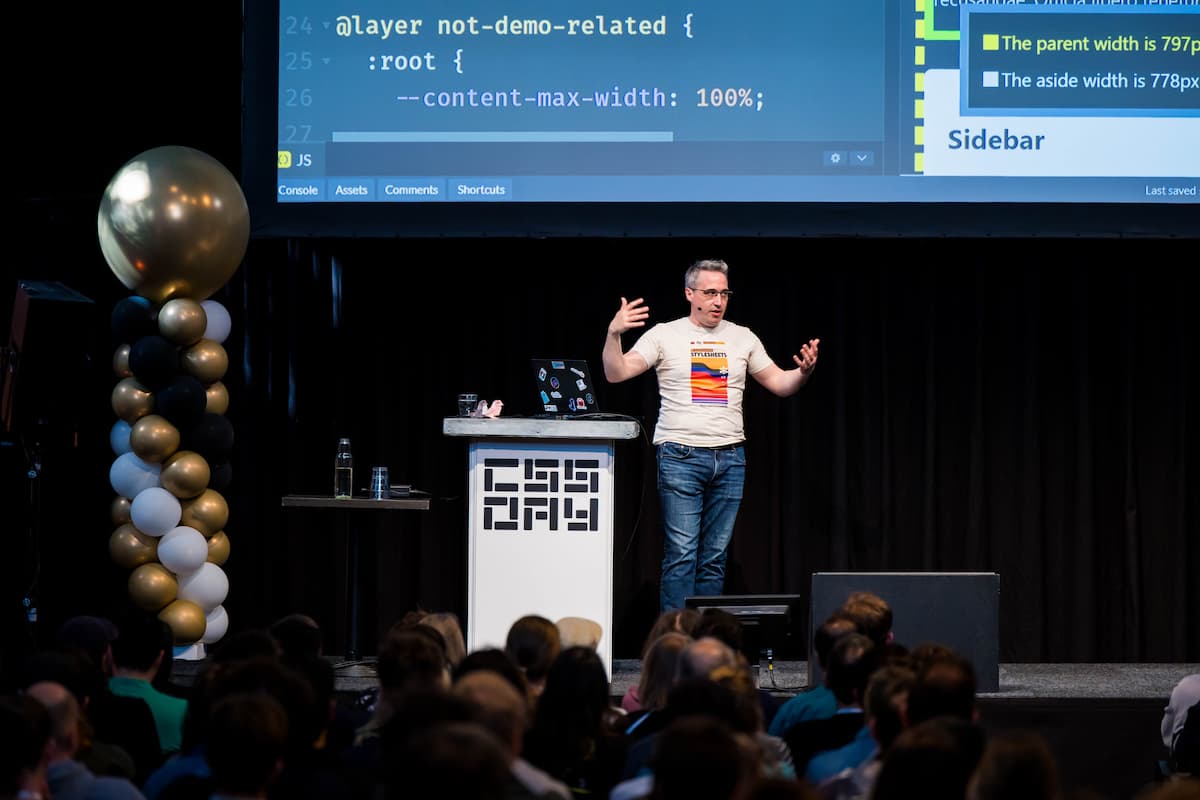
Afterward, he concluded that the visible repair had offered something a polished video could not. People saw a real error and a real response. That does not make every broken demo a teaching triumph; it makes the ordinary act of debugging less lonely. The teacher in the audience who took comfort from it was evidence enough for him.
“That doesn’t make me The King; it just makes me a good communicator.”Kevin Powell, on the nickname he declined
The crown
He kept the compliment and returned the title
The nickname “King of CSS” followed a friendly CSS battle video with Kyle of Web Dev Simplified. Powell appreciated the intent but disliked the hierarchy. In a 2021 essay, he wrote that the label left too little room for the people whose work made his own lessons possible. He credited Jen Simmons and Rachel Andrew for early CSS Grid learning, Lea Verou for widening his sense of CSS's creative possibilities, and Miriam Suzanne for changing how he approached the language. He also named Andy Bell, Heydon Pickering, Una Kravets, Adam Argyle, Stephanie Eckles, and others.
The list is more than modesty. Powell describes a genuine chain of knowledge: someone researches a feature, someone experiments with it, someone writes a careful explanation, and he finds a use case that helps another developer see it. Communication is its own craft. He knows that an approachable lesson can make a difficult idea stick, and he also knows that his lesson has a lineage. His advice to learners follows naturally: listen to more than one teacher. Different people notice different things in the same code.
A decade of teaching has also brought broader opportunities. He has taught a Frontend Masters course, which had a particular resonance because he had taken courses there when he was learning web development. He spoke at SmashingConf in New York in 2024 and gave a talk and workshop at its Amsterdam event in 2026. CSS Day invited him back in 2026, and ZurichJS hosted a talk that September. The venues are varied; the subject stays recognizable. He keeps asking what the browser can do and how to explain it to someone who is about to try.
The next lesson
Why the fundamentals still have a defender
In May 2026, Powell published a plea for readers to thank the people who teach them. His concern was that educators can feel as though they are speaking into a void while an industry hungry for output pays less attention to the slow work of understanding. He connected that concern to automated coding tools. People using them, he argued, still need enough foundational knowledge to recognize a mistake and judge a result. The point fits the rest of his career: a working website is useful, but knowing why it works gives its maker options when circumstances change.
He did not ask readers to send their thanks to him. He suggested contacting other writers, video makers, and teachers whose work had helped. That gesture echoes the essay about the crown. Powell's own lessons sit inside a community of people trading discoveries in public. Keeping that community alive requires more than a large subscriber count. It requires attention to the people at the other end of the lesson.
His announced 2027 talk at beyond tellerrand Düsseldorf is set to trace how a hobby became a career. The older version of the story is easy to romanticize: child makes websites, child grows up to teach the web. Powell's account is more interesting because of the detours and the unfinished learning. He was a print designer who preferred the build, a teacher who wanted to go beyond the syllabus, a video maker who arrived at conferences still nervous enough to feel his clicker shake. Those details make the path useful to somebody else. A career can begin with an old teacher's call, a tiny question about CSS, or a broken demo that someone in the back of the room knows how to fix.