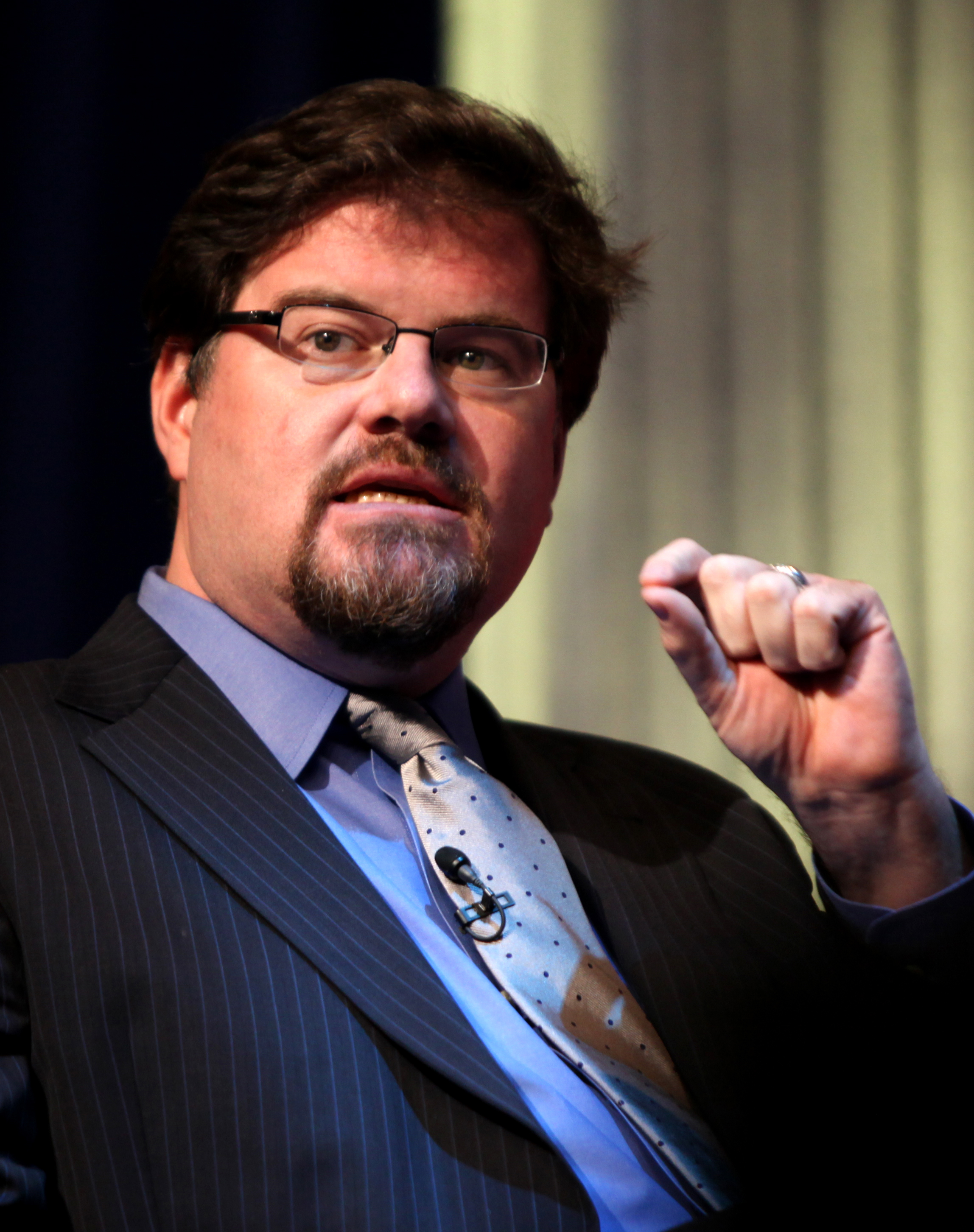
Person · Journalist · Author
Jonah
Jonah
Goldberg.
He quit the best perch in conservative media to start over. The bet: there is still a market for honest argument.
He quit the best perch in conservative media to start over. The bet: there is still a market for honest argument.
In 2019 Jonah Goldberg had the kind of job most pundits spend a career angling toward: editor-at-large at National Review, the magazine where he had launched its website back when "website" still needed explaining. He left anyway. With Steve Hayes he co-founded The Dispatch, a subscription outlet built on a stubborn premise - that fact-checked, good-faith conservatism still has paying readers. The subscriber numbers have been answering yes ever since.
Today he runs that newsroom as editor-in-chief, writes the twice-weekly G-File newsletter, hosts the wildly digressive Remnant podcast, and holds the Asness Chair in Applied Liberty at the American Enterprise Institute. The job titles are tidy. The work is not. A typical Goldberg argument starts with a Senate procedural question and ends somewhere near Aristotle, by way of a Battlestar Galactica plot point and a complaint about his dog.
He calls himself "ideologically grounded, but politically homeless," and he means it as a description, not a lament. When most of conservative media bent toward Donald Trump, Goldberg planted his feet. The cost was real: in November 2021 he and Hayes resigned as Fox News contributors over Tucker Carlson's Patriot Purge documentary, which he called "a collection of incoherent conspiracy-mongering." Resigning a television paycheck on principle is rarer than the principle.
The throughline is older than the politics. Goldberg has spent thirty years arguing that the unglamorous machinery of liberal democracy - markets, institutions, the rule of law - is a historical fluke worth defending, and that the only sane response to inheriting it is gratitude. It is not a crowd-pleasing message. He has never seemed to want the crowd.
The roots run back to a New York apartment where the news was the family business. Goldberg was born on the Upper West Side in March 1969 to Sidney Goldberg, an editor and media executive, and Lucianne Goldberg, a literary agent who would later become a household name for her role advising Linda Tripp during the Clinton-Lewinsky scandal. He went south to Goucher College in Maryland, majored in political science, edited the student paper, and graduated in 1991 into a job market that pointed him, briefly, toward teaching English in Prague rather than journalism. The detour did not last. By 1992 he was back stateside at the American Enterprise Institute, and by the mid-1990s he was producing documentaries and the PBS program Think Tank - a long apprenticeship in argument before he ever had a column of his own.
What makes the position interesting is that he arrived at it from inside the establishment he now needles. He was the founding editor of National Review Online, which means a fair share of the modern conservative internet runs on plumbing he helped lay in 1998. He wrote a nationally syndicated column from 2000, joined the Los Angeles Times opinion pages in 2005, and turned up as an all-star panelist on Fox News and later a commentator on CNN. The Atlantic once put him on a list of the fifty most influential political commentators in America. He has the credentials of an insider and the instincts of a heckler, and he has never resolved the tension because resolving it would mean choosing.
The Dispatch did not arrive as a manifesto. It arrived as a wager about economics. Most conservative media of the late 2010s ran on outrage and the advertising it attracts; Goldberg and Steve Hayes bet that a meaningful slice of readers would pay, directly, for reporting and argument that did not insult their intelligence. Subscriptions instead of clicks. Fact-checking instead of feeding the algorithm. It was the kind of plan that sounds quaint right up until the membership numbers prove it works.
Running it, Goldberg became something the punditry rarely produces: an owner. The G-File, his twice-weekly newsletter, is the clearest window into how his mind actually moves. It opens on, say, a question of constitutional structure and detours through dog ownership, Latin tags, a half-remembered movie, and a digression about the digression, before circling back to land the point it promised forty paragraphs earlier. Readers do not tolerate the wandering. They subscribe for it.
The podcast works the same way. The Remnant takes its name from a small, stubborn group that keeps the faith after the majority drifts off, and Goldberg treats the conceit literally. Episodes run long and go sideways, hosting guests who range from New York Times columnist Bret Stephens to his Dispatch colleague Kevin D. Williamson and former Representative Peter Meijer. As recently as late 2025 he was taking the show on the road, recording in Grand Rapids and chewing over tariffs, the pardon power, and what the post-Trump map might look like in 2028.
His politics resist the usual shorthand. He supported the Iraq War and later called the invasion a "noble" mistake, which managed to satisfy no one. He spent the Trump years as one of the most consistent conservative critics of the president, describing the standard defenses of Trump as "cynical rationalizations." Yet he bristles at being claimed by the left, and the bristling is the point: his quarrel is with tribalism itself, the instinct to let team loyalty stand in for thought. He has been making that argument across books, columns, broadcasts, and a podcast for the better part of three decades, and he shows no sign of getting tired of being outnumbered.
For all the heat, the private picture is domestic and a little nerdy. He has been married since 2001 to Jessica Gavora, a writer who served as chief speechwriter to Attorney General John Ashcroft, and he has spent three years on the board of trustees of his old college. He is the kind of conservative intellectual who will reach for a Star Trek or Battlestar Galactica plot to explain a point about institutional decay, and mean it. The science fiction is not decoration. It is how he thinks: stories about fragile orders, about what holds a civilization together and what pulls it apart, told back as politics. The titles change. The preoccupation does not.
The provocation that made his name and his enemies. He spent the next decade arguing with people who read only the title.
An instant bestseller dismantling the slogans that, he argues, let one side cheat the war of ideas.
His most ambitious case: the miracle of liberal democracy is unnatural, fragile, and owed nothing but gratitude.
His mother, literary agent Lucianne Goldberg, advised Linda Tripp during the Clinton-Lewinsky scandal. Jonah grew up inside the news cycle before he ever wrote for it.
He entered Goucher College as part of only the second class of men admitted after the formerly all-female school went co-ed. Being odd in the room came naturally.
In 2005 he offered historian Juan Cole a $1,000 wager over the Iraq War's trajectory. Cole declined. Goldberg rarely let the stakes get in the way of the point.
A 2012 book jacket called him a "two-time Pulitzer Prize nominee." A reporter noted he was merely an entrant; Goldberg and his publisher quietly removed the line.
Before the columns and the bestsellers there was a stint teaching English abroad. The journalism career was an accident he kept showing up for.
The podcast is not named for an audience. It is named for the people who keep showing up when the crowd has moved on. Which is the whole project, really.
A devoted Star Trek and Battlestar Galactica fan who smuggles science fiction into political columns.
The G-File newsletter wanders from philosophy to dogs to pop culture - and he insists the digressions are the point.
Married speechwriter Jessica Gavora, former chief speechwriter to Attorney General John Ashcroft.
Helped pioneer conservative blogging as founding editor of National Review Online - in 1998.
The Remnant runs long, runs sideways, and lands guests from Bret Stephens to Kevin D. Williamson. The Dispatch keeps the video.
An interview show on politics, conservative theory, and whatever else gets him going.
Apple Podcasts Spotify YouTube