A tax form is an unlikely guest at a computer demonstration. It has neither glamour nor a gift for conversation. Yet when John Warnock prepared a sample page for Steve Jobs to print on Apple’s LaserWriter, he chose an IRS form. He wrote its instructions by hand in PostScript, including the loops that produced its dashed lines. The page took two minutes to emerge. Jobs wanted it faster.
Warnock changed the processing, reducing the wait to thirty seconds. He remembered the technique. Years later, it helped inform the architecture behind PDF. An everyday bureaucratic object had become a small experiment in a larger question: how could a computer preserve a page’s appearance without making the next computer reconstruct all the work that produced it?
That question occupied an inventor with unusually practical visual interests. Warnock painted, took photographs and collected old books. He also co-founded Adobe with Charles Geschke in 1982. The mathematician and the image-maker shared a desk inside the same person, and neither seemed inclined to leave.
“I’ve never separated my visual world and the world of mathematics.”John Warnock
A school report with an unpromising beginning
Born in Salt Lake City on October 6, 1940, Warnock grew up in nearby Holladay. Drawing and painting were ordinary activities in his family. His recollection of third grade included a teacher who let him draw while other children did their assignments. When a friend complained about the arrangement, the teacher expected him to catch up.
By ninth grade, algebra had become a problem. Warnock failed it. He later recalled trying to solve equations in his head without properly learning the procedures. A high-school mathematics teacher changed the terms of the encounter, challenging students to work through a college trigonometry book. Warnock found himself enjoying the subject.
The episode resists the convenient idea that technical ability announces itself early and consistently. The same boy could be absorbed by pictures and baffled by equations. A different way into the work mattered. His education then carried him through a bachelor’s degree in mathematics and philosophy in 1961, a mathematics master’s in 1964 and an electrical-engineering doctorate in 1969, all at the University of Utah.
His route into computing also involved a tire shop. Retreading tires was repetitive, hot work, and Warnock wanted a better way to earn a living. IBM hired him and trained him in computing. The glamour of founding a software company was still some distance away. For the moment, a useful job was quite enough.
The printer had to understand the picture
At Utah, computer graphics supplied a problem that suited his interests. When one object sits in front of another, a computer has to decide which surfaces should appear in the image. Warnock’s doctoral work addressed that hidden-surface problem. His algorithm divided a complicated view into smaller regions, making the task easier to resolve.
Utah brought him into the orbit of David Evans and Ivan Sutherland. At their company, Evans & Sutherland, graphics became a commercial task. Warnock worked on a simulation of New York harbor for training ship pilots. These were pictures with a job to do: the view had to change as a simulated ship moved.
The path to Xerox’s Palo Alto Research Center came through William Newman, a fellow graphics researcher. In 1978, Warnock joined PARC, where Geschke hired him. Their common ground included education, children of similar ages and refereeing soccer. A partnership with consequences for publishing began with rather recognizable subjects of conversation.
At PARC, they worked on Interpress, a protocol for communicating a page’s appearance to a printer. Xerox used it internally but did not pursue the broad licensing opportunity they wanted. A technology confined to one organization could only go so far. Warnock and Geschke left to establish Adobe, named after a creek behind Warnock’s home.
A shared description let the page travel beyond the machine that made it.
Their first business plan included producing systems with workstations and printers. They moved toward licensing software instead. Other companies could build the equipment; Adobe could supply the language that made it useful. This placed the company between several businesses rather than requiring it to manufacture every part of the solution.
Four people, one sheet of paper
PostScript treated the contents of a page as shapes that could be described mathematically. A letter could change size without requiring a separate drawing for every size. Text and graphics belonged to the same imaging model. For someone concerned with how a page looked, this was an agreeable marriage of precision and flexibility.
Good geometry still needed recognizable typefaces. Adobe licensed established fonts, understanding that designers wanted the names and forms they already trusted. A publishing tool had to meet people where their working habits were. The quality of the engineering and the credibility of the typography both mattered.
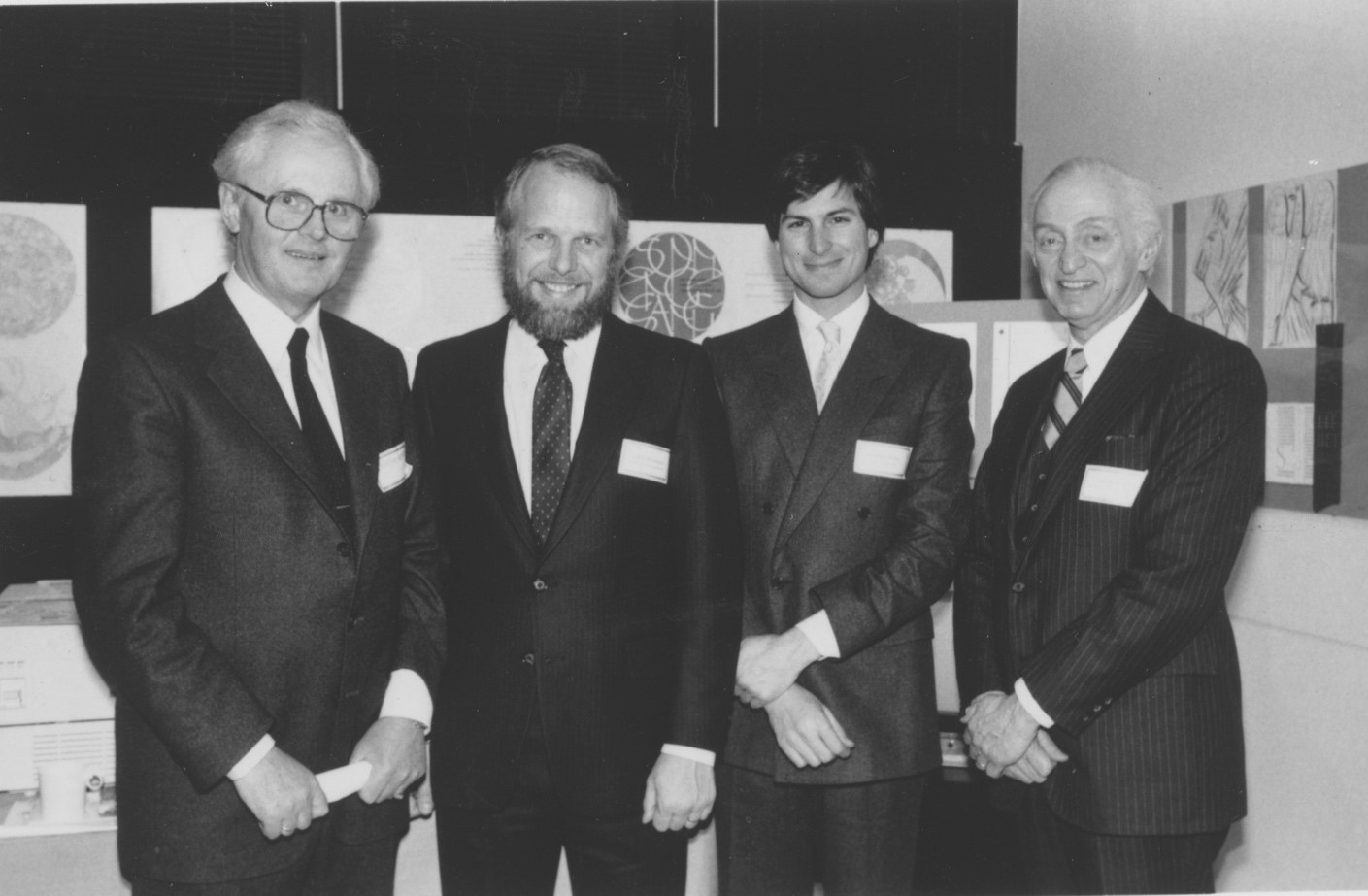
The photograph from the LaserWriter’s debut makes those connections visible. Wolfgang Kummer represented Linotype; Aaron Burns co-founded the International Typeface Corporation. Warnock stood beside Jobs. Apple’s hardware, Adobe’s software and licensed typography were meeting on a printed sheet.
The Macintosh, LaserWriter and Aldus PageMaker brought composition and output into a desktop workflow. People could arrange material on a screen and print a page that respected those choices. The changes involved relationships as well as inventions: each participant supplied something the others needed.
A tax form learns to travel
Printing was only one destination. Sending a document to another computer introduced another difficulty: the receiving machine might lack the originating application, or run a version that interpreted the file differently. An electronic document could arrive with its appearance altered. The message got through; the page sometimes had other plans.
Warnock’s Camelot proposal described an approach to preserving a document for viewing and printing across systems. Adobe’s team developed that approach into PDF and Acrobat, formally launched on June 15, 1993. A page could become an object that traveled, rather than a request for the recipient to own and operate the same collection of software.
The idea sounds obvious after decades of attachments. Its early audience was less persuaded. Warnock remembered demonstrations where people asked why they could not simply send Word or spreadsheet files. From their perspective, another format looked like another step. From his, it removed a recurring source of uncertainty.
Acrobat grew slowly enough for Adobe’s board to question continued spending. Warnock and Geschke defended the investment. The IRS became an early adopter, putting forms online. The tax form, which had once served as a printer demonstration, now illustrated a reason to distribute documents electronically.
There was a useful stubbornness in this. The technical problem remained even when potential customers did not immediately name it. Familiarity with an awkward process can make the awkwardness hard to see. Warnock’s case depended on describing the inconvenience clearly and allowing time for people to recognize it in their own work.
“This solves a fundamental problem”John Warnock, explaining his commitment to PDF
The photographer in the software meeting
The tools for making images also drew his attention. Illustrator, released in 1987, exposed the drawing capabilities behind PostScript through a visual interface. Curves, shapes and transformations could become operations an artist controlled on the screen. Programmer Mike Schuster developed the application; Warnock made early illustrations with it.
Photography supplied another connection. As a teenager, Warnock worked in a camera shop and spent his summer earnings on cameras. He had a darkroom and learned the work of developing and printing photographs. Later, when he saw Photoshop, he recognized operations he had practiced physically becoming possible in software.
The comparison gave him a concrete way to judge the product. He could consider what an image-maker wanted to do and how a tool might help. His wife, Marva, was a graphic artist and an Adobe user too. She designed the company’s original logo, giving the enterprise a visual identity from its own household.
Warnock also thought about the conditions under which people would make these products. With Geschke, he emphasized cooperation, fairness and transparency. They wanted a company they would enjoy working for themselves. That ambition placed the daily experience of making things alongside the business of selling them.
Euclid gets an internet connection
In London in 1986, Warnock bought a 1570 edition of Euclid’s Elements. Rare-book collecting became another way to spend time with mathematics and images. Through Octavo, founded in 1995, books were scanned at high resolution for distribution on CDs. The business did not succeed commercially, but its files survived.
Warnock made those scans accessible through Rare Book Room. By 2013, the site offered more than 400 volumes. The collector’s problem had become a reader’s opportunity: someone far from an original could look closely at its pages. The project gives his interest in visual fidelity a setting beyond the office.
John and Marva’s life included skiing in Utah, a Native American art collection and ownership of the Blue Boar Inn in Midway. They supported their university, helping fund the engineering building that opened in 2007 with their names on it. Software occupied a substantial part of his life, with room left for things that could be held, visited or hung on a wall.
Warnock stepped down as CEO in 2000, retiring from active management in early 2001. He remained co-chairman until 2017 and an Adobe director until his death on August 19, 2023. He and Geschke received the 2008 National Medal of Technology and Innovation at the White House in 2009, then shared the Marconi Prize in 2010.
In January 2023, John and Marva attended the ribbon cutting for the Adobe Experience Museum. Its exhibits gave visitors a place to see the company’s history. Warnock had also helped make the original PostScript code available through the Computer History Museum. The work was becoming something other people could examine.
Looking back on his career, he offered a modest assessment: “We sort of learned as we went. And it turned out all right.” The pages tell a more detailed story. A drawing, a tax form, a photograph and an old geometry book each gave him a reason to look carefully. He spent years helping the rest of us see what he saw.