On Oscar night in 2005, John Hering had brought something less photogenic than an evening gown: a laptop and an antenna, tucked into a backpack. Around him, Hollywood was making its annual argument for the importance of being seen. He was interested in what the arriving guests could not see. Their mobile phones were broadcasting, and some were vulnerable.
The red carpet had plenty of physical protection. A wireless signal, however, had little use for a barrier or a guest list. Hering and his fellow researchers scanned for weaknesses in Bluetooth-enabled phones. The demonstration made a quiet technical problem conspicuous in a place designed to attract attention. He had chosen his venue well. A flaw in a handset might struggle to earn an audience; a flaw near a limousine had better prospects.
The episode still makes a useful entrance to his story. Hering would co-found Lookout with Kevin Mahaffey and James Burgess, become its chief executive, and later move into investing and cyber insurance. But the backpack already contained a recurring element of his work: take a technology people have accepted into ordinary life, examine its assumptions, and make the consequences of those assumptions easier to understand.
A very theatrical antenna
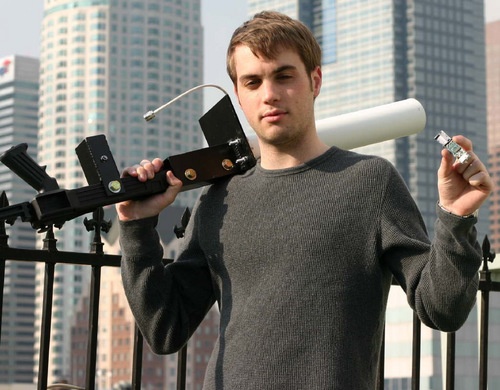
Before the Oscars came the BlueSniper, a Bluetooth research device with the appearance of a rifle. Hering’s team demonstrated a Bluetooth connection over more than a mile. The strange-looking apparatus gave wireless security an unusually memorable prop.
There is an almost comic mismatch between the instrument and its subject. Bluetooth was associated with convenient connections; the BlueSniper looked like an objection you could rest on your shoulder. Its silhouette supplied a visual shorthand for a problem that otherwise required a discussion of radios, range and access. The joke worked because the underlying research was serious.
By 2007, Hering was presenting at Microsoft’s BlueHat security conference. Fellow hardware researcher Andrew “bunnie” Huang photographed him with the device and tried to stage a menacing scene. Huang’s account says Hering looked too friendly to make it convincing. It is a small, welcome correction to the stock image of the security researcher: the apparatus could look threatening even when the person holding it did not.
These early experiments belong to the period when mobile computing was still acquiring its familiar shape. A handset was becoming a place to keep information, access services and conduct business. That change made the research commercially relevant. The more useful the phone became, the more there was on it worth protecting. Hering and his collaborators were working on that relationship before mobile security became an everyday purchasing category.
The app had to be worth opening
Lookout’s founding is generally dated to 2007, following the team’s earlier work under the Flexilis name. The three founders had met at the University of Southern California. Hering studied Public Policy, Planning and Development there, an academic background rather different from the computer science degree one might reflexively assign to a cybersecurity founder.
The first consumer product arrived on Windows Mobile in 2008. Getting it into people’s hands involved an awkward practical detail: the platform had no app store. Mahaffey later recalled promoting it through blogs. Android brought a different distribution environment, and Lookout’s Android launch in 2010 helped it reach a much wider audience. An iOS version followed in 2011.
For the user, the proposition included things that were easy to appreciate without becoming a security specialist: backing up information and finding a missing phone. Those features gave the product a place in daily life. A person could understand the value of recovering a misplaced handset immediately, while the work of identifying a malicious application remained largely out of sight.
Hering was direct about the design ambition in 2013: “We actually built a security product that people want to use.” It is a modest-sounding sentence with a substantial demand inside it. Software could satisfy a security requirement and still irritate its owner. Lookout was trying to make protection useful enough, and approachable enough, that people would choose to keep it.
At that point, the company reported more than 30 million mobile users. Its backers included Khosla Ventures, Andreessen Horowitz, Index Ventures and Accel. The research project had become a business with an audience far beyond conference attendees. That brought another problem to solve: how to organize a company around the thing the founders had learned to build.
Building the company became the product
In May 2013, Hering offered a revealing description of his ambition: he considered the company itself the most significant product he would ever create. The statement shifts attention from the clever demonstration to the organization required to keep delivering useful software. A good experiment needs to work once. A business has to keep working after the audience has gone home.
Jim Dolce became Lookout’s chief executive in March 2014. Hering moved to executive chairman, with a brief covering market strategy, product, partnerships and the security community. The division of responsibilities mattered. The founder remained involved in the questions that had brought the company into existence, while a new chief executive took responsibility for leading it.
A title change can make a company biography look tidier than the work actually is. Product choices, distribution relationships and the expectations of customers do not become separate subjects merely because the organizational chart has acquired another box. Hering’s assigned responsibilities kept him close to those intersections.
His public work also continued beyond the office. Lookout’s biography lists appearances at RSA, Mobile World Congress, Black Hat and DEFCON. These are different rooms with different audiences, from technical researchers to businesses considering what to buy. Explaining the same underlying risk to each is part of the job. The technical detail has to survive the change of audience.
In 2016, Hering participated in a televised phone-security demonstration with Sharyn Alfonsi. Lookout’s account describes a rogue Wi-Fi connection that allowed access to private information. The scene carried the old lesson into a newer setting: a familiar-looking connection can deserve closer scrutiny. The device in a person’s hand does not reveal every system it is trusting.
“The greatest product I’ll ever create is this company.”John Hering / 2013
A breach also comes with a bill
In 2017, Hering co-founded Coalition with Joshua Motta. The company paired cybersecurity tools and services with insurance. Its founding argument concerned what happens to a business across the whole course of an incident: before trouble, during the response, and after the loss.
That is a meaningful extension of the problem Lookout addressed. Identifying a weakness and preventing an attack are valuable, but a business also needs a way to withstand the financial consequences when protection fails. Coalition put those concerns together in a commercial offering rather than leaving them as separate conversations.
The ambition described at launch was to use insurance revenue to support security capabilities, and information about incidents to improve both protection and coverage. The arrangement creates a reason for an insurer to care about prevention, and for a security provider to care about recovery. Hering’s work had moved from the vulnerable device toward the organization relying on it.
There is a practical continuity here. The Oscars experiment drew attention to an exposure that people were overlooking. Lookout offered a product around that exposure. Coalition addressed the losses that could remain despite protective measures. Each asks the customer to understand a risk at a different scale. The phone owner, the business operator and the insurance buyer may be considering the same incident from different chairs.
A percentage with a purpose
Another part of Hering’s company-building work involved deciding what the company should give away. Hering, Mahaffey, Burgess and Dolce contributed personal cash or stock to establish the Lookout Foundation, an initiative run by employees. Their own contributions preceded the request for a corporate equity commitment.
Lookout’s board agreed to allocate 1% of outstanding shares to the foundation over five years, at 0.2% a year. The schedule gave the pledge an operational form. A percentage is easy to put in a speech; a transfer plan gives it somewhere to go.
The sequence is the interesting detail. The founders and chief executive made a personal commitment, then sought the board’s agreement. It attached giving to ownership and to company decisions. Alongside the product and the partnerships, this was another choice about what the organization Hering called his greatest product would actually do.
Company equity, transferred over five years
Five annual allocations of 0.2%From handset radios to satellites
Hering’s investing career broadened the scale again. He became a partner at Vy Capital, whose technology interests included artificial intelligence, quantum computing and space exploration. Work that began with nearby wireless devices eventually placed him alongside companies building communications infrastructure far above them.
Reporting in September 2026 described Hering and Alexander Tamas as equal partners at Vy. It put the firm’s assets under management at $50 billion as of June 2026 and its SpaceX holding at roughly 3.4%. These are figures for the investment firm and its portfolio, rather than a measure of Hering’s personal wealth.
The same reporting described his assistance with Starlink recruiting and financial modelling. That detail is more revealing than a photograph beside a famous founder. It concerns the unglamorous work a technology venture needs: finding people and figuring out how the business will operate. The investor’s contribution extends into the company’s practical problems.
Lookout’s current board roster lists Hering as a co-founder, while Jim Dolce holds the chairman and chief executive titles. The distinction helps place the chapters of Hering’s career accurately. The early researcher, the former CEO, the board member and the investor are roles with different responsibilities, even when one person has held all of them.
Return to the backpack at the Oscars and the career becomes easier to follow. Hering had found an audience for something invisible. He and his collaborators then built a product people could install, a company that could distribute it, and later a way for businesses to manage the cost of digital risk. Today the scale includes satellites and investment portfolios. The starting question remains wonderfully concrete: what, exactly, have we put our trust in?