The most revealing page on JLV College Counseling is an old one called “Services.” It reads like a menu from the business Jessica Velasco once thought she would run: academic planning, college lists, interview preparation, essay help, financial-aid explanations, start-to-finish support. A teenager could begin near the end of eighth grade and stay through enrollment. There were packages. There were hourly services. There was, in other words, a perfectly recognizable private college-counseling practice waiting to happen.
But the page opens with a notice that JLV cannot take clients. On the current About page, Velasco is plainer about why. Independent educational consulting was “not the right fit for her.” The expertise stayed. The appointment book disappeared.
This is an odd move in a market that typically converts anxiety into a premium package. College admissions has an abundance problem: too many schools, too many dates, too many acronyms, too many people promising an inside edge. A family does not merely need information. It needs the next piece of information, at the moment it can still be acted upon.
Velasco had spent more than a decade in higher education, including stints as director of admissions at Northwest University and assistant director at the University of La Verne. She had traveled the country meeting prospective students, read and decided thousands of applications, planned visit events, trained tour guides, weighed admissions marketing, and sat on scholarship committees. JLV became a way to turn that accumulated pattern recognition into public instructions.

01 / THE PIVOTThe mistake that produced the product
The first thing that failed was fit. There is no public tale of a ruined launch, a vanished investor, or a heroic all-nighter. Velasco simply discovered that the private-consultant role was not the work she wanted. Her stated belief supplied the replacement: admissions and financial-aid information should be available regardless of a family's financial circumstances.
Sell expertise
One-to-one packages and hourly counseling for high-school and transfer students.
Wrong fit
The consulting role did not suit the founder, even though the underlying need was real.
Publish it
A free library could answer recurring questions without rationing help by appointment.
That distinction explains what JLV is today. It is not a software platform and does not ask a student to complete a matching quiz before revealing a result. It is closer to a well-labeled reference desk: scholarship lists, college-search tools, application and essay advice, financial-aid explainers, test-prep resources, campus-visit guidance, and articles for the emotional potholes, including rejection and the long wait for decisions.
The archive's shape comes from actual questions. Scholarships can be browsed by deadline, state, major, age, athletics, disability, religion, military connection, gender, and circumstance. There are dedicated paths for international students, undocumented students, LGBTQ students and allies, and parents attending college. The organizing principle is not “content.” It is the sentence a worried student might type at 11:20 p.m.
02 / TRUSTA scholarship list with a bouncer
The obvious competitors are giant databases such as Fastweb and Scholarships.com, tools from the College Board and U.S. Department of Education, school counselors, and private advisers. JLV's advantage is smaller and more editorial. Someone has decided what belongs. In 2026, a guest on the How to Money podcast singled out JLV for doing a good job filtering scholarships - an endorsement of the invisible work, not the interface.
Before a scholarship gets listed
7Those published screening rules matter because the scholarship market contains pages built less to award money than to harvest leads. JLV refuses listings that charge an application fee, ask for a Social Security number, hide the provider's contact details, omit a privacy policy, or muddy the eligibility and required materials. The rules are specific enough that another publisher could copy them tomorrow.
The recurring “Scholarship Saturday” series performs the second useful trick: it adds rhythm. Instead of asking a student to conquer a database, it supplies a finite batch with upcoming deadlines. On September 12, 2026, the batch contained 25 scholarships and contests. The previous Saturday contained 22. Scholarship hunting becomes less like discovering a secret portal and more like doing the laundry - weekly, finite, unromantic, effective.
03 / THE MONEYFree has a small receipt
What does JLV cost? For the student or parent reading it, zero dollars. Velasco says no family is charged for information or advice from the site. The operating bargain is visible: display advertising, marked affiliate links, and voluntary support. The affiliate disclosure says commissions help run the website and provide some income for her family. Buying through those links does not add to the reader's price. A separate page offers the most literal possible membership tier: buy Jessica a coffee for five dollars.
Admissions guidance, scholarship lists, and email updates stay open to families.
One coffee, plus ads and disclosed affiliate commissions.
This is not a venture-capital story. There is no public funding round, investor list, or valuation. Nor does the public evidence support the supplied directory claim of a 200-person staff. The named operation is Velasco, her archive, and a readership displayed at roughly 9,000-plus email subscribers. Its scale is reach, not payroll.
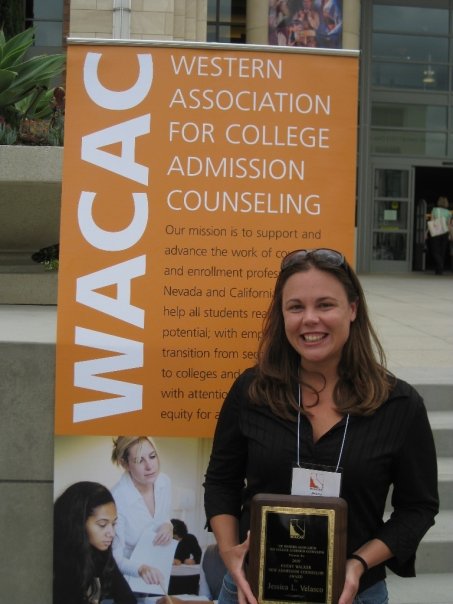
Velasco's authority predates JLV. The Western Association for College Admission Counseling gave her its Emery Walker New Admissions Counselor Award, now renamed the Murdoch-Finks award. But her editorial voice is less oracle than experienced traffic controller. Follow the directions. Use a professional email address. Do not wait for the last minute. Do not treat a safety school as an insult. Do not send extra material when instructions say not to. The appeal is procedural calm.
04 / WHAT TRAVELSThe parts worth stealing
A founder or educator can copy JLV without copying its subject. The portable idea is to identify the questions that repeat in private, answer them once in public, and arrange the answers around the reader's circumstance rather than the publisher's departments.
Turn recurring client questions into durable, searchable pages.
Trust grows when readers can see why an item makes the list.
A weekly deadline roundup converts an intimidating project into a habit.
State who pays, how affiliate links work, and what remains free.
The approach also depends on conditions that are easy to overlook. It works when one person's expertise can be translated into repeatable advice, when search traffic can discover an archive, and when the publisher is willing to perform ongoing maintenance. It is less useful for a student who needs a bespoke application strategy, close essay editing, crisis intervention, or a definitive reading of fast-changing federal aid rules. A free library can reduce confusion; it cannot sit beside a teenager and make the decision.
The date on the page is part of the advice.
Scholarship deadlines expire. Testing policies change. Financial-aid rules move. JLV tells readers to visit each provider for full eligibility and requirements; the smart user treats every list as a discovery layer, then verifies the original page before applying.
Maintenance has a human cost, too. In fall 2022, amid a shortage of teachers and substitutes, Velasco began working as a guest educator in her local school district. By February 2023 she told readers that she had not had a day off and that JLV updates might fall behind. The note is unusually revealing. A one-person public resource is generous precisely because the same person is doing the sorting, writing, screening, and updating.
And yet, in September 2026, Scholarship Saturday was still arriving. That persistence is JLV's quiet achievement. The original consultancy would have measured its work in clients. The library measures it in questions answered before anyone has to ask.
05 / USE ITOpen the right door
Start with the scholarship directory if money is the immediate problem. Use college search and essay resources if the application itself is still taking shape. The social accounts are useful for reminders; the email subscription turns the archive into a recurring prompt.