Breaking
Etherdyne unveils position-free wireless power at CES 2026 Up to 100 watts delivered through the air $1.2M+ raised from 400+ investors on StartEngine 43 granted patents. FCC & CE certified Jeff Yen: "What Tesla imagined is no longer just a lab demo" Eight years of magnetic resonance R&D
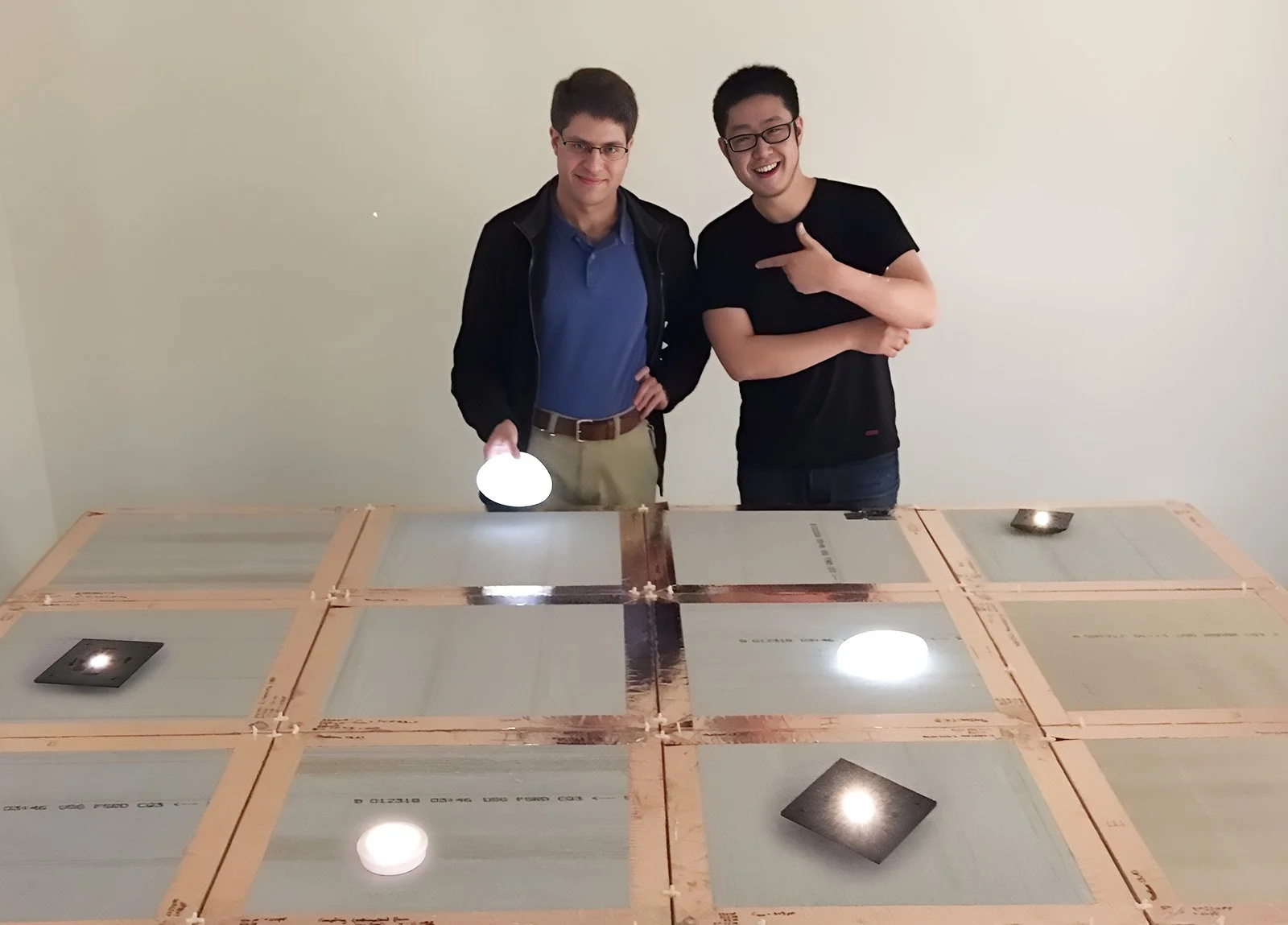
Jeff Yen, co-founder and CEO of Etherdyne Technologies, with co-founder Robert Moffatt
Two physicists, zero cords. Jeff Yen (with co-founder Dr. Robert Moffatt) turned a Stanford friendship into 43 patents on power that flies through the air.
Person · Founder · Physicist

Jeff Yen

He is trying to make the wall outlet obsolete. Slowly. On purpose.

Stanford PhD in physics. Co-founder and CEO of Etherdyne Technologies. The pitch is simple and slightly outrageous: walk into a room and your devices charge. No cable, no pad, no ritual of plugging in. Just a zone of power, humming in the air.

Santa Clara, CA Etherdyne Technologies Co-Founder & CEO
100WThrough the air
43Granted patents
8 yrsIn the lab
$1.2M+Crowdfunded
The Dispatch

In Santa Clara, a physicist who thinks batteries are a bug

Jeff Yen runs an eleven-person company that wants to change how electricity behaves. Etherdyne Technologies, headquartered on Bunker Hill Lane in Santa Clara, builds what Yen calls Ether Power - wireless electricity delivered not to a single phone on a single pad, but to a whole zone. A desk. A countertop. Eventually, a room. Devices inside that zone draw what they need and keep running. The cord becomes a memory.

In January 2026, Yen carried that idea onto the show floor at CES. Etherdyne set up an "Ether Power Desk" and let it speak for itself: a monitor, a phone, a speaker and a laptop, all running with nothing plugged into the wall. The power came from a three-dimensional field, using low-frequency magnetic resonance tuned to 6.78 MHz. A laptop pulled up to 50 watts. The whole zone could push up to 100. Nothing was touching a charging mat. Nothing had to be lined up just right.

"We've reached an inflection point. What Nikola Tesla once imagined is no longer just a lab demo."

That is Yen's whole thesis in two sentences. Wireless power has been the stuff of science fair posters and venture pitch decks for a century - beautiful in theory, disappointing in practice. Yen's argument is that the theory finally caught up. Eight years of patient physics, forty-three granted patents, and the signatures of the FCC and CE regulators say he is not entirely alone in believing it.

Under The Hood

Power, but make it ambient

Most "wireless" charging is a polite lie. Your phone still has to sit in exactly the right spot, touching a pad, drawing a trickle. Etherdyne's approach is different in a way that matters.

01
〰️

Resonate

A transmitter creates a low-frequency magnetic resonance field at 6.78 MHz - a "Wire-Free Power Zone" that fills a volume of space, not just a surface.

02
📍

Ignore position

Receivers inside the zone tune to the field. They do not need to be centered, aligned or even still. Position-free means the device can move and keep drawing power.

03

Power many

One transmitter, many devices, different appetites - a phone sipping, a laptop gulping up to 50W - all served at once, up to 100W across the zone.

By The Numbers

What 100 watts actually buys you

A single Ether Power Zone has enough headroom to run a working desk. Here is roughly how the budget splits.

Zone capacity
100 W
Laptop charge
up to 50 W
Monitor / speaker
~ steady draw
Phone top-up
a sip

Illustrative allocation based on Etherdyne's stated 100W zone capacity and up-to-50W laptop charging.

The Origin

Two grad students, one impossible idea

Yen did not arrive at wireless power by way of a business plan. He arrived by way of a physics department. He studied physics and astrophysics at UC Berkeley, then earned a PhD in experimental physics at Stanford. Somewhere in those Stanford years he met Robert Moffatt, another physics PhD candidate. The two clicked over the kind of problem that keeps physicists up at night - how to move real, useful amounts of energy through empty air.

In May 2016 they turned the obsession into a company. Yen became CEO. Moffatt became Chief Science Officer. Together they are listed as co-inventors on the magnetic resonance technology that Etherdyne is built on, and co-authors on multiple IEEE papers. It was not a weekend hackathon. It was eight years of refinement before they were willing to call it a product.

"Our mission is to spark radical innovation by freeing devices from cords and batteries."

The framing Yen likes is "Electrification 2.0" - the notion that power should stop being a fixed point you walk toward and become an ambient field you walk into. He compares it to Wi-Fi. Once data slipped its wires, whole categories of devices appeared that nobody had drawn on a napkin first. Yen is betting electricity has the same move left in it. The wall outlet, in this telling, is not a solved problem. It is a hundred-year-old habit that everyone stopped questioning.

To pull it off, he built a bench deeper than eleven people suggests. Etherdyne's leadership has drawn engineers and operators from Apple, Cisco, Motorola, Nokia and HP. The plan is not to become a gadget brand. It is to license the Ether Power platform to everyone else - a strategy analysts have compared to being the "Intel Inside" of wireless power. The technology is meant to disappear inside other people's products, which is a peculiar ambition for a founder: to build something so useful that nobody remembers your name while they use it.

There is a discipline in that patience that sets Yen apart from the usual hardware sprinter. Wireless power has a long graveyard of companies that demoed a glowing light bulb across a room, raised a round, and then discovered that a lab bench and a shipping product are separated by an ocean of regulation, safety physics and thermal reality. Yen and Moffatt chose to spend the years in that ocean before surfacing. By the time the Ether Power Desk lit up at CES, the hard questions - how much power, how safely, how far from the transmitter, with what interference - already had answers on file with the regulators.
The Believers

Four hundred strangers and a cordless bet

Most deep-tech founders raise money in quiet rooms from a handful of funds. Yen took a different door. In March 2026, Etherdyne closed a Regulation Crowdfunding round on StartEngine, pulling in more than $1.2 million from over 400 investors. It is a small number by Silicon Valley standards and a telling one by any other. Four hundred people, most of whom will never see the inside of the Santa Clara office, decided a world without charging cables was worth putting their own money behind.

That is the quiet superpower of a clear idea. You do not need to understand magnetic resonance at 6.78 MHz to understand the frustration of a dead phone, a tangled drawer of chargers, or a store display that a tired employee has to crawl behind and plug back in. Yen sells the physics to engineers and the annoyance to everyone else. The crowdfunding round was, in a sense, a referendum on how much people hate cords. The verdict was decisive.

Data slipped its wires and the world reorganized. Yen thinks electricity is next.

The timing is not an accident. Yen has been vocal that the AI age is quietly a power problem. Smart buildings, dense sensor grids, always-on hardware - each new node is another thing to wire, another battery to change, another failure point when someone forgets. On a January 2026 panel at the Computer History Museum, he made the case that ambient power is not a convenience feature but an enabling layer for the infrastructure everyone is racing to build. If you want a building that senses itself, you cannot run a cord to every sensor. Something has to give. Yen thinks it should be the cord.

The Record

From thesis to trade show

'16

Co-founds Etherdyne Technologies in Santa Clara with Dr. Robert Moffatt, a friend from the Stanford physics PhD program. Yen takes the CEO seat.

'16-'24

Roughly eight years of heads-down R&D refining low-frequency magnetic resonance for through-the-air power. Patents accumulate. Certifications get filed.

Jan '26

Speaks on wireless power and energy infrastructure for the AI age at Smart Living Silicon Valley, held at the Computer History Museum.

Jan '26

Unveils position-free, multi-device Ether Power at CES 2026 - the "Ether Power Desk" running four devices with no cords.

Mar '26

Etherdyne closes a Regulation Crowdfunding round on StartEngine, raising more than $1.2M from over 400 investors.

What Nikola Tesla once imagined is no longer just a lab demo.

Jeff Yen · CES 2026
The Reach

Where cord-free power wants to go

Yen's keyword list reads like a map of things we currently apologize to with charging cables. A few of the destinations:

// RETAIL

Displays that never die

Store merchandising that no floor staff has to unplug and recharge. Partner Pacific Northern is already running Ether-powered displays.

// BUILDINGS

Sensors, everywhere

Structural health monitors and building-management sensors that draw ambient power instead of hoarding batteries in hard-to-reach places.

// CONSUMER

The end of the drawer

The tangle of chargers in every home. Yen's zone replaces the plug ritual with a surface that just works.

// AI AGE

Dense, hungry hardware

Yen argues smart buildings and AI-era sensor networks need power that scales without a cord per node.

// INDUSTRIAL

Robots and machines

High-power applications and industrial equipment that would rather not stop to dock and charge.

// BIOMEDICAL

Implants, powered from the air

One of the more audacious targets on the keyword list - devices where a battery swap is not a casual thing.

Marginalia

Five things worth knowing

1

His system can power a moving target, not just a device sitting still on a pad. Position-free is the whole point.

2

The core frequency is 6.78 MHz - a low-frequency magnetic resonance band chosen to deliver power safely, with FCC and CE sign-off.

3

Before Stanford, he studied both physics and astrophysics at Berkeley. He also has research ties to INFN, Italy's national nuclear physics institute.

4

The company is tiny - about eleven people - yet sits on 43+ granted patents. Density over headcount.

5

He built the team from alumni of Apple, Cisco, Motorola, Nokia and HP, then aimed it at becoming invisible infrastructure.

The Horizon

The invisible utility

Ask Yen where this ends and the answer is not a product. It is a standard. He wants power to become invisible and effortless - to shift from static outlets to Power Zones the way data shifted from Ethernet jacks to the air around you. If Etherdyne wins, you will not think about it, which is exactly the ambition. The cord will not be defeated with a bang. It will just quietly stop being necessary.

Whether the world reorganizes itself around power zones is an open question. Physics is on his side; adoption is a different sport. But Yen has already done the hard, unglamorous part - eight years of it - and walked out of the lab with something that switches on when you set it down. Tesla would have recognized the demo. He would have been jealous of the patents.

𝕏 Share in Share f Share ◎ Instagram ⧉ Copy link
The Rolodex

Follow the current