Before Jason Passwaters had a company to run, he had a decision to make on a dog walk. He already managed a global department. There was a salary, equity, a career that was proceeding quite respectably. Starting again would mean giving up something tangible for something that existed mostly between his ears. He and his wife talked it through while walking their dogs. They decided to go ahead. The future co-founder of Intel 471 had secured agreement from the person who would share the consequences.
It is an appropriately domestic beginning for a business concerned with the criminal underground. Cybersecurity tends to arrive wrapped in dramatic imagery: hooded figures, glowing screens, a padlock of improbable dimensions. Passwaters’s story involves rather more ordinary human calculations. Who can you trust? What do you know? What are you prepared to risk? Those questions would follow him from military intelligence into a company he co-founded with Mark Arena in 2014.
The person behind the keyboard
Passwaters spent nearly 12 years in the U.S. Marines. His work included infantry, counterintelligence and human intelligence, along with technical surveillance countermeasures. The combination matters. One part concerns equipment and signals; another concerns the people producing them. His later career would bring those interests together in a field where an intimidating technical vocabulary can sometimes obscure the presence of a person making a decision.
At Crucial Security, he led forensic and intrusion analysts assigned to the FBI’s Investigative Analysis Unit. He supported cyber agents with network forensics and investigations involving Eastern European and Russian cybercriminals. This was contractor work supporting federal law enforcement. Following an intrusion through a network required technical competence; understanding the people responsible called for the habits of an intelligence practitioner.
He went on to become senior director of global research at iSIGHT Partners, leading an intelligence department distributed across 14 countries. His education included a bachelor’s degree in business management from Liberty University. By the time he became a founder, his experience already crossed several institutional borders: military service, federal investigations and commercial intelligence. He had also acquired practical experience getting people in different places to work toward the same objective.
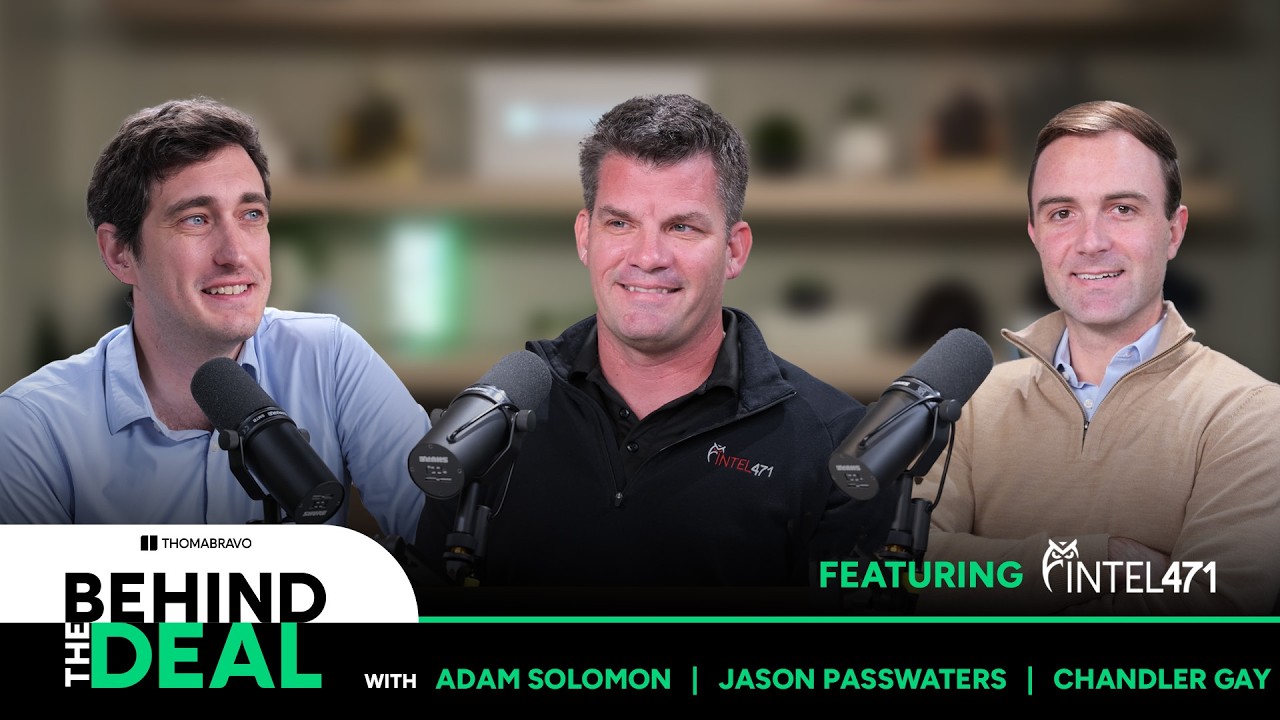
A market with customers of its own
Intel 471 grew from an observation about how cybercrime works. Criminals buy services from one another. They exchange information, sell stolen data, maintain tools and arrange access. An attack may be the visible result of a series of transactions conducted long before a victim discovers anything wrong. Knowing something about those transactions can give a defender time to act.
Passwaters and Arena wanted to turn intelligence collection into something security teams could use. Their backgrounds helped define the proposition: Arena brought experience from the Australian Federal Police, while Passwaters brought military intelligence and investigative work. The commercial opportunity lay in making knowledge of that external world useful inside an organization with its own systems, priorities and limits.
“We built the platform that we wished we would have had,” Passwaters said. That is a fairly demanding product brief. A former practitioner knows precisely how much irritation can hide between receiving an interesting report and deciding what to do about it. Collection, organization and interpretation all have to survive that journey.
“We built the platform that we wished we would have had.”
Jason Passwaters
Seven years on their own receipts
The founders built Intel 471 without outside funding until 2021. On the company’s tenth anniversary, Passwaters recalled people who believed the pair were capable researchers but doubted they could create a successful business. His account of their response put hiring and retention near the center of the story. The anniversary post described a company of 200 people across 14 countries serving customers around the world.
There is a particular discipline to building a global intelligence operation with money earned from customers. Each hire is both a commitment and a bet on what the organization will need next. A team can be geographically dispersed and still become financially overextended in a very small office. The founders’ account emphasizes gradual construction: bring in capable people, align them around the work, keep the business sound.
In January 2026, the Navigating Wealth podcast described Intel 471 as having reached $20 million in annual recurring revenue before taking outside investment. That figure belongs to the earlier, bootstrapped business. It is useful because it gives the story scale without pretending to describe today’s revenue. Annual recurring revenue measures the recurring business; it does not describe the founders’ personal fortunes.
From founding to the first outside investment. Seven years of building before bringing in a financial partner.
Letting somebody into the engine room
Thoma Bravo announced its strategic growth investment in September 2021. The announcement said Passwaters and Arena would continue leading the company and retain a significant ownership position. Financial terms were not disclosed. The stated purpose included expanding the product offering and commercial reach, backed by additional operational and financial resources.
For a founder, that arrangement changes the working conditions of independence. You gain resources and another set of people with opinions about how the machinery should run. The interesting question becomes what the original team wants help doing. Here the subsequent record includes acquisitions and a broader product offering, while the founding partnership remained part of the leadership story.
Passwaters became CEO on March 1, 2023, succeeding Arena, who moved into a strategic advisory role and retained his board seat. Passwaters had served as vice president of intelligence until 2018, then as chief operating officer. The sequence gave him experience with the intelligence operation and the running of the business before responsibility for the whole company landed on his desk.
VP of Intelligence
Officer
Officer
The report has to earn its keep
Ask Passwaters what makes intelligence valuable and he returns to the decisions it supports. His approach starts with the questions a business needs answered. Coverage of an adversary matters because it can help answer those questions. A stack of reports, however handsome, does not automatically demonstrate that the work has reduced risk.
He has described measuring an intelligence program by how frequently and effectively it answers the questions needed to address business risk. That is a useful restraint on an industry capable of producing an unlimited supply of alarming information. A company can learn a great deal about the world and still be unsure which system needs attention before lunch.
The logic also explains why human and technical collection appear together in his account. Conversations, forums and direct engagement supply one kind of visibility; understanding an adversary’s tools supplies another. His emphasis is on combining coverage with context. The intelligence has somewhere to go, someone to inform and a decision waiting for it.
question→02Adversary
context→03Defensive
action
A question needs an answer. An answer needs a job. A conceptual view of the requirements-driven approach.
Buying a way to put intelligence to work
In May 2024, Intel 471 acquired Cyborg Security, adding its HUNTER platform and threat hunting capabilities. The acquisition connected intelligence about adversaries with work security teams could perform inside their own environments. The company described the combination in terms of behavioral detections and hunts tailored to the customer’s environment.
A year later, Intel 471 reported a 65% increase in its threat hunting customer base since the acquisition. That is a company-reported measure of one part of the business, rather than a claim about the entire enterprise. The same announcement highlighted Guided Threat Hunts and the ability for customers to bring their own hunts into the platform.
Verity471 followed in July 2025, bringing exposure, intelligence and threat hunting into a unified platform. In March 2026, Passwaters described leading more than 250 employees across more than 30 countries. The larger footprint and the wider product offering added a new management problem to the founder’s original collection problem: helping more people turn intelligence into consistent work.
A faster answer still needs judgment
By July 2026, the company was adding AI capabilities to that workflow. MCP471 connects Verity471 intelligence to compatible AI tools and customer workflows. Agent471 operates within Verity471, helping users investigate across its intelligence, exposure and hunt information. The company’s August explanation described answers with citations back to the underlying reports.
The appeal is easy to understand. An analyst trying to connect an alias, a report and a possible exposure can spend time moving between tools before making an assessment. Bringing relevant material into the same working environment reduces that friction. The quality of the material and the analyst’s interpretation still determine whether the answer deserves anyone’s confidence.
An October 2026 company article made that tension explicit, warning against letting automation replace the reasoning involved in a disciplined threat hunt. That argument fits the long arc of Passwaters’s work: gather evidence, understand the behavior and give the information a practical purpose. Faster retrieval creates an opportunity to do better analysis. It also creates an opportunity to be wrong more efficiently, which is a less attractive feature to demonstrate.
The quiet professional, with racing headphones
Passwaters’s preferred leadership qualities include humility and self-awareness. He talks about recognizing gaps in yourself so you can hire people who fill them. Away from work, he follows Formula One, has a German Shepherd and makes espresso for himself and his wife. At races, the couple listen to the radio chatter through headphones. Even a weekend at the track apparently benefits from another information feed.
Those details make the founder easier to recognize as a person. They also suit a career spent paying attention to how people communicate and what they do next. The dog walk that preceded Intel 471 involved a question about the future. More than a decade later, his business still turns on the usefulness of asking a good question before events supply a more expensive answer.