On his third overnight engineering shift at the Soho Grand, Jason Brown encountered a guest problem that hotel school might struggle to put on an exam. He was fourteen. There was a party in a penthouse. Inside, he recalled, was a cheetah in a cage. Brown and his colleague closed the door. He wondered whether this happened every night. Apparently, even in a New York boutique hotel, it was unusual.
Brown had persuaded his mother’s family, who developed the hotel, to let him intern there and live in the building for two summers. The experience gave him an early fascination with the decisions that shape a stay: where a bar belongs, how people move through a hotel, what they encounter along the way. He remembers those summers as the moment a career became imaginable.
Today, his job includes private equity funds and property investments. The adolescent curiosity survives in a more deliberate form. At Blue Flag Capital, the Boston firm he co-founded, Brown helps turn existing resort hotels into places with a new reason to visit. The buildings already have histories. His work concerns what happens next.
The education behind the atmosphere
Brown went to Cornell’s School of Hotel Administration, graduating in the class of 2005. His professional route then took him through Ernst & Young’s hospitality real estate work and into Kimpton Hotels & Restaurants. Consulting introduced the transactions behind the buildings. Kimpton added acquisitions, development, corporate finance and investment management. These are useful qualifications for someone whose eventual product depends on both a good evening and a viable balance sheet.
At YOTEL, where he served as chief development officer, the assignment became international growth. The brand expanded from a 700-key city-center hotel in New York to more than 3,500 keys across North America, Europe and Asia. Starwood Capital made a strategic investment in 2017. Brown’s career before Blue Flag therefore included a substantial exercise in making a hotel concept travel.
Brand expansion during Brown’s development leadership. “Keys” is hotel shorthand for rooms; these figures describe YOTEL’s portfolio, not Blue Flag’s.
The progression matters because a hotel’s apparent effortlessness is expensive to arrange. Atmosphere sits on top of operations; operations sit inside a property that has to be financed and maintained. Brown’s training placed him on several sides of that arrangement. When he became a founder, he brought more than a preference for interesting interiors.
A different map, a complementary partner
Brown co-founded Blue Flag Capital in 2018. His partner Brad Guidi brought a residential developer’s experience to the work. Guidi now leads development, design and branding as chief development officer; Brown, as CEO, leads the company’s growth and investment strategy. Their responsibilities meet in the same building, often well before it looks like somewhere anyone would book a weekend.
Their partnership makes room for two questions that every redevelopment must answer: can the investment work, and what should the place become? Those questions belong together. A design choice changes the cost of a project; a financial decision changes what the design team can do.
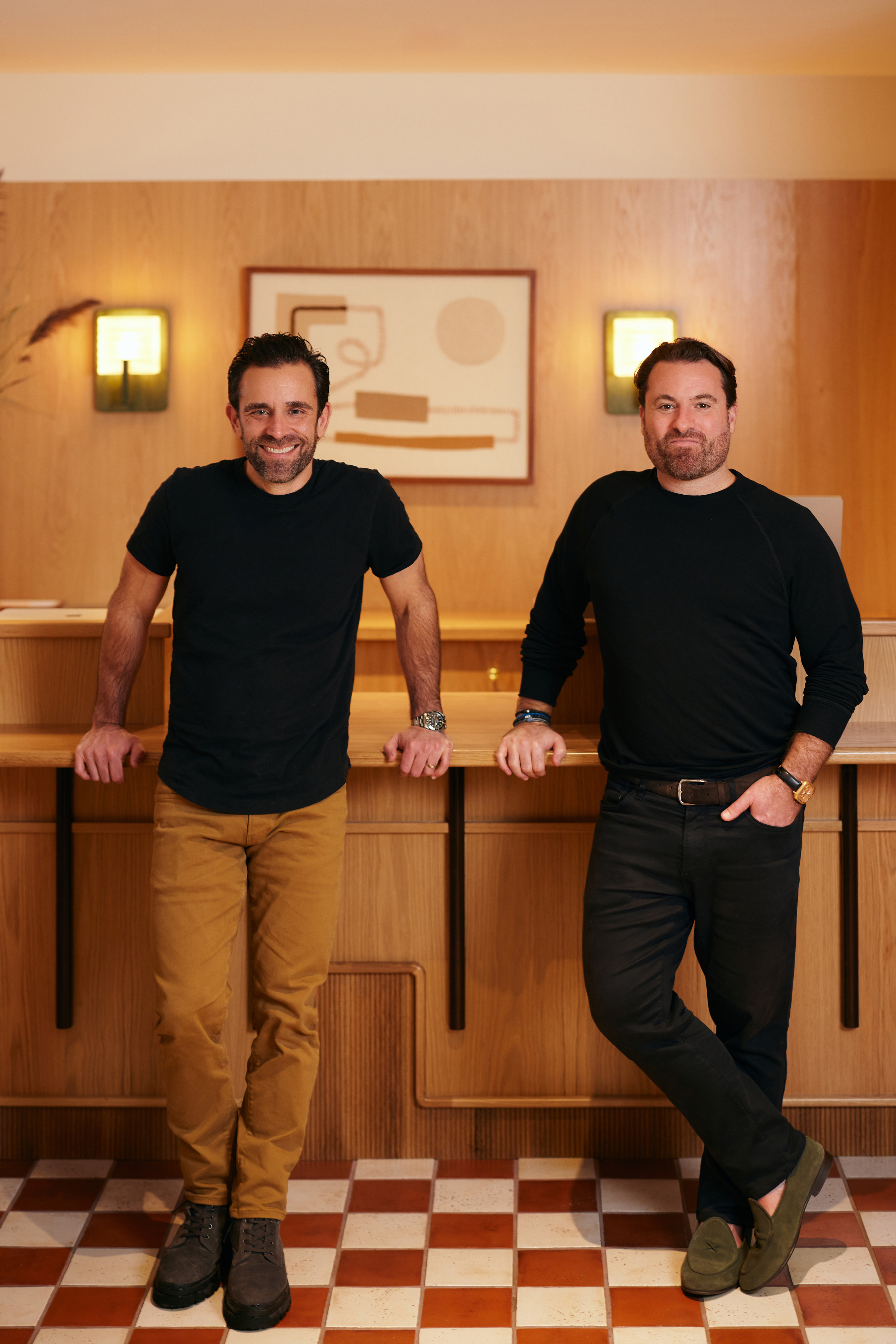
The distinction between their roles makes the work easier to understand. Brown’s hotels are collaborative projects. Designers, operators, restaurant teams and investment partners all appear in the finished experience. The co-founders’ division of responsibility helps explain how a business with a financial mandate also makes room for a creative brief.
A hotel imagined through someone else’s life
Faraway Nantucket began with a collection of old houses in the island’s downtown. To give those buildings a shared character, the team invented a woman who grew up on Nantucket, left aboard a ship, and returned years later with treasure and stories. Her imagined travels supplied the premise for an eclectic home open to visitors. The character was fictional; the design task was quite real.
That distinction is part of the pleasure. Nobody needs to believe an invented traveler actually owned the furniture to understand how her story might help a designer choose it. An imagined host offers a point of view. Objects can seem collected rather than ordered together. A group of buildings can feel related without becoming identical.
When the Nantucket hotel opened in 2021, Faraway had its first address. Martha’s Vineyard followed in 2023. The brand’s premise gives Brown’s investment work an unusual companion: a narrative that must eventually earn its place in a physical room. A story can guide the plan. Guests still need to find their way to breakfast.
The building he knew from the sidewalk
The Kelley House in Edgartown gave Brown a more personal version of that challenge. He had visited Martha’s Vineyard since childhood. In 2020, when Blue Flag bought the property, he also described another connection to the island: he had married on Chappaquiddick ten years earlier. Acquiring a hotel there meant taking responsibility for part of a landscape already woven into his life.
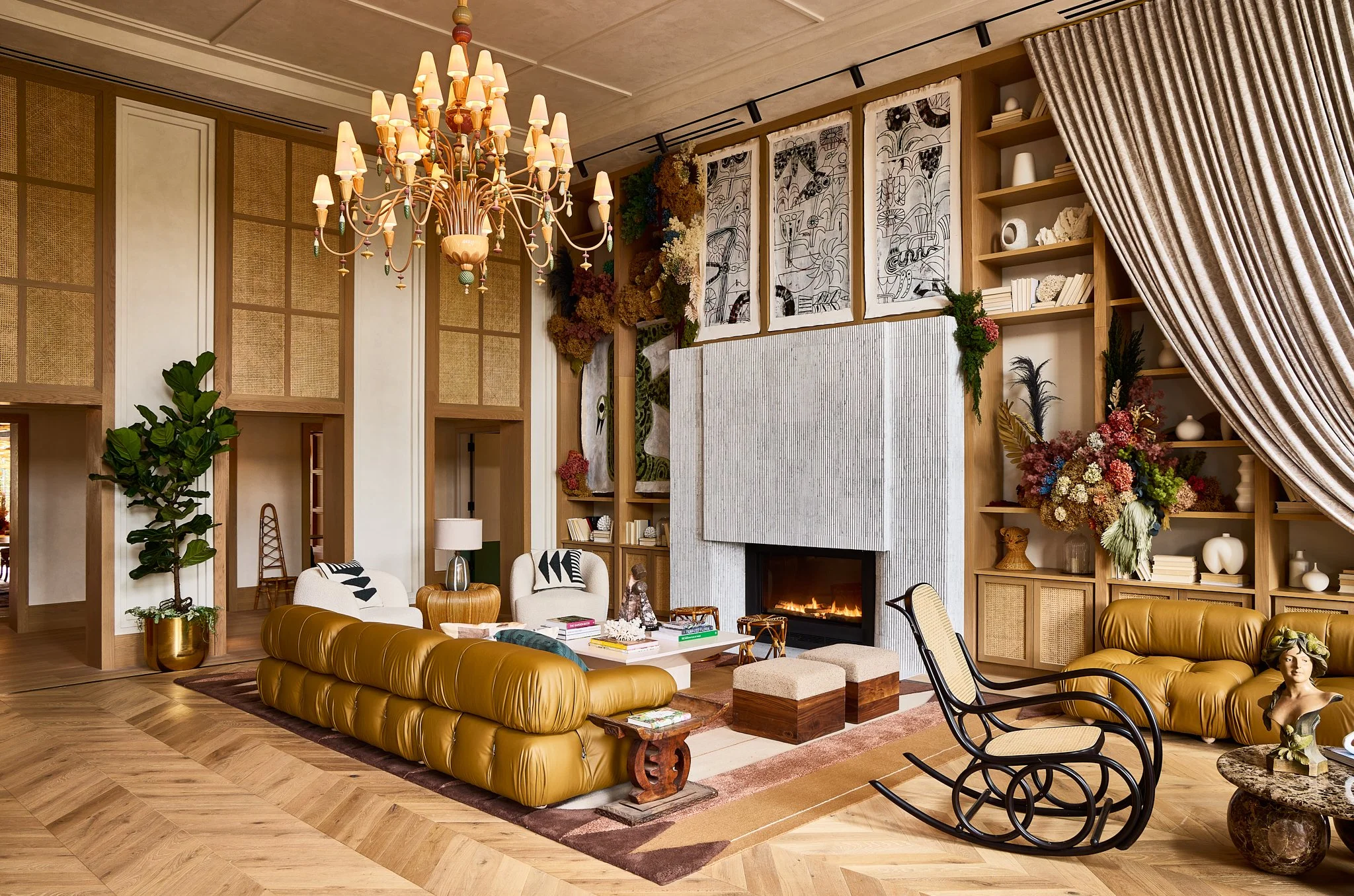
The conversion into Faraway Martha’s Vineyard required more than a new name. Workshop/APD worked on a campus whose separate buildings and outdoor spaces needed a more coherent relationship. The design drew on Carly Simon, whom Brown remembered hearing perform during his boyhood summers. Inside New England architecture, that inspiration allowed a looser mix of midcentury references, vintage objects and botanical touches.
The practical changes were substantial. A taller lobby led toward a library and courtyard. The pool moved into the courtyard. A path through the grounds made the campus more accessible to people passing through town. Those changes to movement and layout turn the language of hospitality into something a pedestrian can actually use.
There was also a less photogenic chapter. In June 2022, renovations were still under way, and the property would remain closed that summer. Plans affecting the historic 1742 building had been put on hold while work elsewhere on the campus continued. Brown emphasized preserving the property’s historic character. The planning history gives the later opening some useful weight: redevelopment proceeds through decisions, revisions and time.
Faraway Martha’s Vineyard opened in July 2023 and received a Michelin Key in 2024. For Brown, the sequence connected a childhood view of a hotel with the adult work of bringing it back into use. The satisfaction has a specific address.
The numbers behind the new chapter
Blue Flag’s ambitions require institutional money. In December 2023, a $450 million joint venture with Bain Capital Real Estate was reported, aimed at resort markets with strong demand and barriers to entry. That partnership helps place Brown’s boutique hotel work in its commercial setting. The intimate scale of a property does not make the investment small.
Consider Baron’s Cove in Sag Harbor. Blue Flag acquired the waterfront hotel in June 2024. Subsequent deed-transfer reporting put the purchase price at $66.5 million. The number is an acquisition price, rather than a renovation budget. It makes clear how much capital can sit behind a familiar local landmark before any new design appears.
Brown’s stated interest in stewardship therefore has a business consequence. An owner seeking a place’s next chapter has to choose where to invest, what to retain and how long to commit. Attractive destinations also come with people who already know the property and have opinions about it. A hotel can change ownership in a transaction. Its relationship with a town takes longer to change.
“We just choose to do hard things every single time.”
Jason Brown, discussing Blue Flag’s 2026 projects
A stay has to work after the rendering
Brown has said the team builds places they want to use themselves. In his account, that means noticing gaps in a destination’s social life, such as the cocktail lounge at Sister Ship, or thinking about what adults and children might enjoy at the Beachside on Nantucket. His description of being a guest in his own hotels gives the design ambition a practical test.
In 2025, Collared Martin Hospitality launched to operate Blue Flag’s luxury and lifestyle portfolio. The management company’s creation added an operating chapter to the investment and development story. A completed property still needs a team to deliver its promises, every day, to people who have paid to be there.
Outside work, Brown describes family travel as a priority and names Estelle Manor in the English countryside among his favorite getaways. He also offers newcomers a compact piece of advice: learn the different sides of hospitality. A lesson from his mentors is even shorter.
“Kill your ego before it kills you.”
Jason Brown, on advice received from mentors
From island streets to the Tetons
By summer 2026, the Faraway map had changed. Sag Harbor’s former Baron’s Cove became a 67-room Faraway property, with the Amalfi Coast-inspired restaurant Zagara. In Wyoming, the former Snake River Lodge became Faraway Jackson Hole, with 90 hotel rooms. Opening announcements confirmed both properties and the brand’s move beyond New England.
- 2021NantucketThe first Faraway
- 2023Martha’s VineyardThe Kelley House campus
- 2026Sag HarborThe former Baron’s Cove
- 2026Jackson HoleThe former Snake River Lodge
The mountain property supplied a different setting for the same underlying task. In an August 2026 interview, Brown and Guidi discussed Jackson Hole as a year-round leisure destination and their approach to reinterpreting a legacy hotel there. They also spoke about the appeal of quieter shoulder seasons in their coastal markets. The conversation about the expanded collection concerns how people inhabit a destination across the calendar, as well as how the rooms look.
In September, the Independent Lodging Congress named Brown and Guidi its 2026 Indie Rebel award winners. The joint recognition suits a partnership in which investment experience and design judgment share the result. Neither a financial model nor an imaginative brief checks a guest in on its own.
Brown’s route now forms a recognizable loop: early exposure to a hotel’s inner workings, an education in its business, years spent growing a brand, and a return to places with personal meaning. His teenage internship offered an unusually vivid introduction to what might happen inside a hotel. His current work asks a steadier question: what should happen there next? The answer has to be built, paid for, operated, and finally experienced by someone arriving with a suitcase.