Three companies. Three frontiers. The man who connected the world's machines to the internet is now building a digital model of every human body - and the numbers are starting to look like a revolution.
When Cisco paid $1.4 billion for Jasper Technologies in 2016, most people in Silicon Valley expected Jahangir Mohammed to step back. He had spent a decade turning a scrappy startup into the IoT platform powering 10,000 enterprises across 100 countries - and he had just handed the keys to one of the world's biggest technology companies. Retirement seemed logical. Mohammed had other ideas.
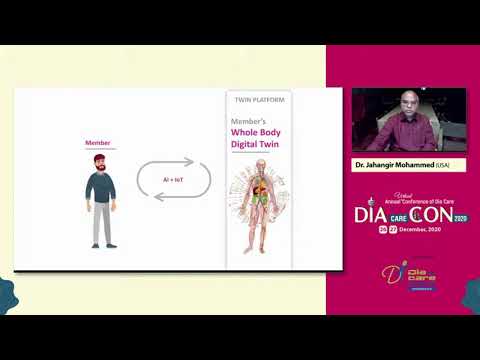
Within two years he had founded Twin Health, a company built on a deceptively simple premise: every human body is a system, and systems can be modeled. By feeding sensor data, lab results, meal logs, sleep patterns, and activity measurements into machine learning algorithms, Twin Health builds a real-time digital twin of each patient's metabolism - then uses that model to guide behavior in ways that actually stick.
The clinical results have been striking. A landmark study conducted by Cleveland Clinic and published in New England Journal of Medicine Catalyst in August 2025 found that 71% of Twin Health participants achieved A1C levels below 6.5% while eliminating most blood sugar-lowering medications - including GLP-1 drugs that have become a multi-billion-dollar category. Standard care achieved the same outcome in 2.4% of patients. The gap is hard to explain away.
Mohammed's path to this point ran through Tamil Nadu, Montreal, and two previous companies that each reached the billion-dollar frontier before Twin Health existed. Before Jasper, he founded Kineto Wireless and invented the technology that became the UMA (Unlicensed Mobile Access) standard - the quiet protocol that lets your phone make calls over WiFi. You have almost certainly used it today without knowing his name.
"It turns out there's one root cause - dysfunctional metabolism. Can you imagine, the world's largest problem has one root cause and we haven't solved it?"
- Jahangir MohammedThat pattern - building something foundational, invisible, and ubiquitous - runs through everything Mohammed has made. The UMA standard. The Jasper IoT platform. And now the whole-body digital twin, a model of you that updates in real time and adapts its guidance as your biology changes.
He holds more than 80 patents. Concordia University, where he earned his Master's in Electrical & Computer Engineering in 1993, gave him an honorary doctorate in 2017. The World Economic Forum named Jasper Technologies a Technology Pioneer. By the time Twin Health closed its Series E round at a $950 million valuation in August 2025 - led by Maj Invest of Denmark, with participation from Iconiq and Temasek - Mohammed had raised over $335 million for his third act alone.
The company operates across two hemispheres. Silicon Valley for technology and partnerships; Chennai, India for a major operational hub launched in 2019 - connecting Mohammed's roots to his most ambitious project yet.
The idea behind Twin Health is not complicated to explain. It is difficult to execute. Every person's metabolism is different - how they process carbohydrates, how their blood sugar spikes after a meal, how sleep quality changes insulin sensitivity, how stress elevates cortisol and glucose. Standard care treats everyone roughly the same. Twin Health builds a model of each individual and treats that.
The platform ingests data from wearable sensors, continuous glucose monitors, lab results, meal photographs, sleep trackers, and self-reported behavior logs. Machine learning turns that stream of data into a dynamic metabolic model - a digital twin that changes as you change. The guidance it generates is personalized to your specific physiology, not a population average.
What makes the Twin Health model unusual is the dual focus on biology and behavior together. Mohammed has been consistent about this in interviews and public appearances.
"Biology is only half the problem, it's also behavior. Behavior causes biology. It's what we put in our body, how we move, how we rest, how we breathe, the thoughts that run in our head. We have to correct the behavior to correct the biology."
- Jahangir MohammedThe platform layers human coaching on top of the AI recommendations - a compassionate clinical team that accompanies the algorithmic guidance. This combination of machine precision and human connection is, in Mohammed's framing, the only viable path to durable behavior change. Pills manage symptoms. Twin Health tries to remove the root cause.
In August 2025, Twin Health expanded its offering with a GLP-1 Stewardship Model - a system designed to personalize the full treatment continuum for patients on or considering GLP-1 medications, the drug class that has dominated health headlines since 2023. The clinical data suggests that Twin Health's approach achieves comparable or superior outcomes for many patients - without the cost or side effects of medication dependency.
The most rigorous clinical validation of Twin Health's approach to date compared outcomes in patients receiving Twin Health's AI precision treatment against those receiving standard care for Type 2 diabetes.
Additional peer-reviewed research published in the Journal of the American College of Cardiology (October 2024) found that Twin Health's approach also addresses hypertension in patients with Type 2 diabetes.
"Diabetes doesn't occur by itself. It occurs as a cluster of diseases - diabetes, hypertension, bad cholesterol, fatty liver, chronic kidney disease. These things happen together, and when not addressed, they show up as heart failure, kidney failure and Alzheimer's."
"It turns out there's one root cause - dysfunctional metabolism. Can you imagine, the world's largest problem has one root cause and we haven't solved it?"
"We have to correct the behavior to correct the biology. The only way to solve this problem is with biology and behavior simultaneously."
Mohammed grew up in Tamil Nadu, India, studied electrical engineering at Coimbatore Institute of Technology, then crossed the Atlantic for a Master's at Concordia University in Montreal. He has never explained his career choices as a linear plan - more like a sequence of problems that looked too important to ignore.
The first was connectivity. In 2000, mobile phones and WiFi networks existed in separate silos. Kineto Wireless invented the bridge. The UMA standard - now embedded in the infrastructure of global telecommunications - was his first invisible invention.
The second was scale. When he founded Jasper Technologies in 2005, connected devices were proliferating but enterprises had no way to manage them. Jasper built the platform. By the time Cisco came calling in 2016, Jasper's platform was handling connectivity for automotive, healthcare, utilities, and consumer electronics clients on every continent. The acquisition price was $1.4 billion.
The third is biology. Twin Health applies the same instincts - find a universal problem, build a platform, operate at scale - to the human body. The World Economic Forum recognized the pattern early, naming Jasper a Technology Pioneer in 2012. Concordia University recognized the broader arc in 2017 with an honorary doctorate.
Twin Health's Chennai hub, launched in 2019, is not an outsourcing arrangement. It is the operational spine of the company. The founding team includes co-founders M.A. Maluk Mohamed and Terrence Poon, and the India operations give Twin Health access to both engineering talent and one of the world's largest populations facing metabolic disease - particularly Type 2 diabetes.
India has over 100 million people with Type 2 diabetes - the largest absolute number in the world. The Twin Health model, if it scales as intended, could change the arithmetic of one of the most expensive chronic disease burdens in human history.
His WiFi voice protocol (UMA) is used billions of times daily. Most of its users have never heard his name.
The Jasper IoT platform connected 10,000+ enterprises across 100+ countries before Cisco paid $1.4 billion for it in 2016.
Twin Health's NPS score of 84 is among the highest recorded in digital health - where most platforms score in the 40s.
He holds 80+ patents spanning three distinct technology generations: wireless standards, IoT connectivity, and AI health modeling.
Concordia University, Montreal gave him an honorary doctorate in 2017 - the same institution where he earned his Master's in 1993.
Bachelor's in Electrical, Electronics & Communications Engineering
Tamil Nadu, India
Master's in Electrical & Computer Engineering
Montreal, Canada
Honorary Doctorate - recognized for visionary leadership and social impact
Montreal, Canada