Jack Conte built a spaceship and discovered a problem with the exchange rate. On one side: music, robots, a handmade cockpit and the considerable satisfaction of getting an elaborate idea onto a screen. On the other: the money an online audience could generate. The two sides bore remarkably little resemblance to each other.
The video was Pedals, released in May 2013. Its set resembled the Millennium Falcon, which is an ambitious place to conduct an experiment in independent music. Conte had already learned how to attract listeners. He could write, record, perform and film. The internet could deliver his work to people who liked it. Somehow, between the enthusiasm and the advertising check, much of the value seemed to evaporate.
His response became Patreon. Together with developer Sam Yam, Conte built a way for the people who wanted another song, comic or video to help pay for the next one. It was a modest question with a large set of consequences: could a creative career run on the commitment of its audience?
the next song?
An audience can arrive all at once.
A working life needs something repeatable.
Show every sound
Conte was born in San Francisco in 1984 and grew up in Marin County. He studied music and composition at Stanford, graduating in 2006. His education also included the SImps, Stanford’s improvisation troupe. At commencement, he and fellow graduating members staged a slow-motion samurai game. A conventional entrance was evidently available and declined.
He began uploading music to YouTube in 2007. His VideoSongs came with rules: no lip-syncing, and no sounds whose production stayed hidden. “What you see is what you hear” was the compact version. A viewer could watch the parts accumulate and understand how the recording had been assembled. The studio itself became part of the performance.
That format suited someone willing to move between instruments and the camera. It also offered listeners an unusually direct relationship with the labor. A finished track can conceal a thousand choices. Conte’s videos made a small spectacle of those choices, with the maker appearing wherever the next part required him.
In 2008, he formed Pomplamoose with Nataly Dawn, who later became his wife. Their arrangements of familiar songs made the appeal accessible: you could arrive knowing the tune and stay to see what they did to it. Their music traveled through videos rather than waiting for an industry gatekeeper to approve the route.
“What you see is what you hear.”
The VideoSong rule
The friend who could build it
The audience was real. So was the awkward arithmetic. Conte would later show a 28-day YouTube statement with more than a million views and $166.10 in revenue. It was a specific example of a broader difficulty: distribution had become inexpensive and abundant, while paying for the work remained stubbornly complicated.
The distinction matters. Advertising purchases attention. An artist needs enough money to make something worth attending to. Those interests can overlap without lining up neatly. A long, fussy production may satisfy a committed listener and make little commercial sense when paid for by incidental views.
Conte took his idea to Yam, his Stanford friend. Their collaboration joined the experience of making the work with the ability to build the software around it. When Patreon launched in May 2013, fans could pledge money for each new piece a creator released. The recurring nature of the arrangement was central. Another release could bring another payment.
Artists had been supported by patrons long before either founder was born. Patreon gave the arrangement an internet-sized front door. A fan did not need to finance an entire career. A small pledge could join other small pledges, and a creator could begin to see what the next release might earn.
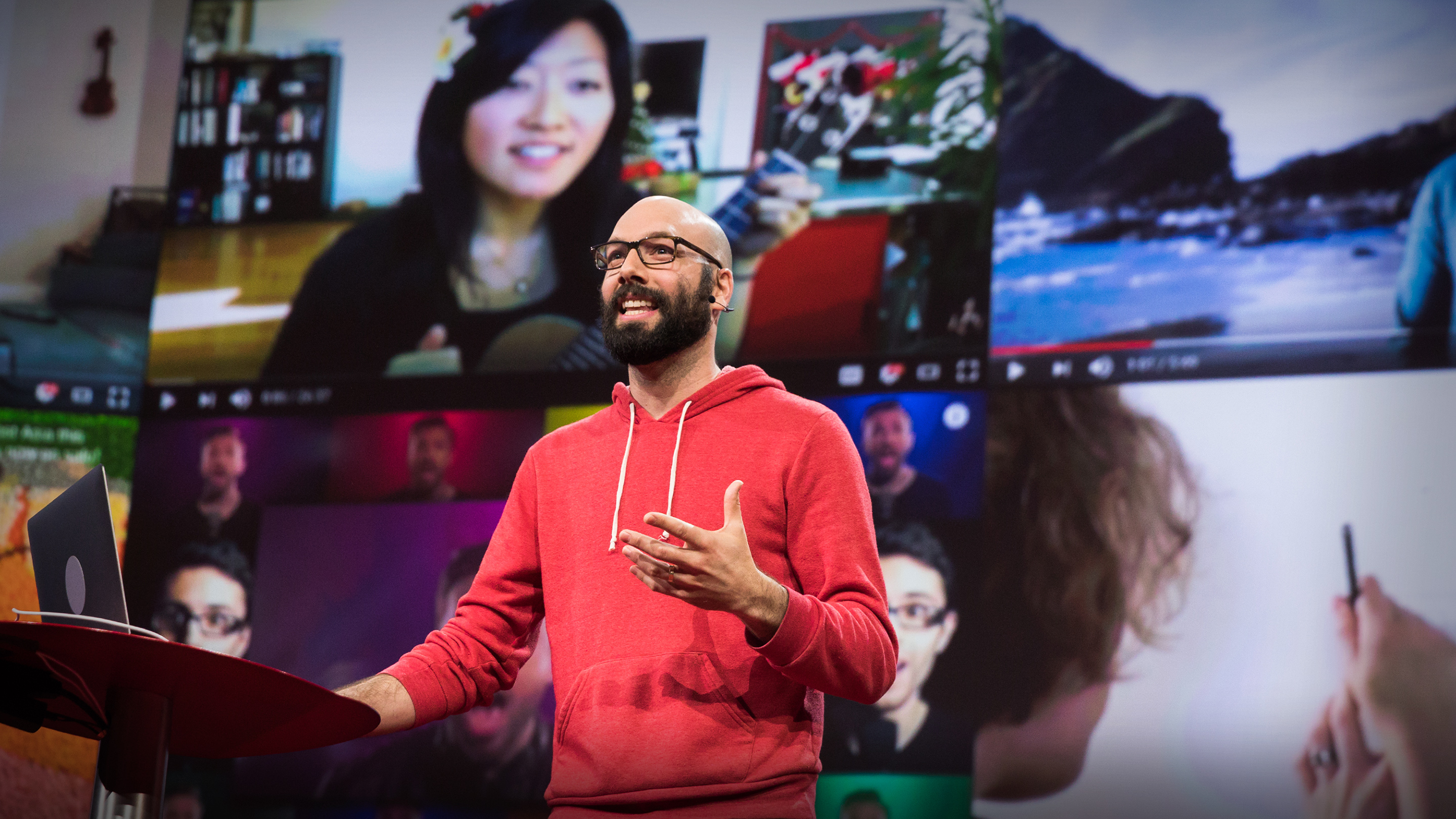
By 2017, Conte was explaining the argument on the TED stage. The question had traveled from his own production costs to the working lives of artists across disciplines. The attraction lay in its practical scale: a person could have a useful audience without becoming a household name.
The tour that opened the books
Conte’s interest in the economics was hardly confined to software. In November 2014, he published the accounts for Pomplamoose’s recent tour: 24 shows in 23 American cities over 28 days. Total income was $135,983. Expenses came to $147,802. The difference was an $11,819 loss.
He explained the spending, including equipment, hotels, travel, salaries and commissions. Dawn had coordinated the tour logistics. They had chosen a fuller production with hired musicians and crew, treating the loss as an investment in future shows. A smaller operation would have cost less. The decision was theirs.
24 shows · 23 cities · 28 days
Conte’s published tour accounts; bars share a zero baseline.
“We have not ‘made it.’ We’re making it,” he wrote. Publishing the numbers gave that distinction substance. A busy tour could still lose money. Recognition could coexist with ordinary decisions about wages, equipment and whether the next undertaking was affordable.
There is comedy in a rock career arriving at a hotel spreadsheet. There is also respect in showing it. Fans usually encounter the evening’s result. Conte let them look at the costs of arranging the evening in the first place.
A Saturday reserved for funk
Building Patreon did not exhaust his appetite for bands. In 2017, Conte and guitarist Ryan Lerman founded Scary Pockets, a funk collective with a rotating cast of musicians and singers. The partnership had a much older beginning: the two had met in high school in Marin County.
Scary Pockets offered another answer to the question of what a music video could be. A familiar song entered a room with players, and the arrangement gave it a different center of gravity. The pleasure was available on camera: people listening to one another, finding a pocket, enjoying the result.
By 2022, the group had been releasing at least one new video each week since its start. The production rhythm gave the collaboration continuity. A creative business needs a reason for people to return; a working band needs reasons to keep gathering. A song can supply both, provided somebody makes room in the calendar.
For Conte, that last condition took work. In a September 2026 interview, he recalled trying to put Pomplamoose on hiatus before returning to music. He described Scary Pockets sessions that could produce four songs on a Saturday. The arrangement gave the executive and the musician some chance of sharing a week.
When the platform becomes the job
The company became much larger than the original studio problem. By August 2025, Patreon said creators had received more than $10 billion through the platform since its founding, and it counted more than 25 million paid memberships. Those figures describe a platform used for livelihoods, with expectations extending far beyond the next upload.
Conte’s public argument also moved toward the relationship between a creator and a follower. On algorithmic feeds, choosing to follow someone does not guarantee seeing their work. The platform keeps deciding what to deliver. For an artist trying to make regular contact with an audience, that is a business condition as well as an annoyance.
By June 2026, he was explaining Patreon’s move into discovery: helping people find creators, alongside helping creators collect payments. He had previously resisted that direction. Depending on other platforms to deliver every new audience now looked like a weakness. Building a network of its own brought Patreon closer to the territory of the companies he criticized.
July supplied a harder chapter. Conte announced the elimination of 93 jobs, roughly 20 percent of Patreon’s staff, alongside organizational changes. He took responsibility and said the company’s core business remained strong. He also said its product priorities would continue. The announcement placed the advocate for creative livelihoods in the position of ending other people’s jobs.
That tension belongs in his biography. A mission does not settle a budget. Running the institution created to support independent work carries obligations to the people doing the institution’s work, too. Conte’s decisions can be examined against the promises that make his company appealing.
Patreon’s 2025 State of Create project asked more than 3,000 creators and fans about their experience online. Putting those groups into the same conversation fits the problem Conte has been working on: somebody wants to make a thing, and somebody wants it to exist. Between them sits an increasingly complicated collection of products deciding whether they will meet again.
The practical standard for his company follows from that history. Do the tools help a creator keep working? Can the audience maintain the connection it chose? Those are questions people can ask of an actual product, regardless of how persuasive its founder sounds on a stage.
Leave room for the next song
His ambitions remain tied to a different experience of the internet: creators compensated for their labor, audiences choosing relationships that last, and software designed around those ends. He describes the goal in human terms even when the work involves feeds, recommendations and company objectives.
The musician makes that ambition easier to understand. Conte has felt the oddity of being seen without being adequately paid. He has published the costs, asked fans for support and returned to sessions after discovering that an executive schedule could swallow the music it was supposed to serve.
The spaceship is a useful place to leave him. A homemade cockpit, real robots, a song: considerable effort spent on an idea someone wanted to make. Patreon grew from asking how such work might continue. After the fundraising, the meetings and the difficult decisions, the question still has an appealingly ordinary destination. Another musician gets to book another day in the studio.