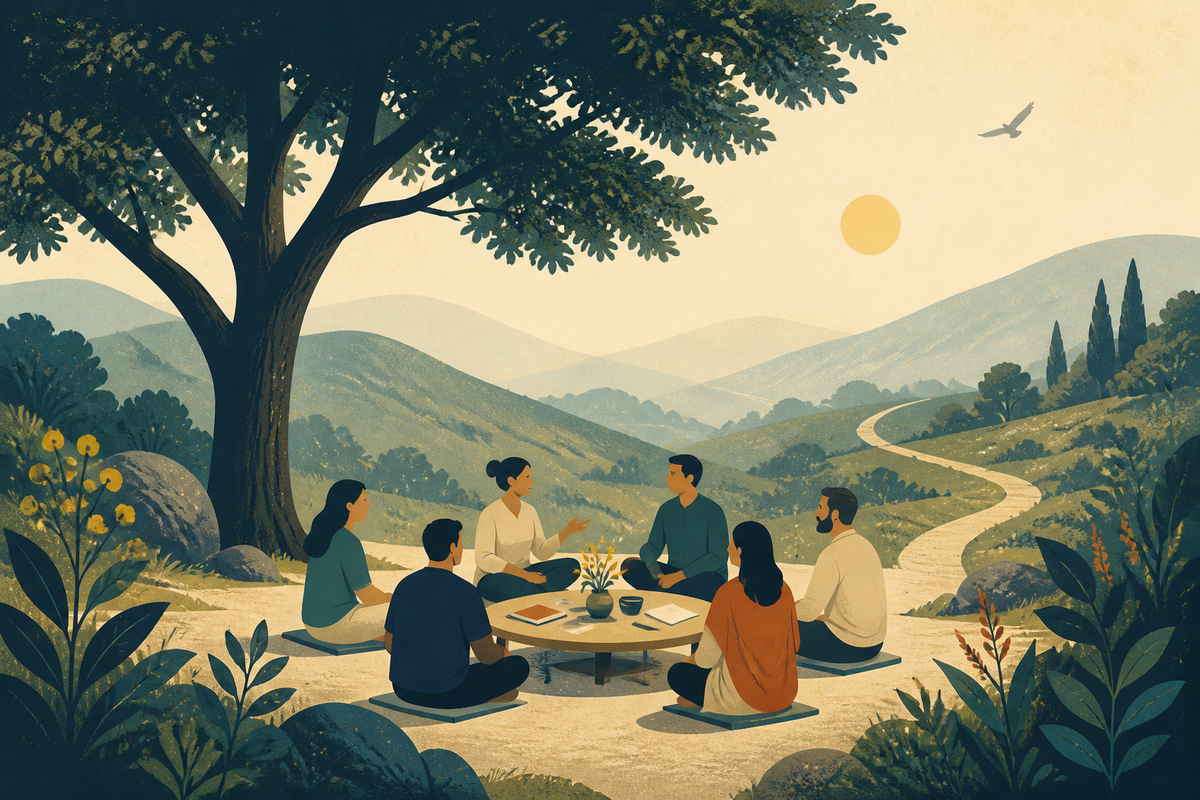
The meeting room is the problem
The corporate offsite has a familiar disguise. Move the same people, hierarchy and slide deck to a prettier postcode; add a buffet; call the change of carpet a change of perspective. Everyone goes home with a tote bag and the same unfinished conversation.
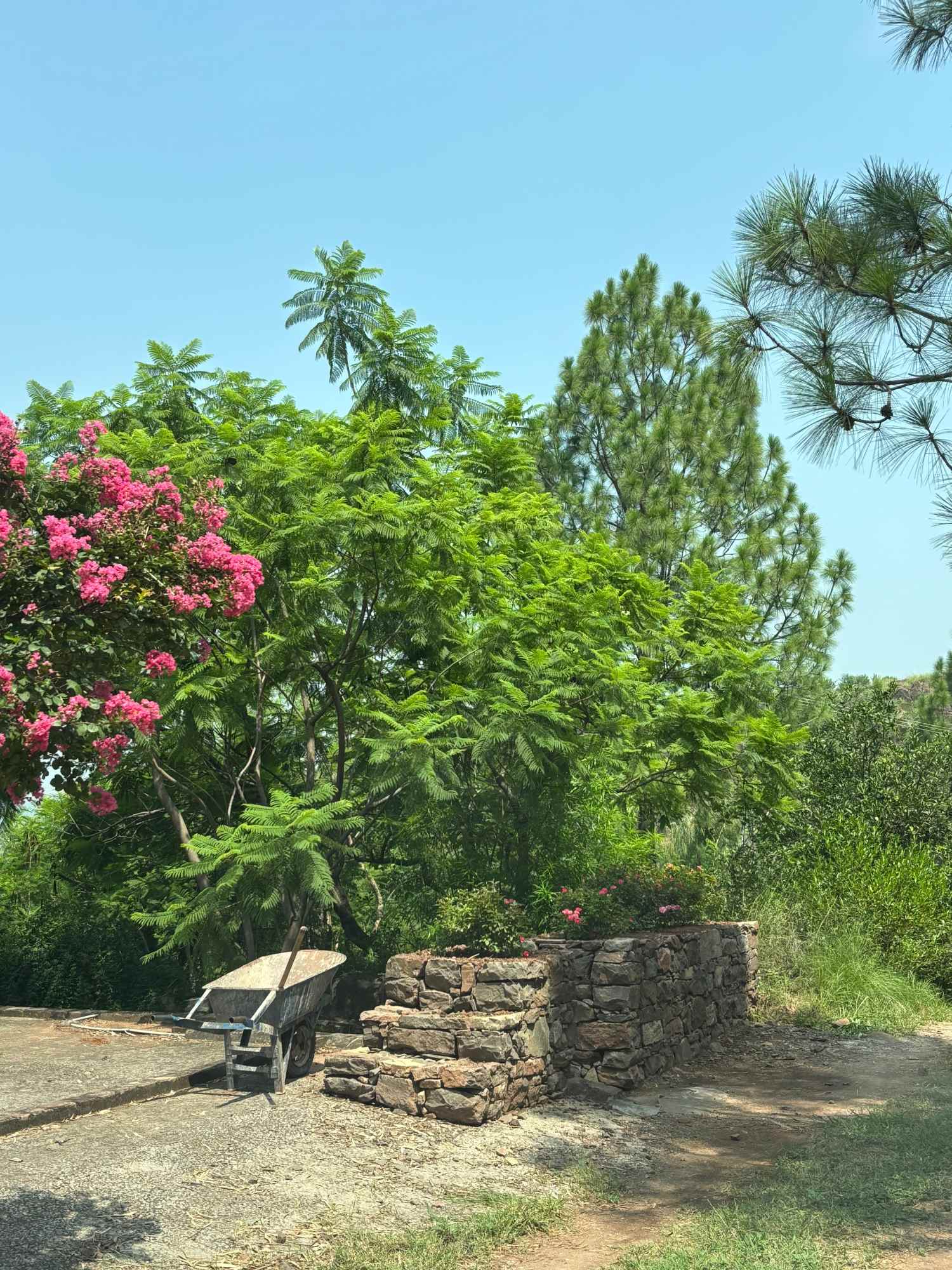
Diyaar begins with a more interesting premise: perhaps the room itself is carrying too much of the office. The Indus River Valley Institute, Pakistan’s first culture, heritage and identity think tank, is developing the rural site as its “Nature Base” near Simly Dam, at the foothills of the Margalla Hills. Its retreat concept does not lead with conference facilities. It leads with a verb: pause.
That matters because a useful retreat is not simply a meeting held somewhere else. It is a temporary change in the rules of attention. At Diyaar, the proposed tools for making that change are quiet, landscape, handwork, food, story and conversation. None is novel on its own. Put together—and taken seriously—they amount to a different operating system for a team.
A useful retreat is not simply a meeting held somewhere else. It is a temporary change in the rules of attention.
Forty-five minutes, and a different tempo
The cleverest feature may be the least romantic: the drive. IRVI places Diyaar about 45 minutes from central Islamabad. That is close enough for a team to arrive without turning the retreat into an expedition, but far enough for the city’s tempo to loosen its grip. The institute’s phrase is better: “Close enough to reach. Far enough to reset.”
The rural setting is not presented as decorative acreage. In IRVI’s concept, landscape is part of the program. Greenery and the natural terrain create room for reflection, conversation, creativity and connection. A silent retreat asks a group to notice what usually gets filled with chatter. Nature meditation and barefoot walks bring attention down from the abstract world of targets and dashboards to breath, ground and weather.
The important design lesson is portable: subtraction can be an activity. Most offsites add more—more sessions, more icebreakers, more scheduled fun. Diyaar’s opening move is to remove noise. A team does not need to perform togetherness every minute in order to become more connected. Sometimes it first needs enough quiet for people to arrive.
Make something that is not a slide
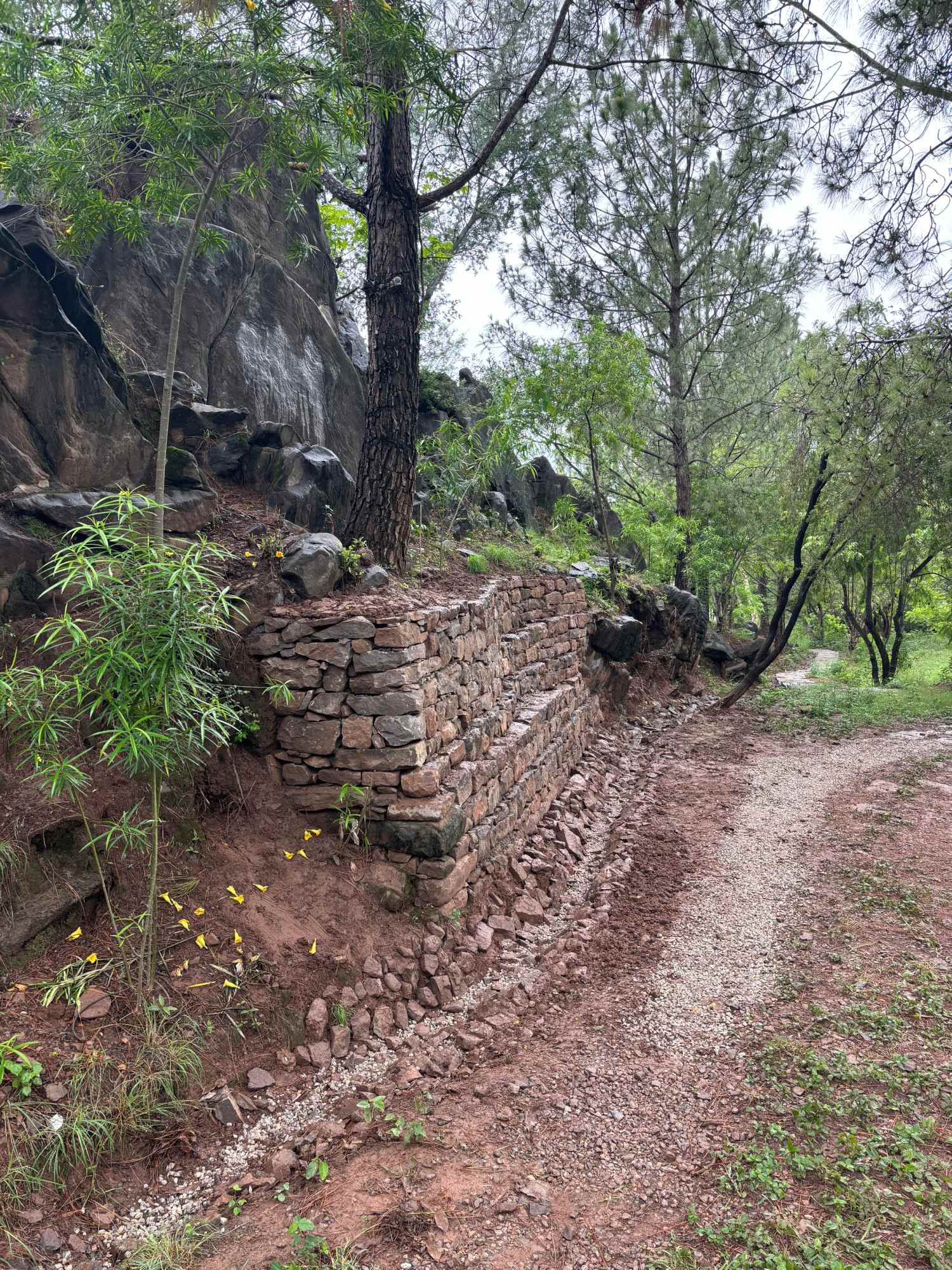
Then come the hands. Under the theme “Create & Build”, the deck proposes art made from natural materials, work with earth and stone, and encounters with local craftspeople and makers. These are not merely rustic substitutes for a trust fall. They change the unit of participation.
In a meeting, fluency wins: the fastest speaker, the cleanest framework, the person most comfortable with the organization’s dialect. Around clay, stone or plant material, that advantage can disappear. A senior title does not automatically make a steadier hand. The group receives a gentler hierarchy—one organized around curiosity, patience and the willingness to be a beginner in public.
This is where IRVI’s institutional identity gives Diyaar an edge. The institute describes heritage as a living inheritance and works with architecture, storytelling, music, food, textiles and craft as forms of knowledge, not just as objects to admire. At a nature base run by a heritage think tank, making can become a way to meet local knowledge on its own terms. The strongest version of the retreat would keep the artisan in the role of expert, with the team there to learn rather than consume a cultural aesthetic.
After dark, the org chart goes quiet
Diyaar’s evening program turns toward stories, sound and the people who carry them. IRVI sketches cultural nights with live music, storytelling and poetry, plus conversations with artists and artisans. This is a different kind of keynote: less a polished monologue delivered at an audience, more an invitation into another person’s practice.
The shift continues around the table. Proposed formats include silent and curated dinners, cooking experiences and workshops with local chefs. A meal is one of the oldest pieces of social infrastructure. It slows a group without forcing intimacy, gives hands small jobs, and produces conversation in the spaces between courses. A silent dinner makes the familiar strange; a cooking workshop turns colleagues into co-makers; a chef’s account of an ingredient can connect ecology, memory and place in a single bite.
The transferable idea is simple: stop demanding that every shared experience announce itself as team-building. Story, music and food already know how to gather people. Design the conditions carefully, invite people with real knowledge, and let the connection arrive sideways.
The idea worth stealing
Design the state of attention first. Then design the agenda.
A retreat can ask a better question
The most ambitious part of the Diyaar menu sits under “Stories & Identity”. Reading retreats, heritage tours and identity talks move beyond relaxation and ask what a group brings into the room: inherited stories, assumptions about place, and ideas of who “we” are. For IRVI, this follows directly from its larger mission to reconnect people with the many cultures and histories carried through the Indus River watershed.
That framing makes the landscape more than an escape from Islamabad. It becomes a place from which to look back at the city—and at oneself—with a little distance. An identity talk need not deliver a tidy conclusion. Its value can lie in making a team notice which stories it repeats, which voices it treats as authoritative and what kinds of knowledge its professional life has trained it to overlook.
The final cluster, “Move & Reflect”, includes art therapy, rain meditation, attention to natural rhythms and other curated IRVI experiences. The deck is a concept menu, not a clinical protocol: it does not specify facilitators, schedules or measured outcomes. That openness is useful, but it also creates a responsibility. A credible program will need to match each experience to the team, explain who leads it and resist cramming every good idea into one day.
Curate the rhythm, not just the package
IRVI names four routes into the offering: Silver, Gold, Platinum and Curated Experiences. The source material does not publish prices or a fixed list of inclusions. Instead, it ends with an invitation to shape an experience around the team. That is the right emphasis. The memorable product is not a tier; it is a rhythm.
experiences
A useful day might move from silence to handwork, from handwork to food, and from food to a story after dark. Each mode allows a different person to enter. The reflective colleague has the walk. The tactile learner has clay or stone. The cook has the table. The historian has the heritage conversation. The team stops being a single corporate personality and becomes a collection of people again.
The curation should also protect what makes the setting distinct. A packed agenda can turn nature into wallpaper and culture into content. The alternative is to give each encounter enough time to retain its texture: the uncertainty before a first mark is made, the questions that follow an artisan’s demonstration, the stretch of a meal when nobody reaches for a phone. These are small moments, difficult to photograph for a recap deck, but they are often where a group’s habits become visible. A retreat earns its distance from the office when it allows those habits to be noticed without immediately trying to fix them.
There is a broader idea here for anyone designing a gathering. Do not begin by asking what activities fit the agenda. Ask what state of attention the group needs, then choose a place and sequence that can produce it. Leave slack. Let local experts remain experts. Make room for the awkward first minutes of silence. And remember that the point of leaving the office is not to reproduce it outdoors.
Diyaar’s proposition can be stated in one line: change how people come together by changing what they do together. Forty-five minutes from Islamabad, IRVI is building a setting in which that experiment can happen—with less presentation, more presence, and perhaps one conversation the boardroom could never quite hold.