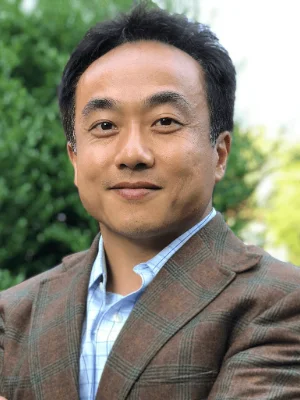
Most drug discovery starts with a frozen photograph. He starts with the movie.
Proteins do not hold still. They twist, breathe, snap shut, and flex open thousands of times a second. Yet for decades the industry designed drugs against a single still image of a protein, frozen in place, as if a hummingbird could be understood from a photograph of its wing mid-beat. Huafeng Xu built a company on the conviction that the still image is a convenient lie.
That company is Fathom Therapeutics, a New York drug-design outfit that until April 2026 went by AtomMap. Its engine, Microcosmos, simulates how a small molecule behaves not against an isolated, motionless protein but inside the crowded, jostling environment of a living cell. The pitch is blunt: stop designing against snapshots, start designing against motion. In Xu's words, it is “a world model of drugs in living cells.”
The claim sounds grand until you look at the receipts. In roughly six weeks, the team designed novel degraders - molecules that tag a disease protein for destruction - against a target the field had filed under “undruggable.” The Microcosmos engine models protein dynamics about ten thousand times faster than brute-force physics, and, Xu insists, without quietly cutting corners on accuracy. That last clause is the whole game. Speed is easy if you are willing to be wrong.
Current drug discovery efforts are limited by reliance on static structures of isolated proteins.
Huafeng Xu, on why Fathom existsXu is not a newcomer wandering into a hard problem. He is a builder of the very tools the rest of pharma now takes for granted. For about twelve years he was a research scientist at D. E. Shaw Research, the secretive lab that built Anton - a custom supercomputer whose only job is to simulate molecules in motion - and Desmond, a molecular-dynamics software package. There, Xu led development of the free-energy calculation methods that let chemists predict, before a single compound is synthesized, how tightly a drug will grip its target. Those methods are now standard equipment across the industry. His publications have drawn more than ten thousand citations.
The path to that lab started in Beijing. Xu studied chemistry at Peking University, then crossed the Pacific to Columbia University for a master's and a Ph.D., with a stint as a visiting postdoctoral scholar at UC San Francisco. Chemist who codes, coder who reasons in physics - the rare hybrid the field had been waiting for.
A $450M exit, two CTO chairs, and then he started over.
Before Fathom, Xu was chief technology officer at Silicon Therapeutics, a company betting that physics-based simulation could power a real drug pipeline rather than just a publication list. In February 2021 Roivant Sciences acquired Silicon Therapeutics for roughly $450 million in equity, plus milestone payments. Xu stayed on as CTO of the combined Roivant Discovery, carrying the simulation engine into a larger machine.
Then, in 2023, he did the thing that founders find hard to explain to anyone with a steady salary: he left to build his own. AtomMap was the result. Within a couple of years it had run discovery projects with eleven partner companies and, on its own, produced first-in-class molecules against a difficult oncology target. The founding team's combined track record reads like a pharmaceutical résumé on steroids - nineteen drugs advanced to the clinic, seven of them FDA-approved.
Microcosmos… translates accurate quantum mechanical calculations to measurable cellular outcomes.
Huafeng Xu, on what the platform actually deliversThe rebrand to Fathom Therapeutics, announced alongside the Series A, is less a pivot than a coming-of-age. The physics stayed. The ambition got a name that admits what it is reaching for: fathom, the old unit for measuring depth, and the verb for finally understanding something complicated. The round - $47 million, oversubscribed - was led by Sutter Hill Ventures, with Chemistry, Alexandria Venture Investments, and Empire State Development's NY Ventures joining. He surrounded himself accordingly: co-founders Yujie Wu (CTO, ex-Schrödinger and Roivant) and Jesús Izaguirre (chief computational scientist), a scientific advisory board that includes Harvard's Bruce Zetter, and a board seat for X-Chem founder Diala Ezzeddine.
What sets Xu apart is not the funding or the pedigree. It is the refusal to accept the convenient approximation. The industry standardized on static structures because they were tractable, and built an entire methodology around the compromise. Xu spent a career making the harder, truer approach fast enough to use. That is a different kind of patience - the kind that builds the chip before it builds the drug.
A founding team that has done this before - 19 times.
A simulation engine is only as good as the people who know which questions to ask it. Xu's co-founders come from the same lineage of physics-first drug design. Yujie Wu, the chief technology officer, arrived by way of Schrödinger and Roivant Discovery - two of the names most associated with computational chemistry done at scale. Jesús Izaguirre, the chief computational scientist, came through Roivant and Silicon Therapeutics, the company Xu helped build and sell. The pattern is not accidental. Xu has spent two decades recruiting from a small world of people who believe that biology is, at bottom, physics you have not finished computing yet.
The numbers behind that conviction are unusual for a company barely past its Series A. The founding team has collectively advanced nineteen drugs into clinical trials, seven of which won FDA approval. That is not a pitch-deck projection; it is a rear-view mirror. Around them sits a scientific advisory board that includes Harvard's Bruce Zetter, alongside Ian Taylor and Dimitris Agrafiotis, and a board reinforced by Diala Ezzeddine, the founder of X-Chem and Magnet Biomedicine. Mandana Honu, formerly chief scientific officer at Kaleidoscope Bio, joined as chief business officer to translate the science into deals.
The money followed the people. The $47 million Series A was led by Sutter Hill Ventures, a firm with a long memory for deep-technology bets, and rounded out by Chemistry, Alexandria Venture Investments - the venture arm of the life-science real estate giant - and Empire State Development's NY Ventures, a signal that New York wants to keep a computational-biology champion in its own backyard. “Oversubscribed” is the polite industry word for what happens when more investors want in than there is room for. For a company that had just changed its name, that is its own kind of endorsement.
It is worth pausing on what the rebrand says about Xu's temperament. AtomMap was a literal name - atoms, mapped. Fathom is a confession of ambition. The word once measured the depth of water by the span of a sailor's outstretched arms; today it means to finally grasp something that resists grasping. A company does not rename itself toward difficulty unless its founder is comfortable there. Xu, who turned the slowest, most accurate corner of chemistry into something usable, appears to be exactly that.
And then there is the man at the whiteboard. By his own account he relaxes with wine and math problems, sometimes at the same time, and he once advised a wine-tech venture called Bevscout as a technology strategist. It is a fitting quirk for someone whose day job is teasing signal out of complexity: the palate and the proof, both demanding attention, both better with a little patience. The throughline of his career is not a single breakthrough but a stubborn preference for the harder, truer model - in proteins, in pipelines, and apparently in the glass.