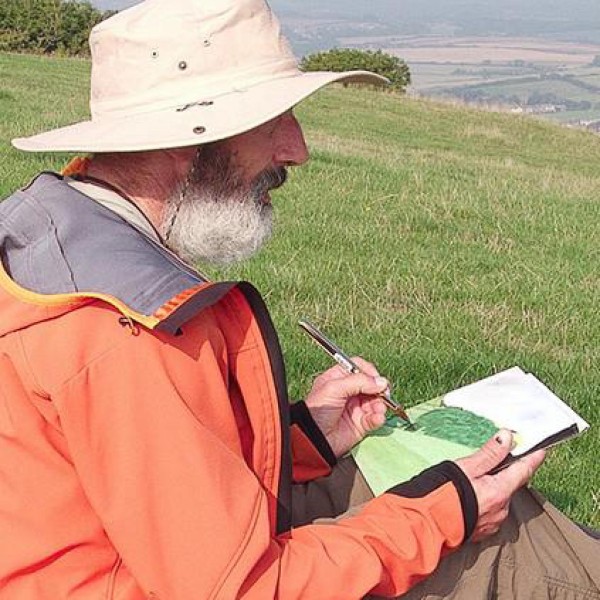
Most mornings, a new post appears at eclecticlight.co before much of the Mac-using world has finished its coffee. It might dissect exactly how XProtect quietly updates itself, or trace what happens to a Time Machine backup when you swap to a new Mac. It might, just as easily, be about a Titian. The author is the same person, working alone, signing off as "Chief Illuminator" beneath an owl.
Howard Oakley runs The Eclectic Light Company, a blog that refuses to pick a lane. Its two obsessions sit side by side without apology: how macOS actually works, and the history of painting. The split sounds like a contradiction until you read a few posts and realise both come from the same instinct - to look closely at a complicated thing and explain it plainly.
The macOS half is where his reputation lives. When Apple ships a new version of macOS, Oakley is often the one who works out what changed under the surface and writes it down in language a curious user can follow. He covers APFS, code signing, Gatekeeper, security data updates, kernel behaviour and Apple Silicon - the unglamorous plumbing that few other independent writers touch in this much detail.
He does not just describe the system; he builds tools to interrogate it. Oakley has written more than 40 free utilities for macOS. SilentKnight checks that your Mac's security protections are current. Consolation makes the notoriously opaque Unified Log readable. T2M2 - The Time Machine Mechanic - diagnoses backups that have quietly gone wrong. LockRattler, Cirrus, xattred, Scrub: each one began as something he wanted for himself and decided to share.
Before the blog, a different kind of cold case
The route here was not the usual one. Oakley studied medicine at Oxford and spent much of his career as a doctor in the British Royal Navy, rising to the rank of Surgeon Commander. He worked as a medical researcher specialising in cold injury - the damage extreme cold does to the body - and took part in Antarctic expeditions. The person now mapping the internals of APFS once mapped what happens to human tissue at the edge of survivable temperatures.
Computing arrived in the middle of that career. His first serious encounter with a Mac - an SE running Macintosh Programmer's Workshop - is the one he describes as having hooked him for life. He started programming, started writing, and became a long-standing contributor to MacUser in the UK and other technology titles.
When MacUser closed, those articles risked vanishing. So in January 2015 he opened the blog, at first simply to give updated versions of his old pieces a permanent home. It grew into something far larger: thousands of articles, a steady audience of more than 100,000 views a month, and a reference that other Mac writers cite when they want to know what really changed.
Written by a human, on purpose
The site carries a small, pointed badge: "No AI content." In an era of generated filler, Oakley's output is deliberately, stubbornly handmade. He has also been clear that the free apps were never a business. They make no money, and that was the point - they are how he gives back to a community he has spent decades inside.
What makes the whole thing unusual is not any single post but the range. Read enough of the archive and you get a portrait of someone genuinely incapable of being bored: a clinician who became a programmer, a magazine columnist who became an indie developer, a security researcher who will happily spend a thousand words on the mythology behind a 16th-century painting. The owl fits.
The Time Machine that nobody else would explain
If you want a single example of the method, look at his work on Time Machine. Apple's own documentation treats backup as a switch you flip and forget. Oakley treated it as a subject worth eleven separate posts: what actually happens when a backup runs, what goes wrong over a network, what becomes of your old backups when you replace the Mac they came from, and how to keep the whole apparatus healthy. The series became one of those references the wider Mac press points to - TidBITS among them - when readers ask the questions Apple's support pages quietly avoid.
It is a pattern that repeats across the blog. A feature ships, the official description is thin, and Oakley goes and finds out. He runs the tests, reads the behaviour, and writes it up in instalments rather than slogans. The tone is never breathless. There are no superlatives, no manufactured drama - just a careful person showing his working, which in a field full of confident guesses is its own kind of rare.
Seven years in, and counting
In January 2022 he marked the blog's seventh anniversary with a retrospective, "The Last 7 Years on My Mac." It read less like a victory lap than a stocktake: how the machine had changed, how the writing had changed, what was still worth chasing. The remarkable part is the consistency. Day after day, year after year, a new post lands - on security data updates, on a quirk of the file system, on a painter most readers had never heard of - all from one desk on the Isle of Wight.
That consistency is the whole proposition. He is not chasing a launch or a funding round; the apps make nothing and were never meant to. What he is building, slowly, is a body of work - a place where a curious Mac user can go to actually understand the machine in front of them, and where the same curiosity gets pointed at art when the mood takes him. Catch the archive mid-stride and you will not find a brand. You will find a person who looks closely at hard things and refuses to let anyone else write it for him.