Who They Are Now
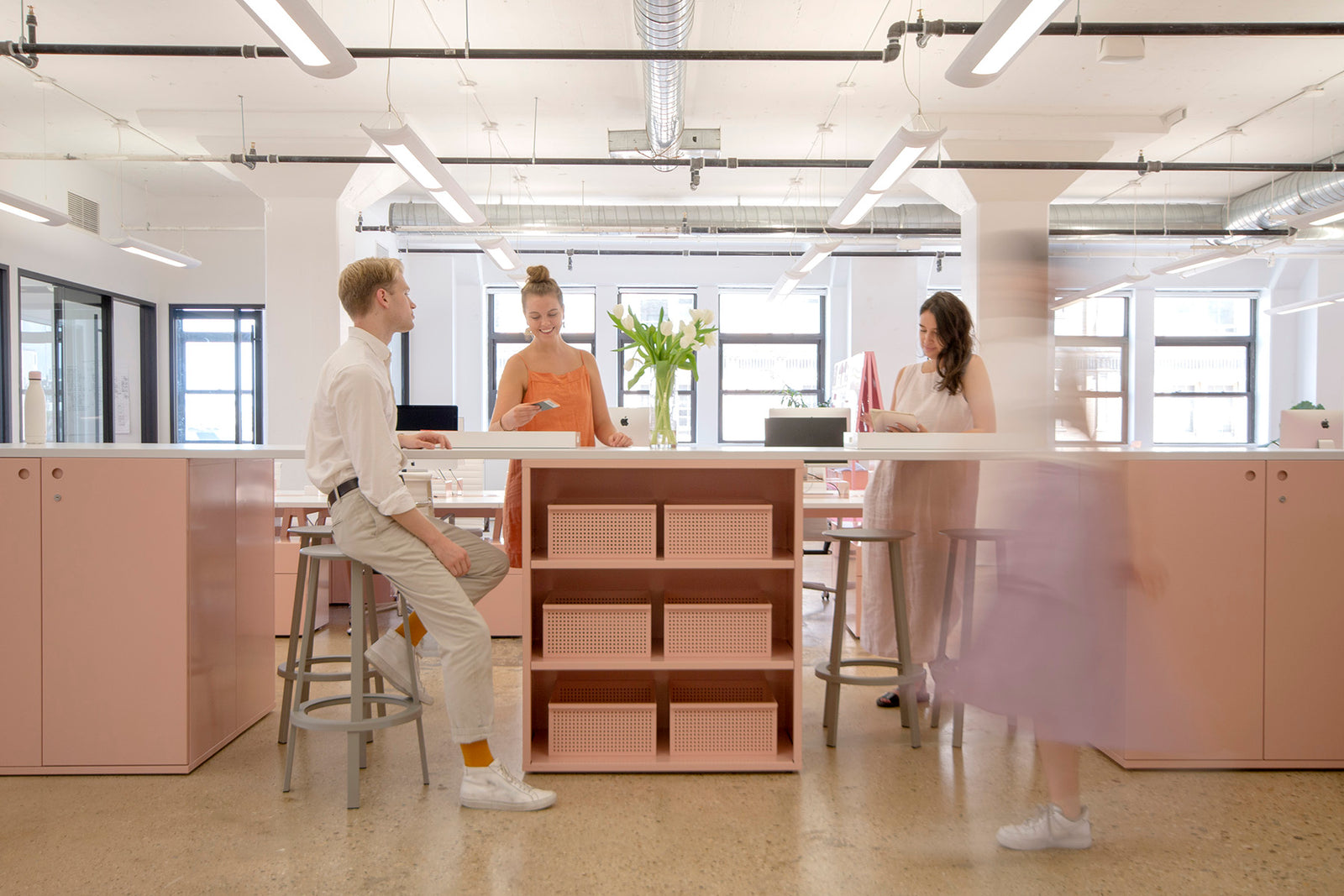
The most interesting thing in the room is the storage
Walk into a well-designed office today and you notice the desks, the lighting, maybe the plants. You do not notice the lockers. That is exactly the assumption Heartwork was built to break. The company makes steel storage - cabinets, credenzas, lockers, desks - that people actually look at, choose colors for, and argue about. In an industry that treats storage as a commodity to be hidden, Heartwork treats it as the point.
From its base at 29 West 30th Street in Manhattan's NoMad district, Heartwork designs and sells furniture to a sweep of clients that runs from Fortune 500 floors to startups still counting their first hires. The catalog reads like ordinary office gear - lateral files, pedestals, bookcases, smart lockers - until you see it. Heavy-gauge American steel. Soft-close hinges. An exclusive powder-coat palette developed with a color expert. It is the unglamorous category, rendered with the care usually reserved for the things that get photographed.
"The design of a space is the fastest way to create a culture."
Karen John, Founder & CEO
The Problem They Saw
Storage was the part nobody designed
Here is the quiet scandal of the commercial furniture world: enormous thought goes into chairs and desks, and almost none into the things that hold everything else. Filing cabinets came in two flavors - beige and slightly-different beige - and were built from laminate that chipped, swelled, and ended up in a landfill within a decade. Storage was the category everyone bought and nobody loved.
Karen John noticed this from an unusually good vantage point. She had spent years at Design Within Reach as VP of Merchandising, watching beautiful furniture sell and watching the workhorse pieces stay ugly. The office storage market was huge, durable in demand, and creatively abandoned. It was, in other words, the rare problem that was both enormous and ignored - which is the only kind worth quitting a good job for.
The drabbest object in the building was also the one bought in the largest quantities. Somebody was going to fix that. It might as well be the person who understood both factories and color.
The deeper issue was philosophical. If a workspace shapes a company's culture - and John was convinced it does - then leaving the most repeated object in that space to chance was a strange thing to accept. A wall of lockers is not a small detail. It is the backdrop to every coffee break, every drop-off, every Monday. It deserved a design decision, not a default.
"Everyone should do what they love. Great design can celebrate those pursuits - even at the supply cabinet."
The Heartwork founding principle
The Founder's Bet
An engineer who fell for steel
Karen John's resume is almost suspiciously well-suited to this problem. Industrial design at Milan's Domus Academy. A master's in Manufacturing Systems Engineering from Stanford. An MBA from INSEAD. She can sketch a credenza, model the factory that builds it, and write the business plan that sells it. When she launched Heartwork in September 2012, the bet was specific: that companies would pay more for storage if the storage was worth more - better material, better design, made to last.
The material was the heart of the wager. John chose steel over laminate, which is the harder, costlier, more stubborn choice. Steel symbolizes work, she argues, and it behaves: fully welded, it does not chip or sag, and at the end of a long life it can be recycled rather than dumped. It was a contrarian decision in a market optimized for the lowest possible upfront price. Heartwork was optimizing for the longest possible life.
18/20
Gauge commercial steel
It was also, quietly, a climate bet. Build-to-order manufacturing means Heartwork does not produce inventory it has to discount or scrap. Factories run on solar. Products carry GREENGUARD Gold and HPD certifications for low emissions and material transparency. None of this was marketing dressing bolted on later - it was baked into the decision to make heavy things that last instead of cheap things that don't.
The Product
Modular, mobile, and a little bit smart
The catalog is built like a kit. Building Block lockers stack into storage walls or cap the end of a desk row. Active Duty lockers look like freestanding credenzas and slot into lounge areas. Base Camp lockers flex for hybrid teams who are in three days and out two. Underneath the variety is a single idea: storage should adapt to how a company works, then adapt again when the company changes.
Smart Lockers
Cloud-connected steel lockers - reservable, shareable, secure, and data-rich. Storage for the era when nobody owns a fixed desk.
Lockers
Base Camp, Building Block, and Active Duty lines: fully welded steel with soft-close hinges and optional perforations.
Cabinets & Credenzas
Lateral files, pedestals, bookcases, and credenzas in commercial-grade steel and exclusive powder-coat finishes.
Desks & Workbars
The signature Sawhorse desk collection, conference tables, and workbars built for creative workplaces.
Then there is the smart locker, the piece that pulled Heartwork into software-adjacent territory. As offices went hybrid, the locker stopped being a place you owned and became a place you booked. Heartwork integrated cloud-connected lock technology so a locker can be reserved from a phone, shared across a rotating team, and managed by facilities through a dashboard. It is the same honest steel box - now with an API quietly attached.
"A locker used to be furniture. Now it's furniture with a login."
On Heartwork's Smart Lockers
The color, meanwhile, is the part that makes people smile. Heartwork worked with materials expert Laura Guido-Clark to build an exclusive palette, so a buyer is not choosing between gray and grayer. You can mix doors, match a brand, or pick a hue that simply makes the hallway better. It is a small permission - to enjoy the storage - and customers take it.
The Proof
Who buys steel on purpose
The customer list is the argument. Heartwork sells to Fortune 500 companies and to startups, to architecture and design firms specifying for clients, and into education and healthcare environments where durability is not optional. The through-line is buyers who plan to keep the furniture - the kind of customer for whom "made to last" is a feature, not a slogan.
The case for buying once
Why Heartwork's pitch lands · illustrative comparison
Directional, not laboratory-precise - the point is the gap, not the decimal.
The financial story is a steady one rather than a fireworks show. Heartwork has taken venture backing from respected early-stage investors including Baseline Ventures and Cowboy Ventures, with funding climbing over the years toward Series A figures. Annual revenue sits in the low millions, which for a maker of heavy steel goods built one order at a time is exactly the kind of number you'd expect - and exactly the kind that compounds.
"GREENGUARD Gold. Solar-powered. Fully recyclable. Sustainable furniture stops being a contradiction."
The Heartwork manufacturing pitch
The proof is also on the wall, literally, in the NoMad showroom that opened in 2017. Part display, part customization studio, part laboratory, it is where the company tests whether the next idea earns its steel before it earns a place in the catalog.
The Mission
Furniture in service of work worth doing
Strip away the steel and the smart locks and Heartwork's mission is almost sentimental: support the businesses and the people who are passionate about what they do, by giving them workspaces that celebrate the effort. The name is the thesis. Heart, work. The bet that the place where you do your work should reflect that the work matters.
It is a female-founded company in a category not famous for them, and it carries its values plainly - adaptability, personalization, quality, sustainability. None of those are revolutionary words. What is unusual is applying all four to the filing cabinet, the object the rest of the industry decided wasn't worth the trouble.
Heart + work. A company that decided the supply closet was a culture statement, and then built it out of recyclable American steel to prove the point.
Why It Matters Tomorrow
The office keeps changing. Storage has to keep up.
The future of work is unsettled, and that is good news for a company built on adaptability. When desks stopped being assigned, lockers had to get smart. As teams shrink and grow and reshuffle, modular storage that reconfigures beats fixed millwork that has to be ripped out. And as companies face real pressure to account for what they buy and throw away, furniture that is built to last and made to be recycled stops being a luxury and starts being a requirement.
Heartwork is positioned at the intersection of three trends that are not going away: hybrid work, customization, and sustainability. It is not chasing them. It built its business on them years before they had hashtags.
"Most furniture wants to disappear into the background. Heartwork wants the background to be worth looking at."
The Heartwork wager
So return to that well-designed office. You came in noticing the desks and the light. But your eye keeps drifting to the wall of lockers in a color you didn't expect, the credenza that doesn't look like a credenza, the storage that someone clearly chose on purpose. That is the change Heartwork is making, one steel box at a time: the most overlooked thing in the room, finally worth a look.