Before the chart records, arena lights and late-night television, Fuerza Regida had a simpler problem: how do you make a room stop talking? The band played covers at parties around San Bernardino, the sort of work where attention is earned between conversations and clattering cups. Jesús Ortiz Paz, the singer everyone calls JOP, noticed the small victories. People paused. They listened. The room tilted toward the music. That reaction became evidence.
The group formed in 2015 with Ortiz Paz at the microphone, Samuel Jáimez on twelve-string guitar, Khrystian Ramos on rhythm guitar and José “Pelón” García on tuba. Moisés López, the tololoche player, later completed the current five-piece lineup. Their instruments belonged to música mexicana; their point of view belonged to Southern California. The combination sounded natural because it was their daily life. Mexican tradition and American street culture did not need an introduction. They had already met in the neighborhood.
Covers paid their apprenticeship. The internet supplied the next room. In 2017, they began putting performances on YouTube. Then an original, “Radicamos en South Central,” caught. It was a corrido with a local address in its title and an appetite larger than the map. Uploaded to Ortiz Paz’s personal channel, it traveled far beyond the parties that had trained the band. A screen had become a stage, and the comments had become a crowd.
The climb was loud, but it was not instant
Online breakthroughs invite a convenient fiction: one upload, then stardom. Fuerza Regida’s version had considerably more mileage. The group signed with Rancho Humilde in 2018 and kept recording at a rate that made patience seem unfashionable. In 2019, Del Barrio Hasta Aquí reached No. 1 on Billboard’s Regional Mexican Albums chart. It stayed there for 18 weeks. The title, “From the Neighborhood to Here,” read like both an arrival notice and a promise not to forget the departure point.
The songs found a public that understood the band’s codes without footnotes: ambition, danger, status, work, heartbreak and the performance of being unbothered. The arrangements carried requinto lines, tuba weight and the dry propulsion of corridos. The delivery carried the cadence of young Mexican Americans who could hear trap, norteño and street talk in the same afternoon. Some listeners called the developing language corridos tumbados. Fuerza Regida simply kept working inside it.
By 2022, the band was mounting its first U.S. arena tour. The following year brought a different sort of validation. “Bebe Dame,” made with Grupo Frontera, entered the Hot 100 and peaked at No. 25. Fuerza Regida then won Top Duo/Group and Top Latin Duo/Group at the 2023 Billboard Music Awards. The first category placed a Spanish-language regional Mexican group in the general field, alongside every other kind of popular duo and band. An industry trophy is merely polished metal, but the category on the plaque said something useful about how the map had changed.
Touring became a second recommendation engine. In 2024, the itinerary threaded through arenas from San Jose and Fresno to Houston, Atlanta, New York, Denver and Las Vegas, before moving through Mexico. Each stop gave the online audience a physical address for one night. The exchange worked both ways. Streams could fill a building; a building full of people singing could send the songs back through their phones with fresh urgency. The old music-business ladder had turned into a loop.
An arena also clarifies what a recording can disguise. There is nowhere for a weak arrangement to hide when five figures stand on a bright platform in the middle of thousands of people. Fuerza Regida’s setup makes the mechanics visible: fingers moving on strings, breath forcing air through brass, the tololoche marking time, Ortiz Paz pacing through the center. The sound may circulate through algorithms, but it is still produced by bodies doing coordinated work.
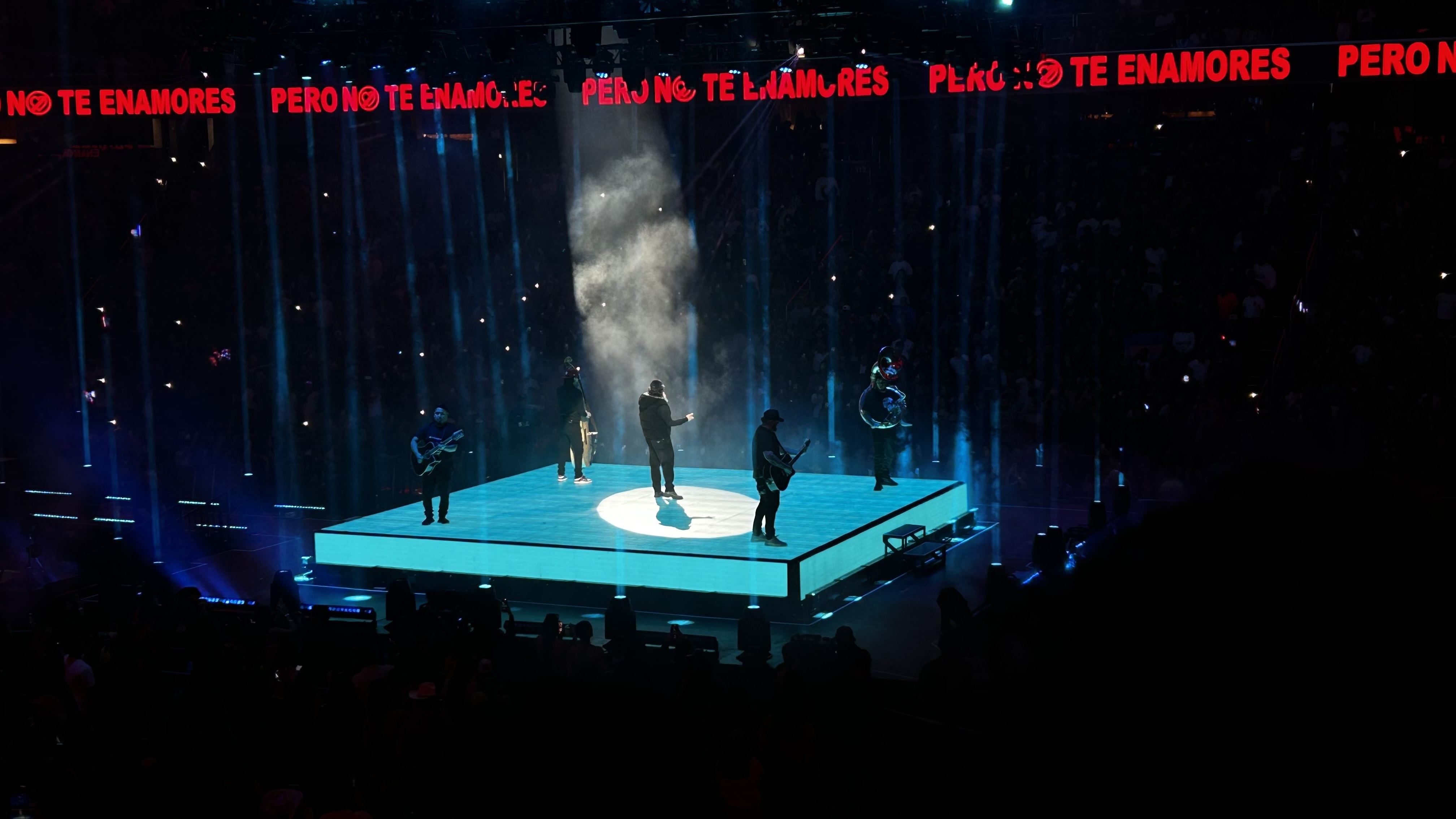
Five people, no decorative instruments
Ortiz Paz is the face at the front, but Fuerza Regida is arranged as a conversation. Jáimez’s requinto can flicker and jab. Ramos gives the songs their rhythmic floor. García’s tuba does the work a bass line might do elsewhere, except it arrives with brass, breath and comic authority. López’s tololoche adds the woody pulse of an instrument built to be felt in the chest. JOP narrates above them in a voice that can sound wounded and pleased with itself in the same verse.
That chemistry lets the band misbehave without becoming unrecognizable. On 2024’s Pero No Te Enamores, it brought Jersey club, drill and house music into the room. This was not a polite crossover exercise. The album allowed the electronic textures to bump against the acoustic ones. Some experiments landed more gracefully than others, which is usually the price of genuine curiosity. A band with a dependable commercial lane had chosen to swerve.
The next album swerved back, though not backward. 111XPANTIA returned to corrido foundations in 2025, using the tololoche and charcheta while retaining the scale and confidence learned from experiment. Its title joined “111,” often treated as an auspicious number, with ixpantia, a Nahuatl term connected to making something present. Even the typography looked like a code passed between the old world, the new world and an online password field.
Billboard 200 peaks. The bars show relative chart altitude, where a smaller rank means a higher position.
A number catches up with a culture
111XPANTIA entered the Billboard 200 at No. 2 in May 2025. Bad Bunny’s Debí Tirar Más Fotos was at No. 1. For the first time in the chart’s history, Spanish-language albums occupied both top positions at once. Fuerza Regida’s release also set a new peak for a Spanish-language album by a duo or group and for a música mexicana album.
The record is striking because it describes a change that had already happened in cars, kitchens, clubs and headphones. In 2023, Fuerza Regida was among the Mexican acts that passed one billion U.S. audio streams during the year. Audiences had made música mexicana part of the country’s center long before the center finished updating its labels. The No. 2 did not grant permission. It printed a receipt.
For JOP, the ambition is blunt. He wants Mexicans to reach No. 1 in the United States. There is no coyness in the goal, and very little ceremony in his public manner. When viewers noticed a retail tag still hanging from his jacket during the 2025 Latin Grammys, he answered the teasing with a joke: it had been on sale. He later left tags on other outfits, converting embarrassment into a bit. A luxury image had slipped on a banana peel, so he kept the peel.
The neighborhood remains on the guest list
Success has enlarged Ortiz Paz’s role. Since 2019, he has built Street Mob Records, working with younger música mexicana acts including Chino Pacas, Armenta, Chuyin and Clave Especial. His pitch is practical: learn the business as if the label were a college. Learn to negotiate. Learn the machinery that artists often encounter only after somebody else has placed a price on their ignorance.
The mentorship is not merely a slogan printed on a wall. Members of Clave Especial remember Ortiz Paz staying with them in the studio until four in the morning, helping configure beats for “Mija No Te Asustes.” The hour tells you more than a mission statement. He is teaching the lesson by remaining in the room until the record works.
The hometown connection can be equally literal. After a 2025 conversation about the group’s rise, Fuerza Regida sent its hibachi food truck into San Bernardino and fed more than 100 residents. The gesture had the band’s usual mix of flash and neighborliness: not a quiet sandwich table, but dinner with flames. Scale had changed. The instinct to make the room turn toward them had not.
By the end of 2025, Fuerza Regida had performed at Madison Square Garden and the Hollywood Bowl, appeared on American late-night television and finished tenth on Spotify’s global year-end artist list. Its joint project with Grupo Frontera, MALA MÍA, brought the group its first Grammy nomination in 2026. The This Is Our Dream tour carried on. The dream, in other words, acquired load-in times.
A decade after the cover-band parties, Fuerza Regida still makes music around the same useful tension. The songs are rooted and restless, traditional in their materials and contemporary in their nerve. The group did not reach a wider public by hiding where it came from. It turned San Bernardino up until the wider public could hear it.