The short version
- Fin mixed machine learning with human operators to complete open-ended errands, 24 hours a day.
- The clearest public rate was about $1 per working minute; many requests landed around $8 to $30.
- The first constraint was labor economics: quality needed people, and people made price and scale difficult.
- In 2019, Fin closed the assistant and sold its internal workflow-measurement system to operations teams.
- The reusable lesson: instrument the work, preserve context and inspect the tool behind the product.
The oddest request sent to Fin may have been the one about milking a goat. Or perhaps it was the prospective purchase of a racetrack. The mundane requests were better business: arrange the meeting, buy the flowers, dispute the cable bill, find the flight, make the restaurant reservation. Beginning in 2015, Fin invited people to hand over the nagging remainder of modern life in plain English. Behind the conversational surface sat a relay team of humans, machine-learning models, checklists and memory tools. It looked like an artificial-intelligence assistant because the seams were deliberately hidden. It worked because there were people in the seams.
The founders were unusually equipped to sell that contradiction. Andrew Kortina had co-founded Venmo. Sam Lessin had led product at Facebook. They called the business the Fin Exploration Company, a name broad enough to admit that the destination was unclear. Their premise was both futuristic and impatient: someday software might provide an agent that knew our context and dealt with the world for us, but there was no reason to wait for general intelligence. Use people now; use software to make those people better.
“The future is people helping people.”Sam Lessin, on Fin's rejection of pure-AI bravado
The assistant was a small city
A customer could reach Fin by message, email, voice, iPhone or Slack. One operator might begin a request and another might finish it. The same user could ask for three unrelated jobs at once. That made the system less like a single executive assistant and more like a city presenting one calm front desk.
Fin's solution was shared memory. It stored preferences - a usual airline seat, a 25-minute meeting default, a favorite coffee shop, a prohibition on seafood restaurants - where any operator could find them. The company translated repeatable work into checklists and used a JavaScript-like rules language called Finscript to put the relevant steps and customer context in front of an operator. Natural-language models tagged each request. Humans supplied judgment, made phone calls and handled the lumpy edge cases.
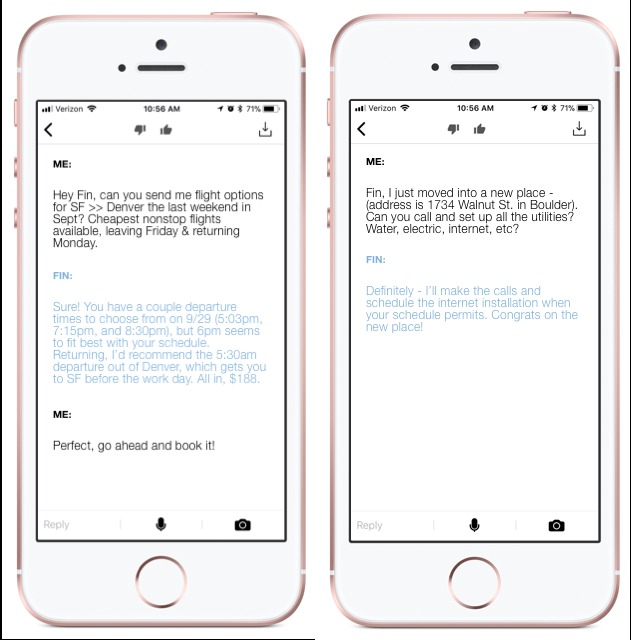
That combination solved a real problem. A conventional assistant sleeps, takes vacations and can only do one thing at a time. Fin operated continuously. When one worker learned a better rental-car trick, the shared system could make every worker better. The customer bought freedom from context switching - the psychic tax of leaving focused work to spend 40 minutes arguing over a fee.
Published working rate
Historical plans also appeared around $20 and $270 a month with credit. Reviews placed many ordinary requests between $8 and $30.
Then the minute hand started talking
The price exposed the architecture. Fin generally charged for the human time a task should take. A simple request might be cheap; an ambiguous request could require research, several calls and a customer clarification. Flat pricing was vulnerable to heavy users and freakishly difficult jobs. Time-based pricing was fairer to Fin, but left customers uncertain about the bill.
This was what failed first: not interest, and not even the quality of the experience, but the fit between open-ended service and mass-market willingness to pay. Kortina later wrote that the team was efficient, yet the assistant remained more expensive than most customers wanted. Unlike pure software, it could not be parked in maintenance mode. Every day required staffing, training, quality control and fresh judgment.
The timing makes the decision more instructive. Fin said its final quarter of 2018 was its strongest for growth and usage. Thousands relied on the service, and direct operations costs had reached break-even. Founders are supposed to follow growth. Fin followed the internal evidence instead.
The camera behind the curtain
To operate the assistant, Fin had built a way to watch work closely. Its system captured screen video and a stream of clicks, scrolls and application changes. Managers could replay a task, find where an error began, compare strong and weak workflows, annotate the footage and decide whether the fix belonged in training, process, software or automation.
The product hiding inside the product
This was operational game tape. A sports coach would never judge a player only from the final score, yet many support leaders saw only outcome metrics: handle time, satisfaction, cases closed. Fin Analytics connected the outcome to the path. The founders had gone looking for an assistant and accidentally built the missing replay booth.
Companies noticed. In late 2018, dozens expressed interest in using the measurement tools. In January 2019, Fin shut the consumer service and concentrated on analytics. The new customer was not a busy individual but a support or contact-center leader managing teams across Salesforce, Zendesk and a thicket of other applications. The price moved from dollars per errand to roughly $1,000 through more than $10,000 per company each month.
Outcomes Fin reported in 2021
Publicly named customers included Coinbase, Airbnb and OpenTable. Coinbase used Fin while its contact-center staff moved home, then expanded it across the customer-experience workforce. In 2021, Fin announced $20 million led by Coatue, appointed former Twilio executive Evan Cummack as CEO and described itself as a Work Insights Platform. The positioning sat between workforce analytics, process mining and a consulting engagement - except the observer was continuous and the evidence could be replayed.
What is worth stealing
The most portable Fin idea is not “put a human behind the bot.” That can become an expensive disguise. It is to treat every human rescue as research. Record why the software failed, preserve the context needed for the next attempt, convert stable knowledge into checklists and feed the result back into the system. Fin's private joke was that AI meant “Always Improving.” It is a better operating instruction than a product label.
A second lesson is to price the labor honestly from the start. Fin's 2015 charter rejected the fantasy that negative gross margins would one day cross a magical line into profit. That honesty made the consumer proposition harder to love, but it revealed the actual constraint before subsidies could hide it.
And then there is the product-behind-the-product test. Ask which internal tool the team would panic without. Fin needed shared memory, routing, checklists and measurement because arbitrary requests created arbitrary failure. Of those tools, measurement traveled best: other operations teams had the same blindness, even if they had no interest in booking goat-milking appointments.
Where the lesson stops traveling
The model struggles when each task is worth less than the human review it requires, when requests are so rare that learning does not compound, or when screen capture creates unacceptable privacy and employee-trust costs. Workflow analytics also disappoints when managers collect surveillance instead of changing tools, training or process. A replay only matters if somebody is allowed to rewrite the play.
Fin's history ends less neatly than a startup parable. Public funding records disagree: one TechCrunch report, citing PitchBook, described a $30.75 million 2016 Series A; the company called its separate $20 million 2021 financing a Series A too. Its original web address now belongs to an unrelated payments company, while the old assistant survives in an archive assembled by Kortina for the builders who rediscovered agents after ChatGPT.
That archive is Fin's final product in miniature: a memory system passed to the next shift. It says that a capable assistant needs more than a clever model. It needs context, procedures, escalation, measurement and an economic reason for every pair of hands behind the curtain. The goat was funny. The tape was the business.