
In a field where the fashionable answer to every problem is a bigger battery, a small Sydney workshop has spent nearly two decades arguing the opposite - that the electric motor itself is the part worth reinventing, and that the winning move is to make it dramatically smaller.
Evans Electric Pty Ltd is not a household name. It employs a handful of people, operates out of an industrial address in western Sydney, and does most of its talking through spec sheets rather than press tours. Yet the company, founded by Paul Evans in 2006, has been working on one of the more consequential questions in electric propulsion: how much torque can you pull out of how little space?
Its answer is the axial flux induction motor - a design that flips the geometry of a conventional motor on its side and, in Evans Electric's telling, delivers the same peak torque as a standard Tesla Roadster AC induction motor in roughly one-third the volume. That claim, backed by a granted US patent and a run of increasingly specific product announcements, is the reason a two-person company keeps showing up on global lists of axial flux manufacturers alongside firms with hundreds of engineers.
What Evans Electric Actually Does
At its core, Evans Electric develops electric machines and the systems that surround them. The company describes four competencies: axial flux electric machines spanning induction, permanent-magnet and hybrid topologies; high-force electromechanical actuators built to replace hydraulics; silicon-carbide power electronics and control software; and systems engineering that takes a customer from concept feasibility through advanced prototyping.
The through-line is torque density - the amount of twisting force a motor can produce per unit of size and weight. Conventional radial motors, the cylindrical workhorses inside most cars and appliances, route their magnetic flux outward through a bulky steel yoke. Evans Electric's axial design sends flux straight across a flat air gap between a double stator and a single spinning rotor. Strip out the yoke, use a solid copper disc for the rotor, and the machine gets short - the axial length collapses, and with it the volume.
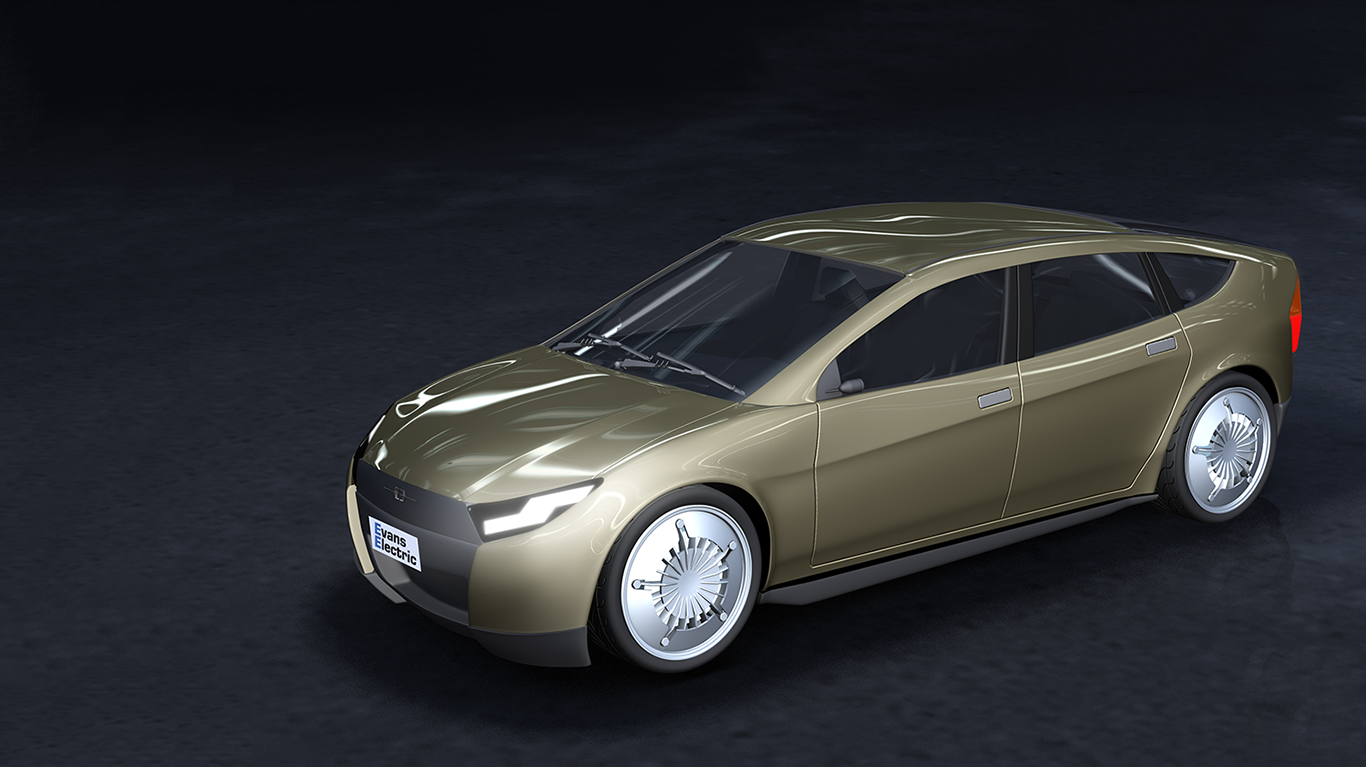
The commercial catalogue reflects that physics. Evans Electric says it can build motors for everything from P2 hybrid modules through to fully integrated dual-motor eAxles and eBus and eTruck hub motors. The flagship, the AFIM-SMC-400, is quoted at 720 Nm of peak torque and 360 Nm continuous, built around a yokeless copper rotor and a high-efficiency soft magnetic composite core.
| Peak torque | 720 Nm |
|---|---|
| Continuous rated torque | 360 Nm |
| Architecture | Double stator, single rotor, axial air gap |
| Rotor | Yokeless solid copper disc (patent pending) |
| Core | High-efficiency soft magnetic composite (SMC) |
| Relative size | ~70% smaller than conventional equivalent |
Who Buys This, And Why
Evans Electric is a business-to-business operation. Its customers are the engineers who build vehicles and machines rather than the people who drive them: automotive OEMs and drivetrain integrators, bus and truck makers looking at in-wheel hub motors, aerospace and light-aircraft propulsion teams, and builders of heavy equipment, robotics and industrial systems where hydraulics are heavy, leaky and ready to be replaced.
The pitch to each is the same, translated into their units. For a carmaker it is torque vectoring and packaging freedom from an integrated eAxle. For a bus operator it is a hub motor that frees up chassis space. For an aircraft team it is power-to-weight. Evans Electric's real product is not any single motor - it is a topology that scales across all of them, which is how a tiny team credibly addresses markets that would normally each demand their own supplier.
eAxles & Hub Motors
Integrated dual-motor eAxles and eBus/eTruck wheel-hub motors for passenger and commercial EVs.
Electric Propulsion
High power-to-weight axial flux machines aimed at light aircraft and aerospace propulsion.
Actuators
High-force electromechanical actuation systems designed to displace hydraulic circuits in heavy equipment.
SiC Electronics
Silicon-carbide inverters and control software, including torque vectoring and drive-by-wire.
The Problem It Is Solving
Electrification, the company likes to point out, is transforming every industry - and each of those industries hits the same wall. Electric machines are heavy, they run hot, and packaging them into an existing vehicle or airframe is a compromise. A motor that is 70% smaller changes the arithmetic: it leaves room for more battery, or a lower floor, or a lighter aircraft, or a robot arm that no longer needs a hydraulic pump behind it.
There is a thermal catch, and Evans Electric knows it. Peak torque is easy to quote and hard to sustain, because heat is the enemy of any compact motor. This is where the silicon-carbide controllers and the soft magnetic composite core matter - SiC switches run efficiently at high frequency and temperature, and the SMC core reduces losses. The continuous 360 Nm figure, not the 720 Nm peak, is the number that tells you the design holds up under real load.
How It Differs From Its Competitors
Axial flux is having a moment. Mercedes-Benz owns YASA; Renault backed Whylot; Koenigsegg has its Quark and Terrier motors; and integrators such as BorgWarner, ZF and Vitesco sell eAxles by the container-load. Against that, Evans Electric is a rounding error on headcount.
Two things set it apart. The first is the rotor. Most axial flux players lean on permanent magnets - powerful, but dependent on rare-earth supply chains and expensive to source. Evans Electric's headline machine is an induction motor with a solid copper disc rotor, sidestepping magnets entirely. The second is longevity of focus. The company has been iterating on this one architecture since 2006, with a granted US patent (8,393,443) and further filings pending. In a field crowded with recent entrants, that patient, single-problem persistence is its own moat.
Business Model And Expertise
Evans Electric makes money the way deep-tech hardware shops do: designing and prototyping machines for customers, offering systems-engineering and feasibility work, and building an intellectual-property portfolio that can be licensed. The 2018 Series A - a modest US$750,000 by the standards of the sector - reads less like a growth round and more like fuel for a founder-led lab that has kept its burn low and its patents current.
The expertise is narrow and deep. This is not a company that also dabbles in software platforms or consumer gadgets. It is electromagnetic design, rotor mechanics, thermal management and power electronics - the unglamorous physics that determines whether an electric vehicle is good or merely electric. For an OEM that wants a compact motor without building an electromagnetics team from scratch, that focus is the selling point.
Where It Fits In The Market
Evans Electric sits at the specialist end of the electric-machine market: a technology and IP house rather than a volume manufacturer. Its natural role is to license or co-develop with larger players who own the assembly lines and customer relationships, contributing the one thing that is hardest to buy - a genuinely differentiated motor architecture with patents around it. Whether the axial flux wave lifts it or the giants simply out-scale it is the open question. What is not in doubt is that the underlying bet - smaller, denser, magnet-free - is aimed squarely at where electrification is heading.
A Timeline
Evans Electric founded
Paul Evans establishes the company in Sydney to develop advanced electric machines.
Core patent granted
US Patent 8,393,443 is granted, protecting the axial flux motor architecture.
Axial flux EV motor previewed
The company reveals a next-generation motor claiming a 70% size reduction.
Series A funding
Evans Electric raises US$750,000 to advance motor and controller development.
AFIM-SMC-400 & dual-motor eAxle
Launches a 720 Nm axial flux motor and a fully integrated dual-motor eAxle with SiC controllers.
Frequently Asked
What does Evans Electric make?
High torque density axial flux induction motors, integrated dual-motor eAxles, silicon-carbide motor controllers and electromechanical actuators for electric vehicles, aerospace, heavy equipment and industry.
What is special about its motor technology?
Its axial flux induction motor uses a double-stator, single-rotor axial air-gap design with a patented solid copper disc rotor, achieving roughly the same performance as conventional motors in about one-third the volume.
Who founded Evans Electric and where is it based?
It was founded by Paul Evans (Founder & CEO) in 2006 and is based in Sydney, New South Wales, Australia.
How much funding has it raised?
Public records show a US$750,000 Series A round closed in May 2018.
What are the AFIM-SMC-400's specs?
It delivers 720 Nm peak torque and 360 Nm continuous, using a yokeless copper rotor with a high-efficiency SMC core.
Follow Evans Electric
Official channels, video and further reading