Before Erik Asgeirsson spent his days helping accountants work with new technology, he taught high school science in Tanzania. His Peace Corps service ran from November 1993 to December 1995. Along the way, he helped build two town libraries. It is a useful opening chapter for someone whose later career would involve a similar practical question: how do you get useful knowledge into the hands of people who can do something with it?
The comparison has limits. A library and an accounting platform are different undertakings. But both require more than a persuasive demonstration. Someone has to organize the thing, make it available, and give people a reason to return. A shelf of books can sit unopened. So can a software subscription. The purchase is the easy part of the story.
Asgeirsson is now president and CEO of CPA.com, where he was part of the original founding team. His career has stretched across several versions of the technological future: the internet portal, cloud accounting, digital audit tools, and artificial intelligence. Through all those changes, one question keeps recurring. Once a machine can do more of the work, what should an accountant do with the time?
A science teacher enters the accounting business
His preparation was an unusual fit for an accounting company. He studied electrical engineering at George Washington University and later earned an MBA in finance at New York University’s Stern School of Business. At AT&T, he worked across business development, operations, and product management. That put him on the technology and commercial side of the conversation before he joined the organization that became CPA.com.
The early job titles help explain the path. He was vice president of professional services at CPA2Biz from 2000 to 2002, then became CEO in 2002. These were years when a professional association’s internet business could still be described as a portal without sounding like an archaeological discovery. The name CPA2Biz itself belongs to that particular moment in internet optimism.
There was a concrete commercial idea beneath the name. Accountants already had relationships with businesses. Online services could give those relationships more reach and more uses. A trusted adviser might help a client do more than complete a return or close the books. Technology could make additional services practical. Asgeirsson’s work would become an extended effort to turn that proposition into something firms could deliver.
He has also described a lesson from his Peace Corps years in terms of perseverance and perspective. That is a more measured account of progress than the usual technology launch language. It leaves room for setbacks, adjustments, and the possibility that the person explaining the new system still has something to learn.
When a portal was a business plan
In 2001, the planned CPA2Biz offering mixed familiar professional needs with ambitious online possibilities. Continuing education and information sat alongside plans for payroll, administrative services, and ways for accountants to help clients participate in electronic commerce. The vocabulary has aged. The underlying ambition is recognizable: put useful capabilities close to the professional relationship.
The venture attracted substantial backing. Microsoft and Thomson committed a combined $50 million to the portal project. Its intended audience included accountants and the businesses they advised. At a time when moving a business process online was itself a selling point, the plan extended well beyond putting a brochure on the web.
That history gives Asgeirsson’s current work some useful scale. He has been working on the relationship between software and professional services since before today’s AI vocabulary existed. The tools have changed considerably. The organizational problem has proved more durable: a firm has clients to serve this week while someone is asking it to reconsider how it will earn its living next year.
- 1993-95Peace Corps science teaching in Tanzania
- 2002Becomes CEO of CPA2Biz
- 2020AICPA Town Hall begins; .cpa launches
- 2023Dynamic Audit Solution commercial launch
- 2026AI and business model change remain central
The cloud needed a different sort of firm
Cloud accounting made it easier for firms and clients to work with shared financial information. It also helped establish client advisory services, or CAS, as a distinct practice area. CPA.com became closely associated with that development. The attraction was straightforward: an accountant with better access to current information could have a more useful conversation about a business.
The important word is “conversation.” A business owner rarely wakes up yearning for a more elegant ledger. Questions about cash, hiring, investment, and the next few months have a stronger claim on the morning. Accounting information becomes more valuable when someone can connect it to those decisions. CAS gave firms a way to build an ongoing service around that work.
The 2024 CPA.com and AICPA PCPS benchmark survey reported 17% median growth in CAS net client fees among respondents, compared with 16% in the 2022 survey. Those figures describe participating practices, rather than every accounting firm. Even with that qualification, they give a tangible shape to a category that once needed explaining.
Median growth in CAS net client fees reported by respondents in the 2024 benchmark survey.
Survey editions shown. Respondent results, not a market-wide growth estimate.For Asgeirsson, the lesson carried forward into AI is that firms have to reconsider staffing, services, and business models together. Software can make a task possible; it cannot decide how a practice should organize itself around that task. There is no download button for a working business model, an omission that must disappoint a fair number of conference attendees.
A microphone with a practical purpose
AICPA Town Hall added another dimension to his work. He co-founded the broadcast in 2020 and became one of its hosts. Its early programming helped accountants work through business relief questions, including the Paycheck Protection Program. The profession needed timely explanations that could travel quickly from technical specialists to firms and then to business owners.
In 2021, he described the previous two years as a defining moment in helping firms act as trusted advisers to millions of businesses. That emphasis matters. The achievement he chose to discuss was the work accountants could do for their clients. A broadcast audience was a means of getting that work done.
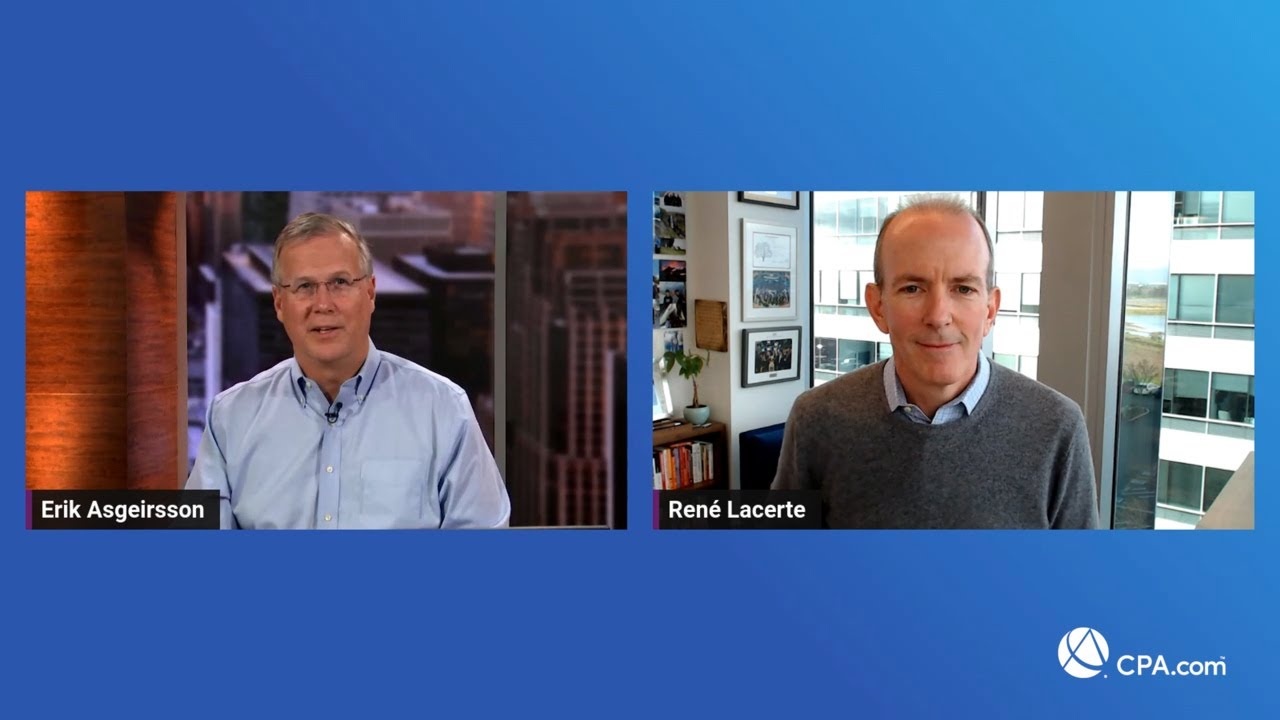
The format also gave him a way to bring technology executives into discussions of immediate business problems. In March 2023, he spoke with BILL CEO René Lacerte about the Silicon Valley Bank collapse. Their discussion covered payment continuity, banking relationships, and how firms can preserve trust during uncertainty. These are subjects that make the phrase “advisory services” feel less abstract.
By October 15, 2026, the Town Hall agenda included a discussion with Withum’s Jim Bourke and CBIZ’s Peter Scavuzzo about emerging AI capabilities and changes to firm business models. The program had kept its connecting role while the questions changed. A regular broadcast gives a profession somewhere to bring its unfinished thinking.
Trust has an address. Audit needs a method.
Some of Asgeirsson’s projects concern details that are easy to overlook until they matter. The .cpa internet domain is one. Launched for licensed firms in September 2020, it offered a restricted digital address tied to the profession. He oversaw its global rollout. The proposition was to carry professional identity into an online setting where a convincing name alone proves very little.
His explanation of the domain focused on verification, branding, and trust. That is a different technological problem from automating bookkeeping, but it belongs in the same career. As more business moves online, people need ways to recognize the professionals with whom they are dealing. Three letters after a dot are a small place to put that ambition.
Audit presents a larger design problem. Asgeirsson co-sponsors the Dynamic Audit Solution initiative, developed through the AICPA, CPA.com, and Caseware. Commercially launched in June 2023, DAS combines cloud technology with a risk-focused methodology and guided workflows. The project asks firms to consider how an audit is conducted, alongside the software used to conduct it.
That distinction has consequences. A familiar procedure transferred to a screen can remain a familiar procedure. Changing the method requires training and adjustments to how people work. CPA.com’s own comparison of OnPoint Audit and DAS makes the difference explicit: the former improves steps in an existing methodology, while DAS involves more foundational change.
The latest machine, the familiar question
At Digital CPA in December 2025, Asgeirsson returned to the relationship between people, process, and technology. The conference theme was “growth by design.” It is a useful phrase because it assigns some responsibility to the firm. Growth is something to organize for, rather than something that arrives with the next product announcement.
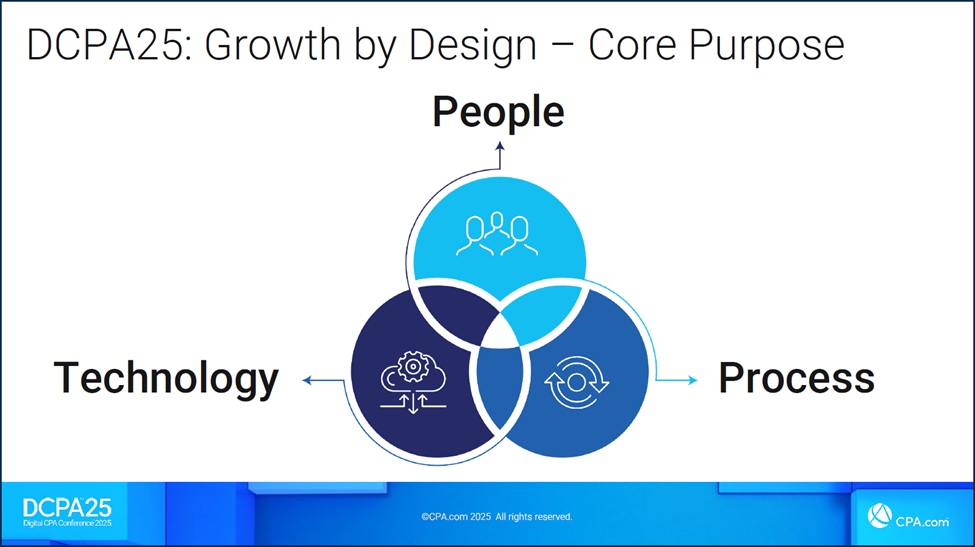
His 2026 outlook includes productivity gains, new services, changes to training and pricing, and opportunities for firms of different sizes. Those are expectations about what AI may enable. They still have to survive contact with an actual practice, its clients, and its budget. The interest lies in what firms choose to build with the available capacity.
“You’re going to be able to provide better outcomes.”
That is a useful standard for a technology executive to volunteer. An impressive demonstration can win a room for an afternoon. A better outcome has to mean something to the client when the meeting is over.
Outside work, his public biography places him in Rye, New York, with his wife, Claudia, and their four daughters. He enjoys sailing and skiing. Those details give the conference speaker a life beyond the stage, without requiring a theory about what a sailboat teaches a CEO. Sometimes a person simply likes sailing.
The Tanzania classrooms and libraries remain a more telling early detail. Long before the cloud became a business category, Asgeirsson was doing work that involved making knowledge usable. His later career has given that question different settings and much larger networks. The test remains appealingly ordinary: after the explanation, can someone do something useful?