Two thousand microservices is an awkward number of things to introduce to the internet. Each needs traffic to arrive at the right place. Each can move, multiply or disappear. Emile Vauge was working on a platform of roughly that size when he encountered a chore that would eventually become a company: keeping the traffic directions up to date.
He was a developer with a practical complaint. The applications were becoming dynamic; the machinery directing requests toward them demanded too much attention. A system designed to make deployment easier had left someone holding a configuration file. Vauge decided that the software ought to do more of its own housekeeping.
In 2015, he began writing Traefik, an open-source reverse proxy in Go. In 2016, he founded the business behind it. By July 2026, he was reporting 3.5 billion pulls of its official Docker image and a thousand contributors. Along the way came venture investors, a change of company name and a move from CEO to CTO. There were also cheeses. We will get to the cheeses.
The chore that refused to scale
Vauge’s career had already taken him through substantial engineering environments. He attended EFREI between 2000 and 2004, worked as a lead developer at Airbus from 2006 to 2009, and later held development roles at payments company Lyra Network and consultancy Zenika. The route to Traefik ran through the daily business of making software function.
A reverse proxy receives a request and sends it toward the appropriate service behind it. That sounds modest until the services keep changing. Containers made it easier to start and replace pieces of an application. The traffic controller needed to learn about those changes quickly enough to remain useful.
Traefik’s approach was to connect to the systems managing those services, discover what was running and adjust its routing automatically. The original documentation described services being added, removed, replaced or upgraded, sometimes several times a day. The proxy would listen for those changes. Routes would follow.
The appeal was partly architectural and partly merciful. Every configuration step handed back to software was a step a person could stop repeating. Vauge’s early ambition was concrete enough to test: could the proxy keep pace with the environment around it?
appear / change / disappear↓Traefik
discovers & updates routes↓Requests
reach the right service
A side project acquires a public
On September 22, 2015, Vauge posted Traefik to Hacker News. He later recalled that it reached the front page and attracted a community within weeks. He had expected the prototype to interest a few people. Instead, other developers recognized their own routing problems in it.
He left his job and formed a company to work on the project full time. That order matters. The public tool existed before the business built around it. People could try the software, examine its decisions and tell its creator where it failed them. Interest arrived with a useful degree of specificity.
“I am a software developer that became an entrepreneur by accident,” Vauge said in 2022. The description leaves room for the less accidental work that followed: answering questions, organizing contributions and deciding what to build next. An unexpected audience still requires someone to keep the doors open.
His public explanations have stayed close to that developer identity. Automation is the recurring preference. When discussing the expanding cloud-native toolset, he has argued that products should simplify the jobs of the companies adopting them. An additional feature has to justify the additional work it brings.
“Simplicity will win in this ecosystem.”
Emile Vauge
Capital, with a cheese course
The business was initially called Containous. In February 2017, Vauge announced a €1 million seed round led by Elaia Partners, 360 Capital Partners and Kima Ventures. The same post reported more than 6,500 GitHub stars and three million downloads during 2016.
It also announced, with considerable disregard for conventional investor relations, a plan to release more cheeses and the purchase of a factory to double production. Traefik 1.0 had been named Reblochon; version 1.1 was Camembert. The funding announcement carried the joke into the company’s supposed industrial strategy. Load balancing had acquired a dairy department.
Underneath the joke sat a familiar open-source business question. Vauge wanted transparency and a community’s help developing the product. He also needed the resources to employ people and sustain the work. In 2018, he described convincing investors to back an open-source company in France as one challenge, and finding a way to monetize it as another.
By January 2020, Containous had announced a $10 million Series A led by Balderton Capital, with existing investors Elaia and 360 Capital Partners participating. In September, the company adopted the name Traefik Labs. The project’s name had become the business’s public identity.
Vauge’s ambition in that period was to let application teams spend less time on networking. The company expanded beyond the original proxy, while he emphasized that its open-source roots would remain central. The useful promise was still time returned to the people building applications.
The people behind the pull requests
A growing audience creates its own version of the original problem. Questions, bug reports and proposed code changes arrive faster than a small team can handle them informally. By 2022, Vauge was describing the structures Traefik had added: automated processes, hired maintainers, clearer documentation and an openly communicated roadmap.
These are unglamorous achievements. They determine whether a contributor gets an answer, whether a change can be reviewed and whether the project remains comprehensible to someone joining tomorrow. Software may be available to everyone while the practical ability to help improve it depends on careful organization.
Vauge has also described the work of running a team across countries and time zones. In 2020, he put the company at roughly forty people in seven countries, using written, asynchronous communication. He shifted his own work later in the day to overlap more easily with colleagues in the United States. A distributed company needs its information to travel without everyone attending the same conversation.
The project continued growing. In July 2026, Vauge welcomed Kangmin Kim and Nándor Kollár as maintainers while marking the thousandth contributor. He placed particular weight on that human count. Download totals recorded adoption; contributions represented people taking part in the project’s upkeep.
Two different measures: image fetches and people contributing code. Pulls are not a count of unique users.
A different seat at the same workbench
On February 1, 2024, Traefik Labs announced a leadership change. Sudeep Goswami, its chief revenue officer, would become CEO. Vauge would become chief technology officer, concentrating on product development, community development and innovation.
It was a clear division of responsibilities at a company whose founder had begun by writing a tool for himself. Goswami’s brief centered on growth and customer success. Vauge’s kept him close to the product and the people helping develop it. The announcement did not require a departure from the company for its founder to take a different job within it.
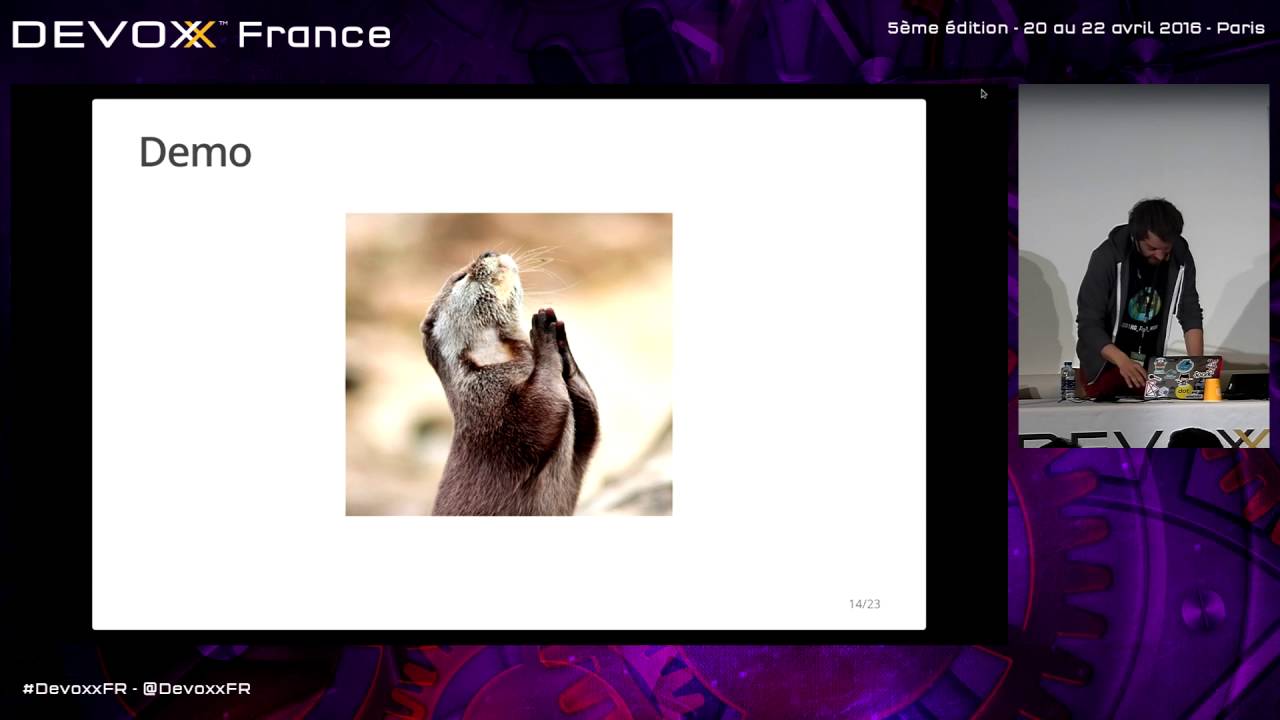
He remained visible in technical discussions. In 2024, a Linux Foundation session had him walking through Traefik 3.0, including OpenTelemetry, Kubernetes Gateway API and WebAssembly plugins. At Devoxx France in 2025, he and maintainer Nicolas Mengin presented Gateway API and demonstrated exposing APIs through the standard.
His release notes offer smaller clues to what catches his attention. Writing about the Traefik v3 release candidate, he singled out its new logging system as a personal favorite. He also credited external contributors for substantial features and asked users to test the release. Even in an announcement, there was room for an engineering detail and an invitation to help.
That work keeps the founder in contact with a particular kind of audience: developers who need to know how a change affects the systems they already operate. A presentation can announce a feature. A demonstration must deal with what happens when somebody actually uses it.
Check your ridges
In August 2026, a more personal problem appeared. Vauge, who said he lives in the Alps, was planning around the solar eclipse of August 12. At his location, the Sun would be about three degrees above the horizon at maximum eclipse. The terrain in that direction rose to seventeen degrees.
The mountain was going to win.
He built Moonshadow, a tool that reconstructs the local horizon from elevation data and maps where the eclipse can be seen. He said its calculations ran in the browser, on the user’s GPU, without a backend. The project began with the search for his own viewing spot.
It is an appealing companion to the Traefik story. In each case, an available tool met a real environment and an awkward assumption became visible. Vauge’s response was to write something that accounted for it. A mountain is less accommodating than a configuration file, but both reward checking the details.
The next request
His current technical interests reach into AI infrastructure. In September 2026, Vauge introduced Traefik Hub’s Sovereign Trust Plane, arguing that organizations need verifiable records of agent actions: who authorized an action, which policy applied and whether the record was subsequently altered. He distinguished that evidence from the traces engineers use to investigate performance and incidents.
He also stated a limit: a gateway can observe communication boundaries without explaining an agent’s internal reasons. It is a useful boundary to draw in a field where product descriptions can grow considerably more ambitious than the software beneath them.
The work has expanded from container routing to API management and AI traffic. Vauge’s recognizable preference remains a practical one: put the machinery where it can take a repetitive burden off somebody’s hands. The result may be a company or a small eclipse application. Either way, there is usually something more interesting to do once the directions have been sorted out.