The trouble with a sentence is that it can be perfectly grammatical and still fail. It may be stiff, vague, overconfident or simply unlike the thought its writer hoped to express. Dmytro Lider built a career in that small, stubborn distance between intention and understanding. The Ukrainian software engineer co-founded Grammarly in Kyiv in 2009 and later led the research strategy and technical product work behind its natural-language analysis engine. His job was not merely to catch the dangling modifier. It was to help a machine notice when language had taken a wrong turn.
That is a curious vocation for someone who has kept his own public language spare. Lider is not a founder who has turned breakfast into a thread, a podcast and a leadership framework by lunch. His verified public footprint is compact: a LinkedIn profile, a handful of comments, company biographies and a few interviews. The restraint makes the available sentences matter. One of them is particularly revealing: he believes work should be energizing and joyful, done with people who share a sense of purpose.
The phrase could serve as the legend for a career that has moved through plagiarism detection, language AI, team culture and, after Russia's full-scale invasion of Ukraine, the supply and repair of vehicles for Ukrainian forces. On paper these pursuits look unrelated. In practice they share a mechanic's logic. Find the point where a system fails a person. Open the casing. Make it useful again.
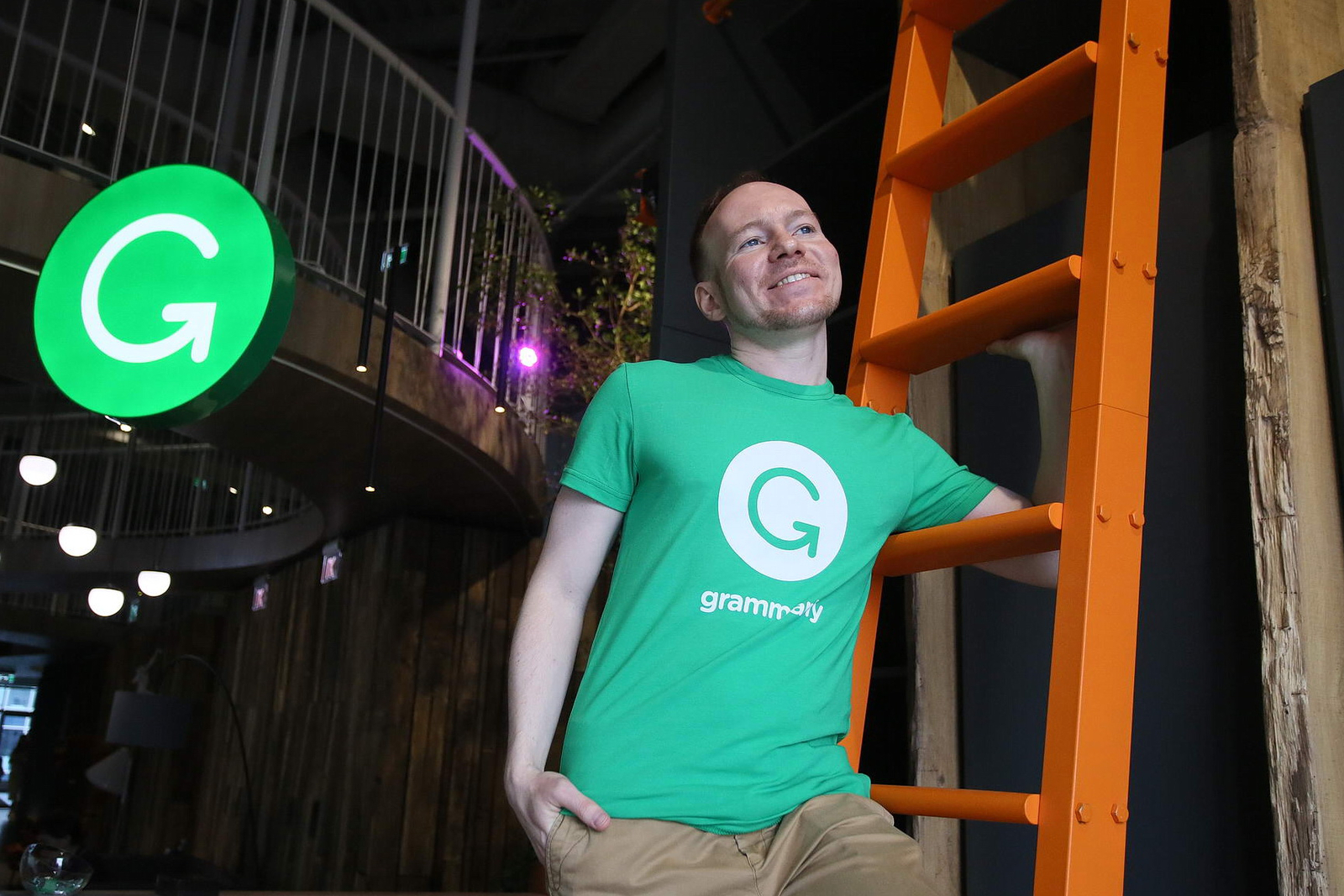
The advantage of writing from outside
Lider studied computer science at National Aviation University from 2000 to 2004, then completed a master's degree in software engineering with honors in 2006. Before Grammarly, he worked as a software engineer and project lead at MyDropBox, the plagiarism-detection company created by Max Lytvyn and Alex Shevchenko and later acquired by Blackboard. The earlier product did something defensive: it found borrowed language. The next product would try to make original writing less forbidding.
The founding insight came partly from being outsiders to English. Lider, Lytvyn and Shevchenko all had experience expressing themselves in a second language. They knew the strange indignity of possessing a sound idea and watching it emerge in an ill-fitting sentence. They also saw a connection between that difficulty and plagiarism. Copying a finished paragraph can be tempting when composing one feels like a private wrestling match with the dictionary.
Their new service was first called Sentenceworks and sold to the education market they already understood. It began as a subscription product for students. Cloud computing made a different kind of checker possible: rules could evolve centrally, processing did not have to live on a user's PC, and the software could learn to address language in context. The team later chose the name Grammarly and moved toward anyone writing English online.
“People now judge us by how we talk digitally.”Dmytro Lider, 2018
Lider explained the opportunity with the economy of someone who had spent years looking at crowded inboxes. People were sending messages at remarkable frequency, he observed, with less time to polish them. Digital writing was becoming both casual and consequential. An awkward phrase in a private notebook harms no one. An awkward phrase in a message to a colleague can consume an afternoon.
A machine needs judgment, and a team needs empathy
As head of language technology, Lider stood where research met the product. The title covered strategy for the natural-language engine and the technical decisions that turned linguistic research into suggestions appearing on a screen. That distinction matters. Research can prove that a system detects a pattern. Product work asks whether interrupting a writer about that pattern is helpful, distracting or faintly insulting.
Grammarly expanded from spelling and grammar toward clarity, tone and style. By 2018 it served 10 million daily users. By 2021 the figure was about 30 million, and a $200 million financing round valued the company at a reported $13 billion. Its latest public biography puts reach above 40 million users and 50,000 organizations. In 2025, after acquisitions of Coda and Superhuman Mail, the parent company adopted the Superhuman name. Grammarly remained the writing product at the center of the suite.
The company had made an unfashionably sensible decision early. In 2010, the three founders met Brad Hoover, then an investor who had discovered Grammarly while looking for help with his own writing. They asked him to become chief executive. Rather than spending the next decade treating the corner office as a birthright, the founders divided their attention among product, technology and revenue. Headquarters moved to San Francisco in 2012, while Kyiv remained an important engineering center. Lider's role suited this arrangement: close enough to research to understand what the system might do, close enough to product to decide what it ought to do, and largely absent from the theater of founder celebrity. It was a structure built around comparative advantage, a phrase that rarely looks glamorous on a conference screen but often looks excellent in a functioning company.
Scale, though, creates the problem Lider had already identified inside language: a technically correct system may still fail a person. His public comments on culture return to empathy with unusual specificity. He defined it as actively listening, putting oneself in another person's position and responding accordingly. His preferred formulation was more demanding than the golden rule: “Treat others as they want to be treated to work well together.”
At Grammarly, that idea was turned into procedure. Bias-awareness training became part of onboarding, with self-study, discussion and role play. The company repeated surveys to measure the effects and tried to make the workplace safe enough for people to raise disagreements and sensitive subjects. It is an engineer's version of kindness: good intentions are welcome, but a mechanism is better.
Built plagiarism-detection software at MyDropBox, working as an engineer and project lead.
Co-founded Grammarly with Max Lytvyn and Alex Shevchenko in Kyiv.
Helped open a larger Kyiv office as the product reached 10 million daily users.
Founded Autobots Ukraine after Russia's full-scale invasion.
Left Grammarly's operating team after a long sabbatical to focus on personal projects.
When the problem had wheels
In early 2022, elegant questions about digital communication collided with the material facts of war. Grammarly blocked access to its products and services in Russia and Belarus. It committed $5 million - the revenue it had received from those markets since 2014 - to organizations supporting Ukraine. Lider oversaw social-impact initiatives connected to the country. He also founded a nonprofit with a name that sounds like a children's cartoon and a task that could not be more adult: Autobots Ukraine.
The organization arranged vehicles for Ukrainian forces and repaired damaged ones. Its team opened a service station near the combat zone and offered temporary replacements while a vehicle was being fixed or another acquired. By September 2024, it had purchased 96 vehicles and repaired 80. These are modest numbers beside millions of software users, but the unit of measurement is different. A single working vehicle can alter what is possible for the people waiting on it.
Autobots Ukraine, counted in working vehicles
Published total through September 2024. Each bar records a vehicle put into service or returned to it.
The work gives Lider's comments about purpose a sharper edge. Shared purpose is easy to print on an office wall. It is more persuasive in a repair bay, where the question is neither philosophical nor optional. Does the engine start?
Leaving the sentence open
After a long sabbatical, Lider decided in January 2024 to leave his operating role at Grammarly and concentrate on personal projects. He remained publicly identified as a co-founder. The move arrived without an elaborate reinvention narrative, and the personal projects were not itemized. A private person had made a private decision, then disclosed the part that affected the company.
His technical record continued to surface in another form. A U.S. patent granted in December 2024 names Lider among six inventors of an AI communication-assistance system that can consider a recipient's capacity and recommend when to send a message. A related application was published in March 2025. The idea extends the old Grammarly question beyond what to say and into when another person is ready to receive it. Grammar finally meets timing.
There is also music. Lider enjoys traveling, singing and playing piano. It is tempting to turn this into an inflated metaphor about code and composition, so let us resist with dignity. We can safely say that both punish poor timing and reward listening.
Lider's public story ends, for now, without a grand finale. He helped build a product that moved from student essays into the daily language of millions. He argued that empathy belonged inside technical work. When his country needed machinery more literal than a language engine, he helped organize it. Then he stepped away from the role by which the industry knew him.
That open ending suits someone whose work has always lived before the final period. A draft can be repaired. A system can be reconsidered. A useful career can change subjects without losing its theme.