A software engineer can be excellent at the work and still be wrong for the vacancy. Perhaps the employer needs a different programming language. Perhaps it needs someone nearby. Or perhaps the work sits behind a door that requires an active U.S. government security clearance. In hiring, the small qualifying detail can become the whole story.
DHI Group has made a business of those details. Its two principal brands, Dice and ClearanceJobs, give recruiters places to search where the qualifications already have some context. Yet the company’s recent history contains a useful complication: knowing the right people does not guarantee that employers are ready to hire them.
- Two distinct audiences: technology professionals on Dice; the security-cleared workforce on ClearanceJobs.
- Employers pay: recruitment packages buy postings, candidate access and engagement tools.
- Different economic weather: in 2025, Dice revenue fell 17%; ClearanceJobs grew 1%.
- A wider cleared hiring business: AgileATS and Point Solutions Group extend DHI into applicant tracking and professional services.
A better address book, with an opinion
A general job site promises breadth. A specialist site must justify its narrower guest list. DHI’s argument is that a recruiter searching for a database specialist or cleared engineer needs more than a pile of résumés with impressive titles. The search has to distinguish the qualifications that make a candidate plausible.
Dice is the technology marketplace. Its listings span software engineering, systems administration, data work, project management and related occupations. The buyers include direct employers, staffing companies and recruiting agencies. Technology hiring happens inside banks, manufacturers and government contractors as well as software companies, so the audience is defined by occupation rather than the employer’s industry.
DHI says its patented algorithm manages more than 100,000 distinct technology skills. That number describes the breadth of its skills model; it should not be mistaken for a success rate. The proposition is practical: give employers a more precise way to describe what they need, then help them search for people whose profiles contain the relevant experience.
ClearanceJobs adds another kind of specificity. It serves professionals with active U.S. government security clearances and the defense, intelligence and government contracting employers seeking them. A clearance helps define the eligible pool, but it does not settle every hiring question. Skills, agency experience and program requirements still matter. The marketplace narrows the conversation before it begins.
Distinct technology skills. A vocabulary for recruiting, rather than a promise that every match becomes a hire.
The subscription has two sides
For candidates, the opening move is familiar: create a free profile, make experience legible, search vacancies and use career guidance. For employers, DHI sells recruitment packages that combine job postings with access to searchable candidate databases. Contracts can run annually, quarterly or monthly; the price varies with seats, posting types, profile views and terms.
There is also employer branding, sourcing help and career events. These services recognize that finding a name and persuading its owner to respond are separate jobs. A résumé database can produce a list. A recruiting operation has to turn that list into conversations.
The economics give some sense of the customer commitment. DHI reported average annual revenue per recruitment package customer of $15,795 at Dice and $26,420 at ClearanceJobs for 2025. These are realized averages across customers, not public sticker prices. A small employer’s quote cannot be read off those figures.
At the end of 2025, Dice had 4,132 recruitment package customers and ClearanceJobs had 1,775. During that year, the platforms averaged approximately 1.5 million and 967,000 monthly users respectively. Paying customers and users are different populations. The marketplace needs both: people worth contacting and organizations willing to pay to contact them.
One parent. Two forecasts.
The awkward part arrived in the numbers. DHI’s annual revenue declined from $141.9 million in 2024 to $127.8 million in 2025. Underneath that total, however, were two different businesses. Dice fell from $87.8 million to $72.9 million. ClearanceJobs edged up from $54.1 million to $54.9 million.
DHI attributed Dice’s decline to a difficult hiring environment: lower renewals, weaker new business and reduced activity in products outside annual packages. The problem showed up in customers’ willingness to buy and renew. Matching technology could improve the service without restoring an employer’s recruiting budget.
Management changed the organization accordingly. In January 2025, DHI announced separate operating divisions for Dice and ClearanceJobs, placing sales, marketing and product development under dedicated brand leaders while retaining centralized support functions. The announcement included an approximately 8% workforce reduction.
“a strategy tailored to their respective markets”Art Zeile, CEO, describing the January 2025 reorganization
Then came a larger reset. In June, DHI announced another restructuring that reduced its then-current workforce by approximately 25%, primarily in Dice and associated back-office support. The second-quarter charge was $4.2 million; management projected $14 million to $16 million in annualized savings. Those savings were a target, not a substitute for revenue growth.
The human cost belongs in the picture. DHI publishes workplace certifications and employee engagement results, including a 2025 Gallup survey reporting 57% engaged employees with 66% participation. Those disclosures describe one view of working there. The layoffs describe another. A company that helps people find work is still capable of eliminating work of its own.
Buying the work after the shortlist
ClearanceJobs’ expansion asks a different question: once a recruiter has found the candidate, what else must happen? Someone has to manage the application, keep records, coordinate the hiring process and, sometimes, supply the professional services that a contract requires.
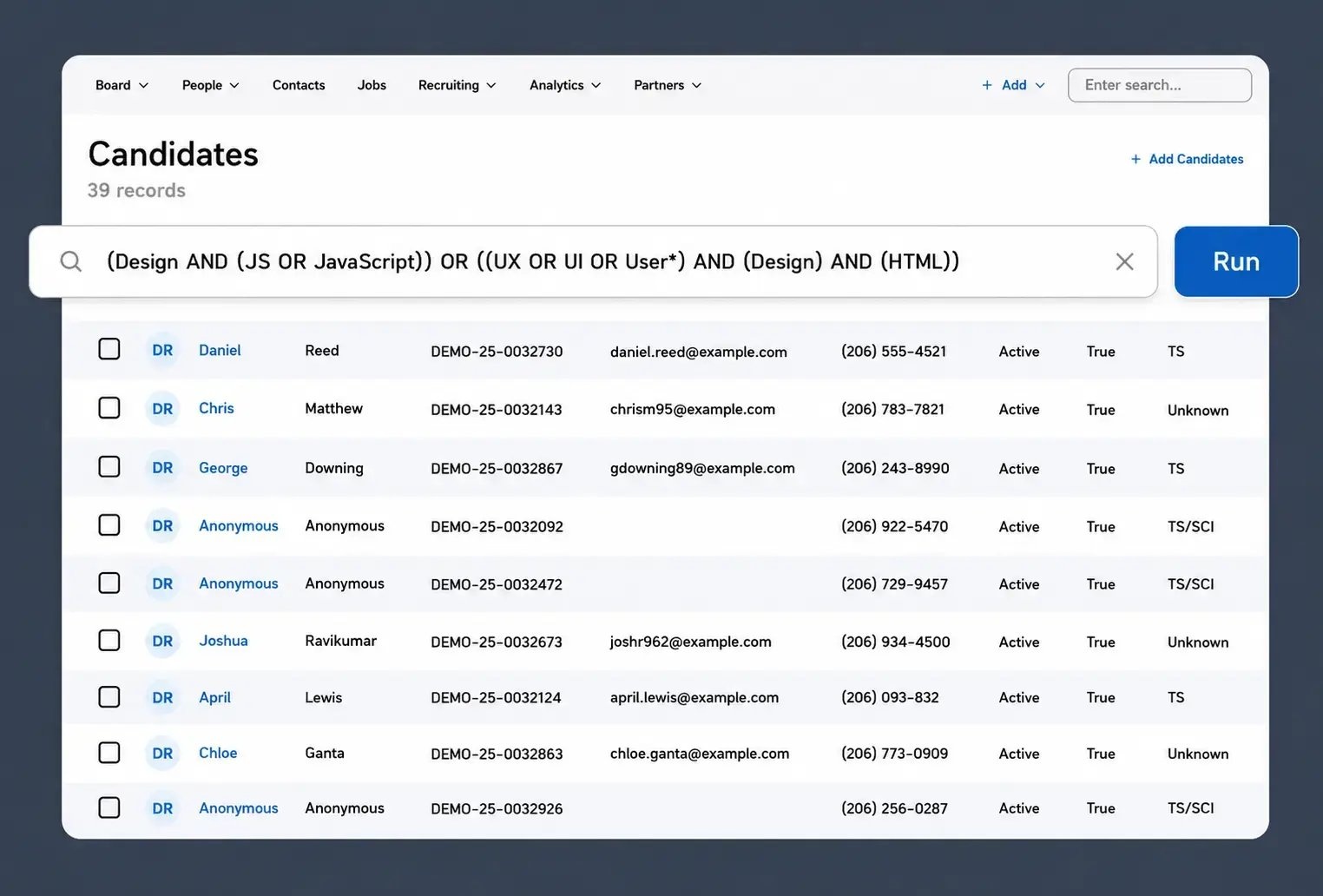
DHI acquired AgileATS in 2025 for an announced estimated price of about $2 million. The applicant tracking system is built for government contractors and cleared hiring. Its tools include résumé parsing, Boolean search, applicant workflows and compliance documentation. DHI was extending its position from candidate discovery into the employer’s operating process.
In February 2026, it acquired Point Solutions Group, an engineering and technology professional services firm focused on defense contracting and government staffing. The subsequent second-quarter filing recorded a $5.4 million purchase price. At the announcement, Zeile highlighted the firm’s Top Secret facility clearance and past performance on federal contracts.
That detail matters because the acquisition adds capabilities and contract experience, not merely more candidate profiles. It also introduces work with different operating demands from selling database access. Integration, service delivery and customer relationships now share the stage with marketplace software.
Distribution is changing too. The May 2025 Carahsoft agreement made that company ClearanceJobs’ public sector distributor, opening access through reseller partners and procurement contracts. For a government buyer, a useful service must also be purchasable through an acceptable route. The purchasing machinery becomes part of reaching the customer.
The lesson hiding in the filter
By the second quarter of 2026, the contrast was sharper: ClearanceJobs revenue rose 14% year over year to $15.6 million, while Dice fell 14% to $15.8 million. ClearanceJobs’ growth included the contribution of Point Solutions Group. DHI’s total revenue was $31.3 million, down 2%; the rounded segment figures do not add exactly to the rounded total.
LinkedIn, Indeed and ZipRecruiter remain alternatives, alongside agencies and employers’ own sourcing teams. DHI’s place in that market rests on focus: technology skills on Dice, cleared professional context on ClearanceJobs, and an expanding set of tools around that second audience. A narrow community can be commercially useful when its qualifications are hard to represent in a general search.
The copyable idea is to start with the attributes that make someone eligible, then follow the customer’s work beyond discovery. The conditions matter. If an employer is filling broad, nonspecialist roles, a general platform may suit it better. If hiring budgets disappear, more precise search will not produce an approved vacancy. And a bigger database is useful only while its information remains relevant.
Dice began in 1990 as a bulletin board service founded by former contractors Lloyd Linn and Diane Rickert. The machinery has changed considerably. The underlying problem is recognizable: help the right person and the right employer find each other. DHI’s recent experience adds a qualification of its own. They must both be ready.
Try the tools. Meet the communities.
DHI Group website ↗ · Find technology roles on Dice ↗ · Explore ClearanceJobs ↗ · AgileATS product ↗
DHI on LinkedIn ↗ · DHI on X ↗ · ClearanceJobs on Instagram ↗ · Dice on Facebook ↗
Dice career advice ↗ · ClearanceJobs news ↗ · Watch the AgileATS demo ↗ · ClearanceJobs interviews on YouTube ↗ · Dice on YouTube ↗