The best way into Dawson College is through a subway station. Step off Montreal's Green Line at Atwater, follow the sign and a public transit corridor deposits you inside a former convent that now receives roughly 10,000 full- and part-time students. Upstairs, a chapel has become a library. Outside, gardens, biodiversity plots and a young micro-forest turn a downtown block into field equipment. The building is a grand old machine for moving people between worlds: high school and university, classroom and career, French and English, stone corridor and living soil.
Dawson is a public CEGEP, the distinctly Quebec institution between secondary school and university or work. It was chartered in 1968 as the province's first English-language CEGEP and opened the next year with 1,500 students. Today it offers two-year pre-university diplomas, three-year technical programs, transition routes and continuing education. Science shares a roof with social service, nursing, theatre, industrial design, photography and computer science. The customers are students, but also the universities, hospitals, studios, firms and community groups that receive what those students become.
The productA college with four doors
It is tempting to describe a college by its course list. Dawson makes more sense as a set of four doors. The first is pre-university education: five broad programs and numerous profiles that prepare students for degree study. The second is technical education: three-year programs designed for the workplace, with the option of further university study. The third is transition, including Pathways for students missing prerequisites and Journeys for First Nations, Inuit and Métis students. The fourth is continuing education, where adults can take credit courses, earn an AEC, satisfy university prerequisites, seek recognition for existing skills or pursue non-credit training.
One public institution, four ways in
2 years
3 years
1 year
Flexible
The business model is public infrastructure, not venture capital. Provincial funding supports the core CEGEP mission. Governments fund major building work. Learners pay for some continuing and non-credit courses. The Dawson Foundation raises philanthropic money for student support and special projects. This matters because the institution's success is not measured by a valuation. Its useful outputs are completion, transfer, job readiness, access and the long tail of an alumnus who later returns as a partner.
That breadth is Dawson's market position. Montreal students can choose other English-language CEGEPs such as Vanier, John Abbott, Marianopolis or Champlain, alongside a large French-language network. Dawson's difference is the bundle: a central commuter location, direct metro access, an unusually wide program mix, a large multicultural population and a campus identity strong enough to make a very complicated building feel shared.
The old machineFirst, repurpose a convent
The motherhouse of the Congrégation de Notre-Dame was built between 1904 and 1908. Its architect, Jean-Omer Marchand, picked yellow brick so it would stand apart from the grey city around it. Dawson took possession in the 1980s, protected the trees, main entrance and chapel, then rebuilt most of the interior. According to David Wigglesworth, the architect who oversaw the conversion, 90 to 95 percent inside was demolished. Wings, gyms and engineering space followed. Dawson moved in during 1988; the last of its scattered campuses closed in 1997.
The chapel presented the delicious problem. Planners considered a cafeteria, theatre, agora and exhibition hall before making it the library. The choice still works because the room's original calm matches its new job. Brass rails, chandeliers and organ pipes survived. The building did not become a museum of itself. It kept teaching, which is the more demanding form of preservation.
“It continues to embody its vocation. Learning and teaching continues that was begun by Marguerite Bourgeoys.”David Wigglesworth, architect of the motherhouse conversion
The lesson is easy to steal: preserve the few elements that carry memory, then allow the rest of the building to earn its keep. The conditions matter. Adaptive reuse works when the structure is sound, transit and location create enduring demand, and public capital can pay for systems hidden behind the handsome brick. It fails when reverence turns every wall into an untouchable artifact or when an old envelope cannot meet modern ventilation, accessibility and circulation needs.
The operating systemMake the campus teach
Sustainable Dawson began in 2008. Over time, the college built an operating system it calls Living Campus: gardens, rooftop agriculture, biodiversity zones, a Peace Garden, indoor planting, waste work, certificates and student projects connected to class. The slogan underneath it all is “Well-being for All.” It sounds soft until one sees how aggressively Dawson applies it. Student success, community belonging and environmental health appear as nested parts of the same strategic plan.
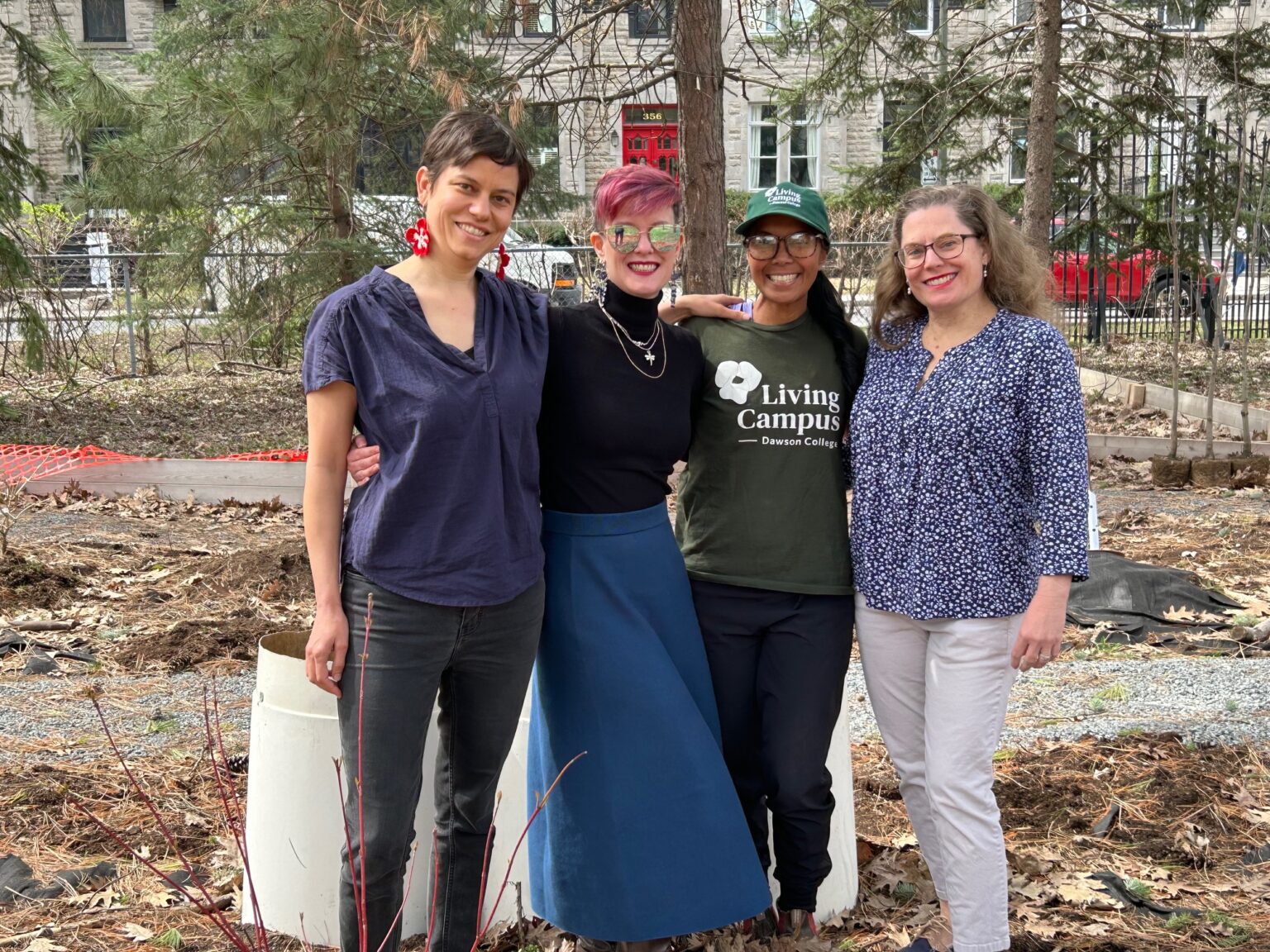
The micro-forest crew poses where the campus is learning to behave a little less like real estate and a little more like habitat.
What did they actually do? Facilities teams upgraded lighting and HVAC, added computerized air-flow and temperature monitoring, and kept reducing direct emissions. Students counted species, audited bins and worked in gardens. Dawson partnered with Taking Root to plant and monitor trees on marginal land in Nicaragua for the remaining carbon balance. The board voted in October 2018 to make the “Carbon Neutral Forever” commitment permanent.
The cost is unusually concrete. Completed efficiency work announced in 2019 received C$1.24 million from Canada and C$1.42 million from Quebec, about C$2.66 million combined. Dawson reported C$1.4 million in energy-cost savings over eight years, alongside 343 tonnes of carbon dioxide equivalent eliminated. These figures do not prove every project pays back neatly. They do show why the boring layer - meters, ducts, controls and maintenance - belongs beside the garden in any serious climate curriculum.
Offsets need the asterisk they always deserve. A tree planted elsewhere is not identical to a tonne never emitted at the building. Permanence, verification and the share of reductions versus offsets determine whether a neutrality claim remains useful. Dawson's sequence is the stronger one: reduce energy demand first, monitor the remainder, then use a forestry partner with traceable farms. A school that buys opaque credits while ignoring leaky systems should not borrow the slogan.
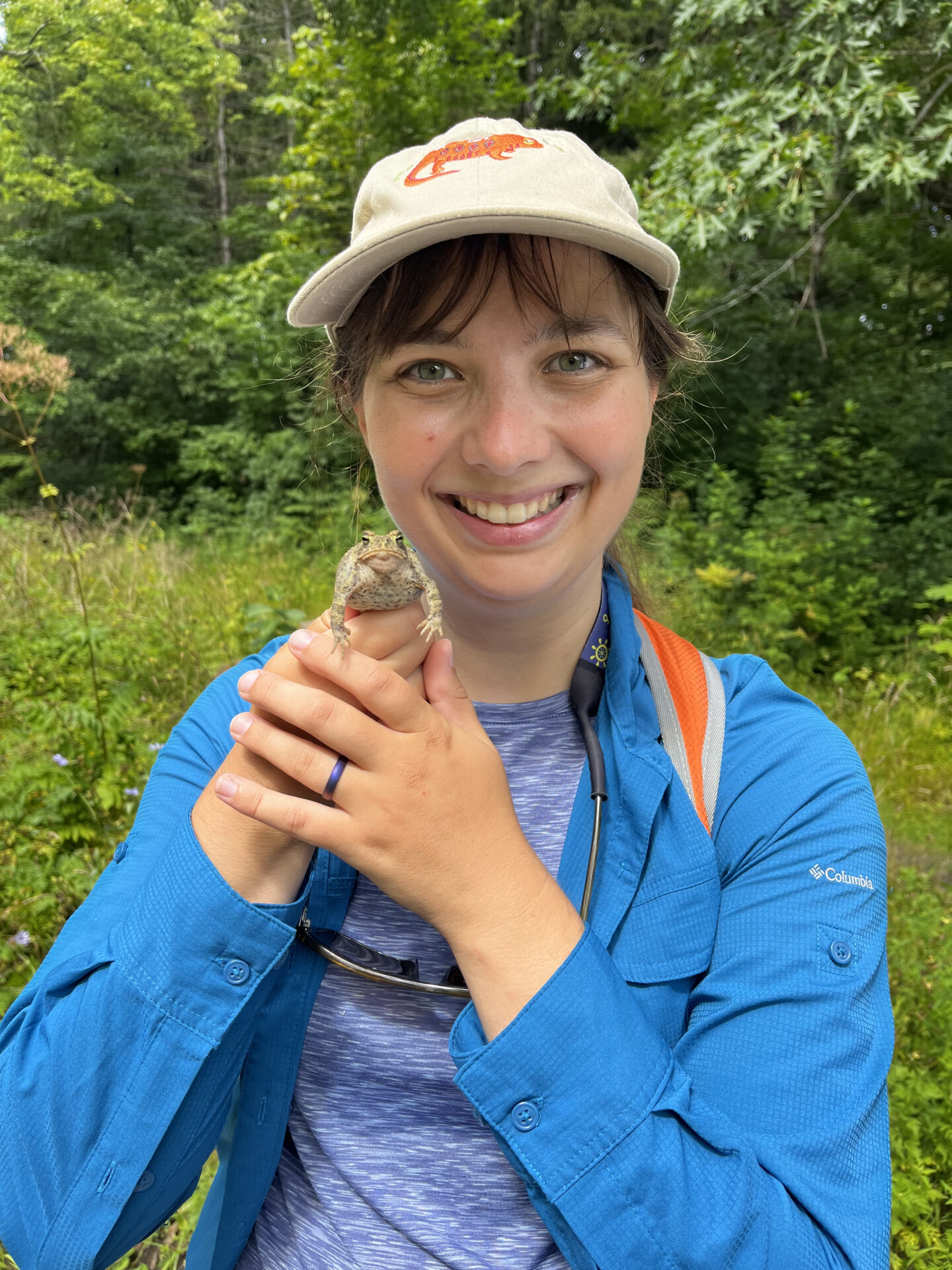
A field researcher meets the lake's smallest stakeholder. Dawson's biology work now feeds a five-year study of changing Canadian lake ecosystems.
The constraintIngenuity does not create floor area
The first thing to fail was not the Living Campus idea. It was the assumption that patient public planning would eventually produce more room. Dawson worked for more than seven years on a project to move health programs and a teaching clinic into another building. Quebec had assessed the college's space deficit at 11,200 square metres - more than ten ordinary office floors. In early 2022, the provincial government withdrew support and said resources would be redirected toward francophone students.
Dawson explored leasing and other options, but the underlying arithmetic remained. A crowded heritage building can be managed intelligently; it cannot be persuaded to contain another 11,200 square metres. This is where the model would not work: rapid enrollment growth, laboratories that demand specialized infrastructure, accessibility retrofits without capital or governments unwilling to support English-language capacity. Student-led energy can improve a place. It should not become an excuse to underfund it.
The cancellation also clarifies what competition means in Quebec education. Dawson competes for applicants, faculty and reputation, but it depends on political decisions about language, public investment and network capacity. Its strategic answer has been to emphasize what it can control: coordinated student services, evidence-based program quality, inclusion, Indigenous perspectives, community and the physical environment. That is less dramatic than a new building. It is also what keeps a college functioning between budget announcements.
The playbookWhat another school can borrow
Start small enough to finish. A waste audit, native planting bed or classroom energy dashboard gives students a problem with edges. Connect it to more than one discipline: biology can count, design can explain, social science can study behavior and facilities can verify outcomes. Put the work somewhere visible. Then create a certificate, club or learning community that lets students carry the project beyond one semester.
Next, make operations legible. Dawson's most persuasive climate graphic is not a butterfly. It is the pairing of C$2.66 million in public retrofit contributions with C$1.4 million in reported savings. Students should see that environmental work includes procurement, maintenance schedules and capital budgets. The campus becomes preparation for the real world precisely when it contains invoices.
Finally, protect the social layer. Dawson's 2024-2029 plan uses well-being as a decision rule, not a wellness add-on. The micro-forest was developed with guidance from the First Peoples' Centre and Kanien'kehá:ka staff. A student science club now helps younger learners understand photosynthesis at the Montreal Biodome. Biology research contributes to a five-year national study of lakes. These partnerships widen the classroom without requiring the college to own every expert or venue.
Dawson's achievement is not perfection. It is coherence. A commuter arrives by metro, studies in a converted chapel, learns a profession, counts a frog or sorts a waste sample, then carries that experience into Montreal. The campus tells the same story as the strategy: education is what happens when a place, its people and its consequences are allowed into the lesson.