David Bild does not want to slow you down. He wants the wrong move to be the hard move. That single inversion - make secure the easy default, not the painful exception - has run underneath everything he has built, from networks that resist surveillance to Terraform blueprints that refuse to misconfigure themselves.
Today that work lives at Resourcely, the cloud-security company where Bild is a technical co-founder and engineering leader. Resourcely's pitch is deceptively simple. Platform, security, and DevOps teams are tired of being the office of "no." So instead of blocking developers after the fact, Resourcely hands them self-service blueprints with guardrails baked in - the infrastructure is set up correctly the first time, by default, because the only path offered is a good one. Developers move at the speed of the cloud. Security teams stop chasing misconfigurations they could have prevented.
In July 2025 that idea got a very public stamp of approval. Anysphere - the company behind Cursor, the AI code editor that would go on to a reported $29 billion valuation - acquired Resourcely to harden its own security posture. Bild and the team did not coast into the acqui-hire afterglow. They moved full-time onto Fraim: an open-source, genAI-based application- and cloud-security tool. The bet is blunt. If AI is going to write more of the world's code, AI had better help secure it too.
The dissertation was about helping people communicate without being surveilled. The day job is helping companies deploy infrastructure without leaking it.
The through-line of David Bild's career
Rewind a decade and the subject matter looks different but the wiring is identical. Bild's Ph.D. at the University of Michigan, finished in 2014 under Professor Robert Dick, centered on communication networks built with a decentralized architecture - systems designed to combat censorship and surveillance. He modeled how humans actually communicate, designed security protocols around those patterns, and implemented them down on Linux and Android. His research ranged wider than the headline topic: CAD and VLSI, performance optimization for mobile systems, even fault and thermal modeling inside integrated circuits. The common thread is a person who likes problems that touch both the math and the metal.
Before Michigan there was Northwestern, where he stacked a B.S. (2007) and an M.S. (2008) in Computer Engineering. Before that, in college summers, there was Sandia National Laboratories - three internships at one of the country's premier engineering labs. The biography reads less like a meteoric founder myth and more like a craftsman quietly accumulating range.
That range got its first commercial test at Xaptum, where Bild served as CTO from 2016 to 2022. The hard problem there was the Internet of Things - millions of small, dumb, security-naive devices that somehow need to talk to the cloud without becoming a breach waiting to happen. Bild's answer was overlay networking: a layer that drastically simplified deploying secure IoT applications, so that "secure" did not require every device maker to become a security expert. Sound familiar? It is the same move he would later make for cloud infrastructure - push the security into the substrate so the humans on top can just build.
He had founded before, too. Tellur, Inc. from 2014 to 2016, and earlier Cardcast, LLC. None of these are household names, and Bild does not seem to need them to be. His public footprint is almost stubbornly understated: a personal site with a PGP key, a Keybase profile, a GitHub account with 16 followers and a fistful of genuinely useful open-source libraries - sslpsk, which adds TLS-PSK support to Python's ssl package; json2yaml, which converts between the two while preserving order; a Scala "tristate" Option with both implicit and explicit None. Small, sharp tools. The kind an engineer writes because the right one did not exist yet.
Push the security into the substrate, so the humans on top can just build.
From IoT overlays to cloud guardrails - one idea, two decades
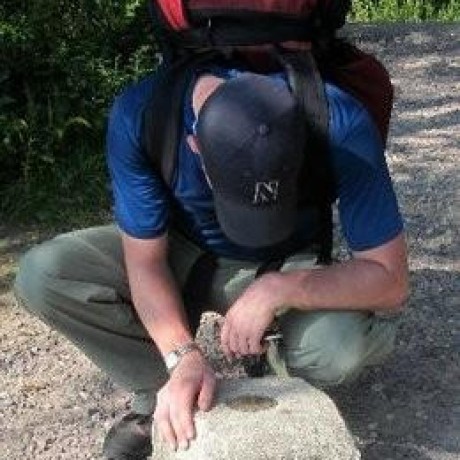
There is a tell in his GitHub avatar, the closest thing to a public portrait he keeps. It is not a studio headshot with a navy blazer and a soft-focus bookshelf. It is Bild crouched on a gravel trail, a backpack on, ball cap pulled low, hunched over a rock he is clearly far more interested in than the camera. It would be easy to over-read it. But it fits a man who left the open-plan offices of the Bay Area to work from Southwest Harbor, Maine - a small town that sits at the doorstep of Acadia National Park. He grew up in Albuquerque, New Mexico, and now codes cloud security from the granite edge of the Atlantic. The country, bookended.
Note the careful detail of it all: a security researcher who keeps a published PGP key, whose email runs through Keybase, whose open-source repos are about the unglamorous plumbing - SSL, key exchange, data format conversion. The discipline goes all the way down. This is someone for whom "secure by default" is not a marketing slogan grafted onto a pitch deck; it is a personal operating system that happens to have become a company.
The Resourcely chapter put that operating system in front of a market. The product translated the dry world of policy-as-code into something a developer would actually choose: blueprints that generate correct Terraform, guardrails that evaluate policy in real time, exception routing for the genuine edge cases, sensible defaults and inline guidance instead of a 40-page compliance PDF. The company's open-source "cloud-guardrails" project gave away best practices for protecting a sane cloud platform - the security equivalent of leaving the porch light on for the whole neighborhood.
Then Anysphere called. The acquisition was read across the industry as a signal: AI coding tools that want to win the enterprise will have to treat security as a feature, not a footnote. Travis McPeak, Resourcely's CEO and co-founder, went to lead security at Cursor. Bild and others turned to Fraim, carrying the guardrails philosophy into the AI era. The arc is tidy in a way real careers rarely are - censorship-resistant networks, secure IoT, secure cloud, now AI-native security - but each chapter is the same person asking the same question. How do I make the safe path the easy one?
What makes Bild worth watching is not a single headline. It is the consistency. Twenty years of choosing the unglamorous infrastructure problem, the one where success means nothing breaks and nobody notices. Plenty of founders want to be seen. Bild seems to want the guardrail to be invisible - to do its job so quietly that the developer never knew there was a cliff. That is a harder thing to market and a better thing to build.
For now the work continues from Maine, in the open, on a project anyone can read and fork. If the next decade of software really is going to be written with AI in the loop, someone has to make sure the loop does not leak. David Bild has been rehearsing for that job his entire career.