BREAKING  Newomics ships 100th mass-spec front-end system M3 emitter: up to 100x more sensitive 96 emitters on a single chip Spun out of Berkeley Lab, 2013 $11.8M raised across 8 rounds Bruker collaboration on high-throughput bioanalysis BREAKING  Newomics ships 100th mass-spec front-end system M3 emitter: up to 100x more sensitive 96 emitters on a single chip Spun out of Berkeley Lab, 2013 $11.8M raised across 8 rounds Bruker collaboration on high-throughput bioanalysis
Founder / Scientist / Berkeley

Daojing Wang

He built a shower head for molecules. One big flow in, eight tiny flows out - and suddenly a mass spectrometer could see what it used to miss.

Founder & CEO, Newomics Princeton PhD, Chemistry Ex-Berkeley Lab PI
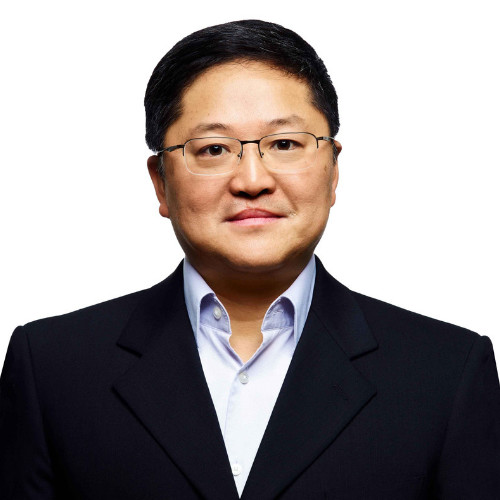
Daojing Wang, founder and CEO of Newomics

// Wang with the chip-based mass-spec hardware he carried out of a national lab. Photo: Berkeley Lab.

100x
Peak sensitivity gain
96
Emitters per chip
11
Years at Berkeley Lab
$11.8M
Total funding raised

A box that bolts onto any mass spectrometer - and changes what it can find.

Daojing Wang runs Newomics out of a building on Heinz Avenue in Berkeley, a few miles from the national lab where the whole thing started. The company is small - around nine people - and the ambition is not. Newomics makes the front end of a mass spectrometer: the part that turns a drop of liquid into a fine spray of charged droplets the instrument can actually read.

That sounds like plumbing. It is plumbing, in the way that a jet engine is a fan. The bottleneck Wang attacked sits at the very start of electrospray ionization - one capillary, one stream, one shot at getting molecules into the machine. His answer was to split the stream. The M3 emitter replaces a single nozzle with eight or more, and packs up to 96 of them onto one silicon chip. Smaller droplets ionize better. Better ionization means the instrument detects things it would otherwise shrug past - up to ten times more sensitively, and for some molecules, a hundred.

The pitch is plug-and-play: a Newomics emitter clips onto instruments from the major vendors and runs at microflow or nanoflow without the fuss those setups usually demand. In 2023 the company shipped its hundredth front-end system and announced a collaboration with Bruker on high-throughput bioanalysis. The target market is everyone trying to read biology from a vanishingly small sample - proteomics, metabolomics, lipidomics, single-cell omics, clinical diagnostics, food safety, forensics.

Wang's north star is blunt and old-fashioned in the best way: precision medicine that actually works. Read disease and toxins from a single drop of blood. Make the reading cheap enough and robust enough that it leaves the lab bench and gets near a patient.

The product line has grown around that idea rather than away from it. There are M3 emitters and duo-ESI sources that mount on instruments from Agilent and Shimadzu, splitter kits for post-column mixing, a dedicated native MS kit, and the MEA chip itself. The company describes much of it as plug-and-play - the deliberate opposite of the finicky, hand-tuned reputation that microflow and nanoflow LC-MS have carried for years. Robustness and reproducibility are not glamorous selling points. For a working lab that has to run the same assay a thousand times, they are the only ones that matter.

Newomics keeps showing up where new ground is being broken. Beyond the Bruker partnership, Wang has announced collaboration with Advanced Electrophoresis Solutions to push CE-MS, and the company has been rolling out higher-throughput formats like a high-throughput ESI-MS platform meant to accelerate workflows without conventional liquid chromatography in the loop. The application list reads like a tour of modern biology: proteomics and single-cell proteomics, metabolomics, lipidomics and glycolipidomics, glycomics, oligonucleotide analysis, native protein complexes, biomarker discovery, drug development, environmental monitoring, food safety, and forensic analysis. One front end, many problems.
The shower-head trick

// How the multinozzle emitter array splits one flow into many

ONE LARGE FLOW  →

MANY SMALL FLOWS → smaller droplets → better ionization → higher sensitivity

Imagine a shower head design. You have one big flow coming in, and many smaller flows going out.
- Daojing Wang, on the M3 emitter
By the numbers

What "more sensitive" actually buys you

Sensitivity in mass spectrometry is the difference between seeing a biomarker and missing it. Wang's emitters move that line. Relative detection sensitivity, his words:

Conventional emitter
1x
M3 emitter (typical)
up to 10x
M3 (some analytes)
up to 100x

From Hefei to Princeton to a chip you can hold.

The route was not a straight line. Wang took his undergraduate chemistry degree at the University of Science and Technology of China, then crossed the Pacific for a Princeton PhD that he finished in 1999. A postdoc at UC Berkeley followed. Then came a year at SurroMed, a year doing research at UCSF, and in 2002, a job at Lawrence Berkeley National Laboratory that would last more than a decade.

At the lab he was a career scientist and principal investigator, building tools for systems biology in the Biosciences Area. Working with collaborators Pan Mao and Peidong Yang, and leaning on the nanofabrication muscle of Berkeley Lab's Molecular Foundry, he developed the multinozzle emitter array - a silicon chip that could dramatically shorten the time it takes to identify proteins, peptides, and other molecules inside tiny volumes of biological sample.

A lot of national-lab inventions stay inventions. Wang's didn't. He founded Newomics in 2011 while still a PI, then left the lab in 2013 to commercialize the technology full-time. The patents - M3 emitters, MEA chips, senescence chips - became the spine of a product line instead of a citation count. He has published across PNAS, Analytical Chemistry, Cancer Research, Aging Cell, and Molecular and Cellular Proteomics, but the thing he is proudest of probably ships in a box.

There is a tell in how he thinks. Native mass spectrometry - the technique for studying proteins in something close to their natural state - has carried the same name since 2004. Wang decided the name was muddy. In The Analytical Scientist he made the case for a cleaner term, NS-MS, "native spray mass spectrometry," arguing the field should decouple sample prep, the spray, and the measurement so people stop talking past each other. It is a small fight to pick. He picked it anyway, because precision in language is the same instinct as precision in a chip.

That same instinct shows up in how he describes the goal. The early demonstrations of the technology were aimed squarely at the clinic - screening for disease markers or environmental toxins in a single drop of blood, with diabetes management cited as a concrete first use. The through-line from a 2002 national-lab bench to a 2023 commercial shipment is not a pivot story. It is one idea, carried patiently, refusing to die in a journal.

Running a nine-person company that competes on hardware against instrument giants takes a particular kind of stubbornness. Wang's version is quiet. He has spent more than two decades inside molecular detection - SurroMed, UCSF, Berkeley Lab, now Newomics - and the resume reads less like a series of jumps than a single subject studied from every angle: how do you get a molecule into a machine cleanly enough to trust what comes out the other side. The shower head was just the best answer he found.

In his words

Quotable Wang

Our first product, the M3 emitter, is up to 10 times more sensitive than conventional emitters, and with some analytes, even 100 times more sensitive.
We can improve the sensitivity and throughput of mass spectrometry for detecting biomarkers in blood or other biological fluids for precision medicine.
Imagine a shower head design. You have one big flow coming in, and many smaller flows going out.
Clearly defining which step is native - and decoupling sample preparation, the electrospray process, and mass spectrometry - will promote NS-MS technology and adoption by a wider group.

Five facts worth keeping.