Person • Founder • Physicist
Danny Rogers
He asks one question for a living: is your phone hacked? Then he built the tools to answer it.
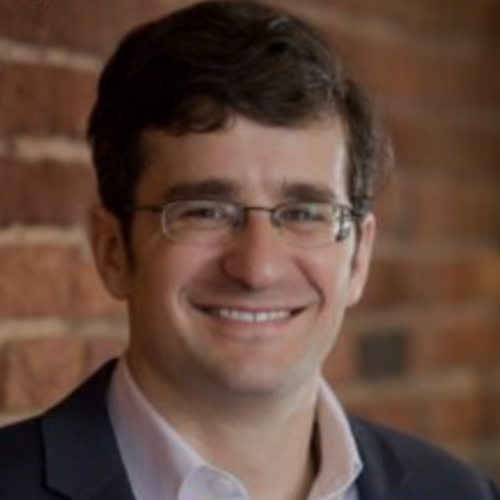
Danny Rogers // the man who reads your phone's mind
He asks one question for a living: is your phone hacked? Then he built the tools to answer it.
Danny Rogers runs iVerify, a New York company that catches spyware on smartphones - the zero-click, nation-state kind that ordinary antivirus never sees. He came to the job the strangest way possible: he was a customer first, liked the product so much he recommended it to his own family, and then he bought the company he was recommending.
Start with the Twitter handle, because it tells you everything. It is @IsMyPhoneHacked. Not a brand, not a slogan, not a growth-hack. A question. The exact question that Rogers has organized an entire career around answering. Most executives hide behind a title. Rogers put his job description where his name should be.
The résumé reads like it belongs to four different people. A bachelor's in math and physics from Georgetown. A PhD in chemical physics from the University of Maryland. Years managing sensor and physics research at the Johns Hopkins University Applied Physics Laboratory, the kind of place that quietly supports defense and intelligence work. Somewhere in there, quantum cryptography, patents, papers. It is not the biography of a person you would expect to be worrying about the malware on a journalist's iPhone.
And yet that is exactly where the physics led. Rogers found his way into information security more than a decade ago and never left. He has since founded or co-founded three organizations, each aimed at a different kind of invisible threat: stolen data traded in the dark, lies engineered to spread, and spyware slipped silently onto the devices in our pockets.
What ties them together is not the technology. It is a stubborn belief that the most dangerous attacks are the ones you cannot see, and that catching them is a solvable problem if someone with the right training bothers to try. Rogers keeps volunteering to be that someone.
iVerify did not begin as a company. It began as a suspicion. Inside the security firm Trail of Bits, someone wanted to know whether the employees' own phones were quietly compromised. So they built a tool to check. The tool worked. It kept working. Eventually it stopped being a side project and became a product other people wanted too.
Rogers entered from the opposite direction. He was running a nonprofit whose staff were being targeted, their personal phones doubling as work phones, all of it a soft target for commercial spyware like the tools sold by groups such as NSO to surveil journalists and activists. He needed protection that would not force his people to hand over their private lives to an invasive management profile. He heard good things about iVerify Enterprise. He tried it.
The verdict came fast. Within minutes of deployment, he could see the security posture of an entire fleet of bring-your-own-device phones, spot spyware like Pegasus, flag jailbroken devices - and do it all without an MDM clamped over everyone's personal life. He was, in his own word, impressed. Impressed enough to recommend it to friends and family. Impressed enough that when the chance came in 2023 to run the company, he took it.
The pitch he now makes is deceptively simple. Phones are the most personal computers we own and the least defended. The enterprise pours money into laptops and servers while the device that holds your texts, your location, your two-factor codes and your entire life goes unwatched. iVerify sells mobile endpoint detection and response - EDR for the thing in your pocket - combining threat detection with mobile forensics and automated remediation. It catches spyware, unpatched holes, smishing, and credential theft.
The line Rogers keeps returning to is a refusal of a bargain the industry usually asks you to accept: users shouldn't have to sacrifice privacy for security. iVerify's trick is to read a phone's security telemetry without demanding a management profile that reads everything else. Protection without surveillance. For the people iVerify is built to defend - executives, activists, reporters, the high-value targets - that distinction is the whole point.
In June 2024 the company raised a $12M Series A led by Shine Capital, pushing total funding past $16M, with the customer base reaching into the Fortune 100. In early 2025 it opened a partner program for the managed-service providers who protect everyone too small to have a security team of their own.
Managed a portfolio of physics and sensor research, supporting defense and intelligence community cyber operations. Published patents and papers in quantum cryptography.
Builds a dark-web intelligence company in Baltimore and its flagship, Matchlight - an automated system that detects stolen data on the dark web the moment it appears.
Serves as CTO of a nonprofit built to attack the business model behind online disinformation - starving the lies of ad revenue rather than arguing with them.
Teaches a graduate course with a title that sounds like a thriller: "Disinformation and Narrative Warfare." Named a Security Fellow at the Truman National Security Project.
Joins the mobile security company he first adopted as a customer, after it spins out of Trail of Bits into an independent business.
Shine Capital leads the round; iVerify expands its threat research and pushes deeper into the Fortune 100.
Long before spyware, there was disinformation. In 2018 Rogers helped launch the Global Disinformation Index, taking the role of chief technology officer. The premise was contrarian and a little cold-blooded: you cannot argue a conspiracy theory out of existence, so stop trying. Follow the money instead. Disinformation is a business, and like any business it runs on revenue. Most of that revenue is advertising, dropped onto conspiracy sites by ad networks that never look at where the money lands.
GDI's answer was to measure. Rate the sites, map the ad dollars, and hand advertisers the data they need to stop funding the fever swamps by accident. Rogers, the physicist, treated disinformation the way he treats everything else - as a system that could be instrumented, quantified, and disrupted at its weakest joint. That joint was the wallet.
The work put him on television and in front of policymakers. During the pandemic he warned that the crisis had become, in his phrase, "the Super Bowl of disinformation" - a once-in-a-generation event where fear, uncertainty and a captive global audience made lies more valuable than ever. He testified, wrote, and taught. The teaching stuck: at NYU he still runs a graduate course, "Disinformation and Narrative Warfare," passing the instinct to the next set of people who will spend their careers on invisible threats.
It is not a coincidence that the same person who tracked stolen data on the dark web and mapped the economics of online lies ended up worrying about the spyware on an activist's phone. These are the same story told in three registers. Someone is being targeted. The attack is designed to be invisible. And the defense begins with the unglamorous act of measurement - seeing the thing clearly before anyone can act on it.
At Terbium Labs, Rogers built Matchlight to find breached and stolen data the instant it surfaced in the internet's back alleys - automatically, at scale, before it could be weaponized.
The Global Disinformation Index does not debate the lies. It defunds them, mapping the ad money that keeps disinformation profitable and helping cut off the supply.
At iVerify, the enemy is the zero-click exploit and the commercial spyware that lands on a phone without a tap. The job is to see the unseeable and shut it down.
There is a pattern here, and it is not really about phones or the dark web or the fever swamps of online disinformation. It is about a certain kind of person who cannot leave an invisible problem alone. Rogers trained to measure things nobody could see - photons, quantum states - and then spent his career turning that instinct on the threats that hide inside modern life.
The disinformation researcher, the dark-web tracker and the spyware hunter are the same person doing the same thing: dragging the hidden into the light so someone can do something about it. iVerify is just the current front. Given the pattern, it is unlikely to be the last.
What he wants is not complicated. He wants the sophisticated protection once reserved for governments to reach the people actually being targeted - and he wants it to arrive without asking them to trade away the privacy it was supposed to protect.
Profile compiled from public sources: iVerify, AlleyWatch, NYU, AAAS, GZERO Media, and Grokipedia.