Industrial DevOps - New York, NY
Copia
Copia
Automation
The code that runs the world's factories finally has an undo button, a backup, and a paper trail.
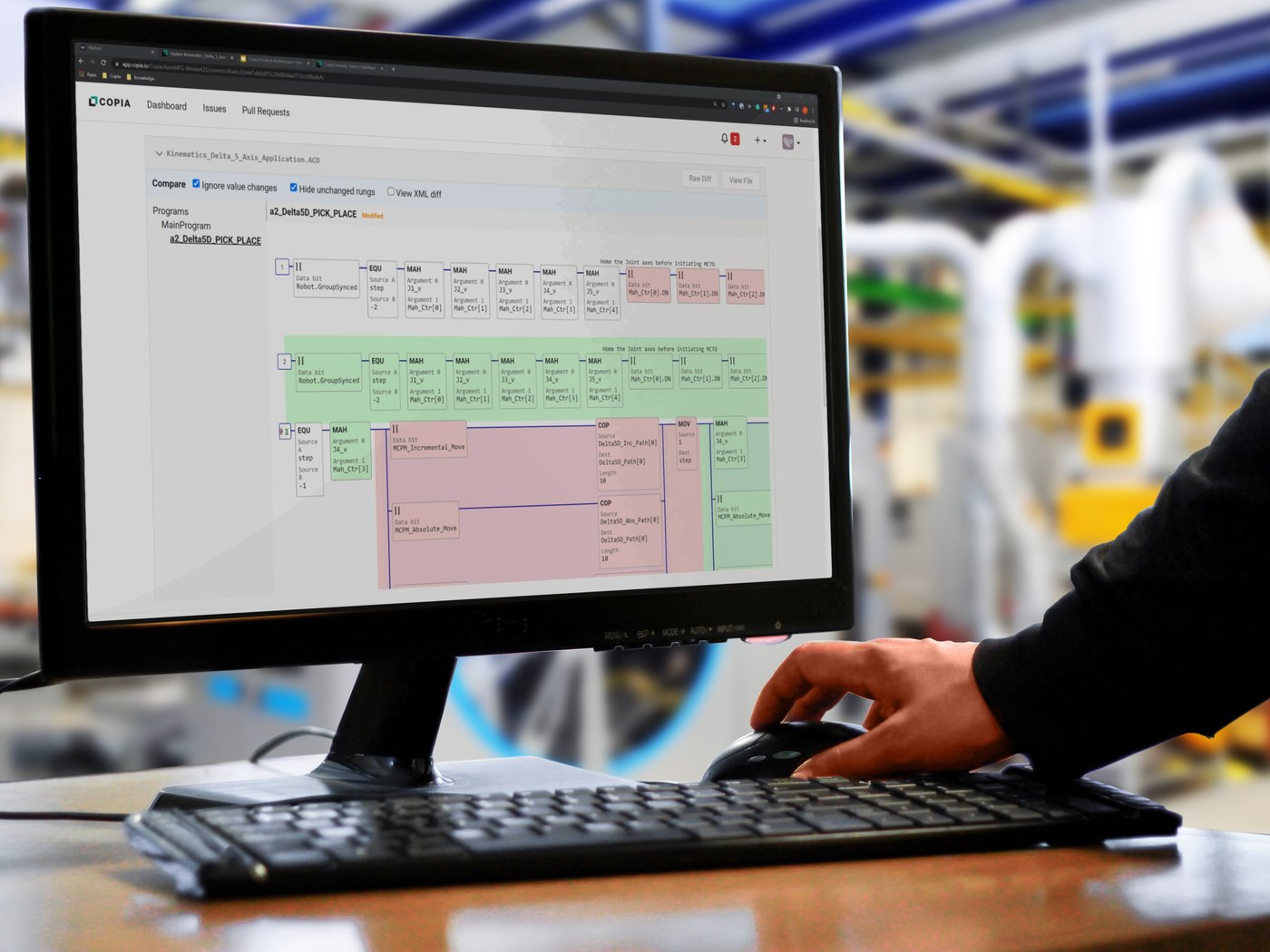
The code that runs the world's factories finally has an undo button, a backup, and a paper trail.
Walk into a bottling plant, an auto line, or a chicken-processing facility and somewhere in a gray cabinet sits a programmable logic controller - a PLC - quietly running the show. That code is the difference between a line that runs and a line that stops. For decades, it lived on a USB stick, an unlabeled laptop, or in the head of the one engineer who wrote it.
Copia Automation decided that was insane. The company builds version control, automated backup, and AI tooling for industrial code - the same kind of discipline software teams have used for years, rebuilt for the plant floor. In June 2026 it raised a $26 million Series B, pushing total funding close to $55 million, and the pitch had not changed since day one: your code is a critical asset, so treat it like one.
"Your code is a critical asset. Treat it like one."
Here is the part outsiders find hard to believe. The software industry solved this in the 2000s - Git, code review, rollbacks, audit logs. Meanwhile the people programming the machines that make cars, food, and medicine were emailing each other files named final_v3_REAL.zip. When a controller failed, recovery meant finding the right file, if it still existed, and hoping it matched the version on the floor.
Then ransomware found the factory. Operational technology - OT - became a target, regulators wrote rules like NIS2, and the quiet gap between "we run our plant on this code" and "we have no idea where the current copy is" turned into a board-level risk. The problem was never that industrial engineers were careless. It was that nobody had built them the tools.
A single missing file can stop a production line. Most plants had hundreds of those files, and no list.
Adam Gluck spent his early career deep in software - a founding engineer on Uber's engineering strategy team, where he helped rebuild the app distributed to millions of drivers and redesign the company's microservice architecture. He knew exactly how much modern tooling did for software teams. So when he looked at industrial automation, the absence of that tooling was less a surprise than an opportunity.
In 2020 he co-founded Copia Automation with Darren Henry and Matthew Lee. The bet was simple and contrarian: take the boring, proven mechanics of software DevOps - version control, diffs, backup, review - and rebuild them for a world of ladder logic and proprietary vendor formats. Investors who had spent careers in factories agreed. The founders landed on Forbes 30 Under 30 and a World Economic Forum Technology Pioneer nod soon followed.
Ex-Uber engineering strategy team. Saw a trillion-dollar industry running on code with no source control and decided to fix it.
Darren Henry and Matthew Lee co-founded Copia in 2020, building the team and the go-to-market across manufacturing.
The hard part was never the idea. It was making one platform read the incompatible languages and formats of every major automation vendor - Siemens, Rockwell, ABB, Beckhoff, B&R, Schneider Electric, WAGO, CODESYS - and present them as something an engineer can version, compare, and restore. Copia did exactly that, then kept building outward.
What you can actually do with it
Git-based history and automated backup for PLC programs, with visual diffs so engineers can see exactly what changed between two versions of a machine.
Connects to running devices to capture code and flag drift between what is deployed on the floor and what is in source control.
A configurable engine - billed as the first built for industrial code - that automates backup, validation, change notifications, and recovery steps.
AI-assisted analysis, troubleshooting, and code translation across control languages and vendor platforms, for teams short on senior engineers.
"It accelerates timelines and maximizes operational uptime."
Adam Gluck, Darren Henry, and Matthew Lee start in New York with $2.2M in seed funding from Construct Capital, Lux Capital, and Liquid 2 Ventures.
Lux Capital leads, with Construct Capital and Ironspring Ventures, to bring DevOps efficiencies to industrial automation.
Named a World Economic Forum Technology Pioneer; founders land on the Forbes 30 Under 30 list for Manufacturing & Industry.
The company ships a configurable workflow engine purpose-built for industrial code.
Co-led by AE Ventures and Squadra Ventures to unify OT code management, backup, and recovery - across cloud, on-prem, and air-gapped deployments.
Adoption is the only argument that matters in industrial software, where buyers are famously skeptical and switching costs are real. Copia's named users include Amazon, Ingersoll Rand, Westfalia, Targan, Varland Plating, AWC, and Automation Nth - operators in food & beverage, automotive, consumer goods, and materials handling. These are not companies that try things for fun.
The Series B investors tell their own story: AE Ventures and Squadra Ventures co-led, joined by KAS Venture Partners and returning backers Construct Capital, Lux Capital, Ironspring Ventures, and Renegade Partners. Several of them invest specifically in industrial and defense technology - the kind of money that does diligence on factory floors, not just pitch decks.
Amazon and Ingersoll Rand do not adopt unproven tools. That is the whole point.
Copia's framing is deliberately unglamorous. It does not promise to reinvent the factory or replace the engineer. It promises that the code running your plant is versioned, backed up, and restorable - so a bad update, a failed drive, or a ransomware note becomes an inconvenience instead of a catastrophe. The Series B is aimed squarely at that: expanding cloud, customer-managed, and air-gapped deployments so even the most security-conscious plants can use it.
There is a quiet ambition underneath. If every controller's code lives in a managed system, the factory floor inherits everything software teams take for granted - review, automation, AI assistance, institutional memory that does not walk out the door when an engineer retires. That is a bigger change than it sounds.
Manufacturing is short on senior automation engineers, long on aging equipment, and newly exposed to cyber risk. Each of those problems gets smaller when the underlying code is managed instead of scattered. AI can only help with code it can read; compliance regimes only work with an audit trail; disaster recovery only works if a current backup exists. Copia is building the layer all of that depends on.
Go back to that gray cabinet on the plant floor. The PLC is still running the show. But now its code has a history, a backup, and a screen where an engineer can see exactly what changed and roll it back in minutes. The machine looks identical. What sits behind it does not. That is the change Copia Automation is selling, one factory at a time.
Watch & learn