The ad looked ordinary until it began behaving like a trap. It had won its place through the machinery that fills a publisher’s page. Then it redirected the reader to a scam. The site owner would take the complaint, though the creative had arrived through several companies it did not control. This is the awkward geography of programmatic advertising: many hands can touch an ad, while the publisher’s name is the one above it.
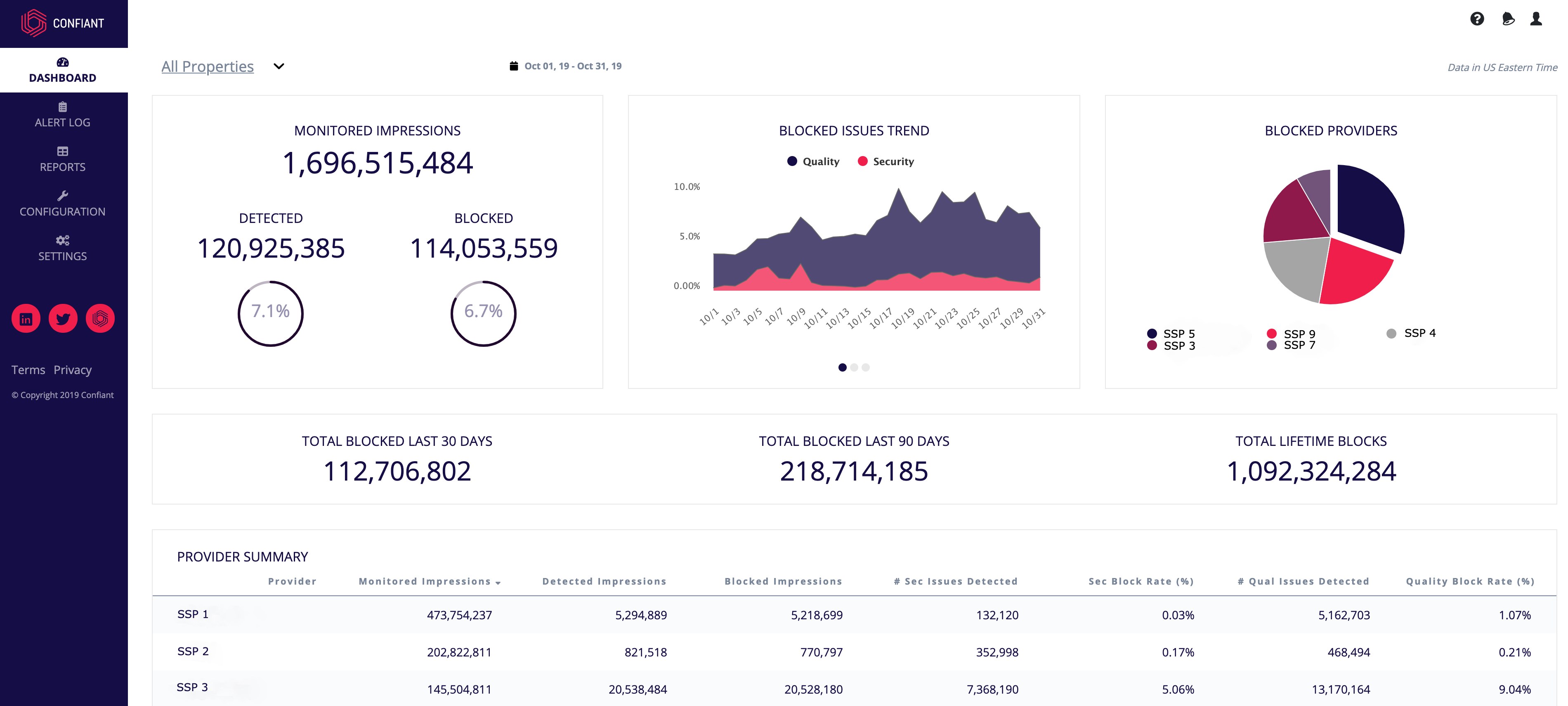
Confiant works in that gap. The New York company monitors ads as they travel through platforms and onto websites, looking for malware, forced redirects, scams, privacy violations and low-quality creatives. Its software can block a dangerous ad before it renders and, where configured, reauction the space. Its customers are publishers and ad technology platforms, not people buying a browser extension. The reader is the person they are trying to protect.
- The job: verify what ads actually do, then stop harmful or unwanted ones at delivery.
- The buyers: publishers, supply-side platforms and demand-side platforms that need safer inventory and fewer complaints.
- The useful trick: a blocked slot can be reauctioned, while an ad trace helps the team find where the trouble came from.
- The scale: Confiant says it protects more than 40,000 premium sites and maps more than 80 malvertising techniques.
The trouble with an approved ad
Louis-David Mangin and Jerome Dangu teamed up in 2013. Their company history records years spent tracking exploit kits, video ad attacks and campaigns that hopped between legitimate advertising systems. In 2016 it says the team blocked a scaled AdGholas exploit-kit campaign on the client side. The decisive product move came in 2017, when Confiant launched real-time verification and blocking. A warning after an attack was useful to an investigator. A block before the ad appeared was useful to the reader.
An auction can choose an ad in milliseconds. That speed is convenient for commerce and for criminals. A creative may be swapped, may redirect without a click, or may behave differently according to device, location or time. Preflight inspection alone cannot describe every live session. Confiant’s answer is to watch both the systems that trade ads and the browser where an ad finally runs. That breadth of visibility is the center of its pitch.
The portfolio now reaches beyond outright malware. Publishers can set brand and category controls, catch heavy or disruptive ads and investigate compliance problems. Confiant offers reports that trace a bad creative through the chain. It also sells a version for demand-side platforms, where the valuable clue is sometimes downstream: which creatives did publishers block after the buyer thought the transaction was done? It has integrations across Prebid.js, Amazon Publisher Services and other ad infrastructure, plus a public Malvertising Attack Matrix that names attackers’ tactics.
The complaint that changed the purchase
Fandom’s account of switching providers is unusually clear about what failed first. It already had an ad security solution, yet redirects kept reaching users. Its two-person ad operations team was spending time hunting the offending ads while supporting five web properties and, at the time of the case study, 200 million monthly unique visitors. The company wanted blocking that worked in real time, plus a view of which demand source had delivered the creative.
After the switch, Fandom reported fewer complaints and roughly four hours a week saved on security issues. Its case study puts that staff-time saving at about $1,760 a month, using an external salary survey. It also reports five billion impressions monitored and eleven million issues blocked to date. These are the customer’s reported results, not a controlled comparison; still, they are more revealing than a claim to be “safe.” The practical unit of success was an ad-ops person who no longer had to spend Friday finding a redirect that had already escaped.
“We definitely receive much fewer complaints than we used to and save approximately 4 hours per week dealing with security issues.”Sylwia Komorowska-Girus, Fandom revenue operations
The cost side matters. Confiant does not post a standard subscription price. On its trial page it describes premium sites investing about 1% of programmatic revenue in protection, an illustrative benchmark rather than a quote for every buyer. It also argues for reauctioning a blocked slot because a publisher should not have to choose between a safe reader and a paid impression. A buyer evaluating the product can measure a concrete set of things: the number of verified redirects, complaint volume, investigation hours, blocked impressions that earned replacement revenue, and false positives that lost good demand.
The MAQ Index describes Confiant-monitored premium inventory; its rates are not a census of every ad on the internet.
The business of seeing both ends
Confiant’s customers include publishers such as Fandom and Insider, and platforms such as PubMatic and Equativ. PubMatic describes using Confiant to scan buyer creatives for security issues as part of a broader ad-quality system. Sharethrough describes a strict approach to keeping bad ads out. In 2025 Confiant announced a partnership with AdPushup that pairs revenue optimization with security controls. These relationships show where Confiant sits: inside the plumbing of advertising, between the company that buys reach and the person whose screen receives the ad.
There are alternatives. GeoEdge and The Media Trust also sell real-time ad security and quality controls. Confiant’s particular emphasis is its view across client-side delivery and server-side trading, coupled with threat research and feedback that can travel back up the chain. Whether that makes it the best choice depends on a buyer’s ad stack, policies and implementation. A site with little programmatic advertising has less reason to buy such a system; a publisher with heavy programmatic demand and recurring redirect complaints has an immediate way to test its value.
 Louis-David Mangin / CEO
 Jerome Dangu / CTO
The company raised $4.1 million in a 2019 Series A led by River Bay Investments and Rubicon Venture Capital. It has since kept extending the perimeter of what counts as an ad problem. Its 2026 Malvertising, Ad Quality & Risk Index examined more than a trillion impressions from 2025 and found one dangerous or highly disruptive impression in every 133 across the inventory it studied. The index also compares thirteen platforms. Confiant is both a vendor and the author of that research, so its benchmarks are best read as evidence from its own vantage point.
That vantage point can be startling. In one investigation published in 2026, its threat team said it found an internal testing page used by a group it calls D-Shortiez. New campaign domains appeared there before the ads went live. Confiant built automation to collect those clues and block the infrastructure ahead of delivery. It tracked 59 million malicious impressions from the group in 2025. The story is a reminder that ad defense is not merely a filter for pictures. It is also detective work on the people and systems behind them.
What a publisher can borrow
The lesson is wonderfully unglamorous: test an ad where it actually runs. Keep the trace, not just the screenshot. Give the operations team rules it can change without a developer. Measure the complaints that stop arriving and the revenue that still comes through after a block. Ask every vendor how it handles a creative that behaves one way in a test environment and another way on a reader’s phone.
Confiant’s business exists because a publisher can be blamed for an ad it never wrote, sold by a platform it did not build, through code it did not inspect. The company’s answer is to make that final handoff visible and interruptible. A tiny rectangle of advertising should not get the last word on whether a reader trusts the whole page.