
A camera company wearing an interior-design costume
Walk into any open house this year and there is a decent chance the photos that lured you there were never staged with real furniture. The sofa, the rug, the moody twilight sky behind the windows - all of it generated by Collov AI from a single picture of an empty box of a room. The agent uploaded a photo, picked a style, and a credible home appeared.
Collov AI - the public face of Collov Labs - sits in Redwood City and calls itself an interior-design platform. That is true and also slightly beside the point. The interior design is the part you can see. Underneath is a company building systems that look at images and figure out what to do with them, which is a much stranger and more ambitious project than picking out throw pillows.
The next interface for AI won't be text or chat-based. It will be the camera.Xiao Zhang, Co-Founder & CEO
The reported numbers are not small for a company this size: more than 6 million users across 200-plus countries, over 300 business customers, and roughly 39 employees holding it all together. In April 2026 they closed a $23 million Series A and opened a research lab. For a business that started by digitally arranging furniture, that is an unusual amount of momentum.
Staging a room cost too much and took too long
Here is the tension that the whole company hangs on. A furnished listing sells faster and for more money - this is not controversial, agents have known it for decades. The trouble is that physical staging is expensive, slow, and logistically miserable. You rent furniture, you hire movers, you schedule a photographer, and you do it for one house while ten others sit empty and unsold.
Empty rooms, it turns out, are bad at selling themselves. Buyers struggle to imagine a life in a blank rectangle. They under-bid, they scroll past, they lose interest. The gap between a vacant room and a desirable one was made of money and hours, and almost nobody had a fast way to close it.
The gap between a vacant room and a sold one used to be measured in moving trucks. Now it's measured in seconds.The Collov pitch, paraphrased
You could, of course, hire a person in Photoshop to fake the staging by hand. People did. It cost a few hundred dollars and took a few days per home, which solved the furniture-truck problem by inventing a slower, pricier one. The industry had a workaround for its workaround. That is usually the sign that someone is about to build something better.
A physics PhD decided rooms were a vision problem
Xiao Zhang did not arrive from the furniture world. He came out of Stanford with a PhD in applied physics, having written a thesis on using machine learning to optimize free-electron lasers - which is exactly as far from scatter cushions as it sounds. He was named to the Forbes 30 Under 30 list. Then he started a company about decorating rooms, which on paper looks like a detour and in practice was the point.
The bet Zhang and co-founder and CTO Casey Zhou made was that interior design is not really a taste problem to be solved by a catalog. It is a vision problem - a question of teaching software to understand the geometry of a space, the light falling across it, and where a chair can plausibly go. Solve that, and staging a listing is just one thing the software can do. The team they built leans academic, pulling researchers from Stanford, UC Berkeley and Yale.
Interior design was never the destination. It was the first room in a much bigger house.YesPress reading of Collov's strategy
The approach combines diffusion models, spatial reasoning, and multi-step agentic systems - software that can look at a scene and then carry out a sequence of edits, not just generate one pretty picture. Most companies would have been content to be a good staging tool. Collov treated staging as the demo and visual intelligence as the actual product.
Point a phone at a room. Get options.
The mechanics are deliberately boring to use, which is the highest compliment you can pay software like this. Upload one photo of an empty or lived-in room. The system returns a fully furnished, photorealistic version in roughly ten seconds. Don't like the style? Pick another. Want the existing sofa gone? Erase it. Different floor, different walls, twilight sky instead of grey afternoon? All a click.
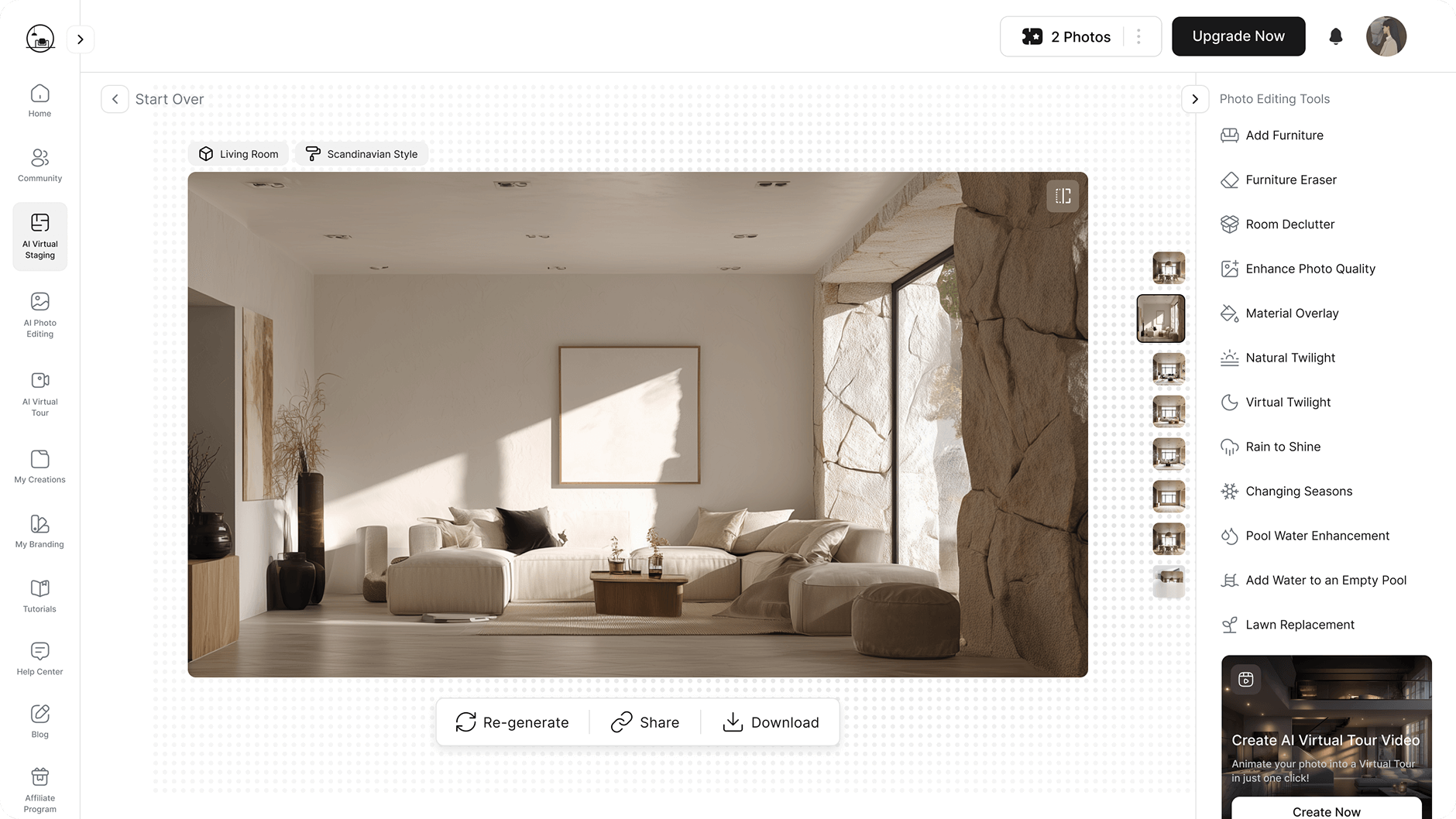
Virtual Staging
Empty room in, furnished photorealistic room out, in about ten seconds, with selectable styles.
AI Home Redesign
Restyle an existing space from a reference photo - swap furniture, walls, floors and finishes.
Photo Editing Suite
Declutter, erase furniture, convert to twilight, control sky and weather, replace lawns, enhance pools.
360 Virtual Tour
Interactive walkthroughs buyers can navigate from any angle, priced from about $7 a room.
CozyAI
Consumer app for iOS and Apple Vision Pro - photograph an item you love and drop it into your own room.
AI Design Agent
Agentic workflow that reads a scene and runs multi-step object and environment edits from plain instructions.
The best AI tool is the one you forget is AI. You upload a photo, you get a home.On Collov's design philosophy
The CozyAI app is where the camera thesis gets literal. Strap on an Apple Vision Pro, stand in your actual living room, and redecorate it in front of your own eyes - no screwdriver, no regret, no second trip to the store. It is a glimpse of where the company thinks all of this is heading: not a website you visit, but a layer over the world you are already looking at.
How Collov got from furniture to vision
The pixels are doing the selling
A vision is only as good as the listings it moves. Collov's own reported figures point at the part of the funnel agents actually care about: more qualified buyers, faster sales, higher prices. Treat these as the company's numbers rather than an independent audit - but they are the case it makes to the people writing the checks.
What staged listings claim to gain
The other proof point is who is shipping Collov's models. The company says its visual AI is integrated into Qualcomm on-device systems - meaning the redesign can happen on the chip in your hand rather than in a distant data center. That is the kind of partnership you get when your software is genuinely about seeing, not just about sofas.
When your models end up on someone's silicon, you've stopped being a feature and started being infrastructure.YesPress, on the Qualcomm integration
Teach AI to see, then to act
The $23 million Series A in April 2026 was not really a furniture round. It funded a research lab, and the lab's stated job is to build visual intelligence systems for the next generation of devices - wearables, real-time interactive hardware, the things you look through rather than type into. The investors - Matrix Partners, MindWorks Capital, Brightway Future Capital and Taihill Venture - were buying the camera thesis, not the catalog.
Strip away the real-estate framing and the mission is simple to state and hard to build: make AI that understands images well enough to do something useful with them, automatically, in sequence. A room is a convenient first test case because the stakes are visible and the payoff is obvious. But a system that can read a room can, in principle, read a shelf, a street, a workbench, a face.
Five things that stick
- The founder's PhD thesis was on machine learning for free-electron lasers - rooms came later.
- Virtual staging finishes in about ten seconds, faster than fluffing one real throw pillow.
- A 360 panorama tour starts around $7 a room - cheaper than most actual scatter cushions.
- CozyAI runs on Apple Vision Pro, so you can redecorate a room while standing inside it.
- The brand answers to both collov.ai and the older "collovhome" handle on Facebook.
Back to the empty room
For most of computing history, talking to a machine meant typing. Then it meant talking. Collov is wagering that the next step is showing - that you will point a camera at the world and the software will understand the world and then change it for you. If that bet lands, virtual staging will look like the quaint first chapter of something much larger, the way the calculator app looks next to the phone it lives on.
There is a healthy reason to stay skeptical. The uplift numbers are self-reported. The competition - Virtual Staging AI, REimagineHome, Interior AI and a crowd of others - is real and growing. "Visual intelligence" is a phrase that can mean everything and therefore nothing. Collov has to prove that a staging tool can become an AI platform without losing the customers who just wanted a nicer listing photo.
Anyone can generate a pretty picture. The hard part is building software that knows what it is looking at.The bar Collov has set for itself
So return to that open house. The room was empty - a blank rectangle that nobody could picture living in. An agent uploaded one photo, and ten seconds later it had a sofa, a rug, warm light through the windows, and a price that crept upward. The furniture was never there. The buyer who fell for it never noticed. That is the whole company in one room: Collov AI didn't move a single chair, and somehow it staged the house anyway.