Claire Gouze has a fondness for problems that look technical until somebody asks a business question. Which revenue? Whose definition of an active customer? What does “last month” mean when the finance calendar disagrees with the wall? An AI agent can produce immaculate SQL and still answer the wrong question with magnificent confidence. Gouze, co-founder and CEO of nao Labs, has built her current company around that awkward fact.
Her proposition is almost severe in its practicality. Before a company gives an agent the run of its warehouse, it should organize what the company knows. Definitions should be explicit. Models should be clean. Questions should become tests. Corrections should feed back into a shared memory that a data team can review. The glamorous model arrives near the end of this sentence, looking slightly overdressed.
That position was earned in the field. Gouze came to data through business school, learned technical skills because she wanted to build things, then discovered how fast a neat architecture becomes a crowded kitchen when a startup takes off. nao is the record of those lessons, translated into software.
The useful detour
Gouze graduated from ESSEC Business School in 2017, after its Grande École program and Strategic Business Analytics Chair. The route from there was not the familiar computer-science procession. She had the business education first and acquired the technical depth by insisting on it. At BCG Gamma, where she says she was the first business-school hire, she spent nearly three years building machine-learning work for clients: forecasting, personalization, optimization, and the less photogenic business of getting models into production.
Consulting taught her to make bespoke things. Sunday, the QR-code restaurant-payments startup, taught her the price of doing so. She arrived in 2021 when the company had roughly 20 people and little that resembled a modern data stack. She built an ETL herself, wrote a Python ingestion pipeline for Salesforce, and created a transformation layer. Then colleagues introduced her to dbt and Airbyte. The custom machinery had to be migrated. She has called the episode a hard and useful lesson.
It is a wonderfully unfashionable founder anecdote because the mistake matters more than the save. Gouze learned that intelligence without shared standards creates private infrastructure, and private infrastructure eventually sends an invoice. Sunday grew to about 300 people within a year. The data function had to serve that motion without turning every analyst into a help desk or every metric into a negotiation.
“A separate markdown file you never touch again is worthless.”Claire Gouze on keeping context close to daily work
Eighty calls and a moving target
Gouze wanted to found a company before she knew which company. The searching phase lasted months: ideas, a co-founder, a first customer, and the special suspense of having chosen uncertainty before uncertainty chooses you. Christophe Blefari, an engineer she had worked with at Sunday, became her co-founder. Together they called around 80 data teams and asked where work was getting stuck.
The loudest complaint was the time it took to ship dbt models across a jumble of editors, warehouse consoles, documentation, and business-intelligence tools. nao's first answer was an AI data IDE, a specialist workspace with the warehouse and its context close at hand. Gouze described it neatly at launch: “nao is the AI data IDE I wish I had.”
Then general coding agents improved. Cursor and Claude became better at the code-editing job, while customers began asking a different question: could anyone in the company use an agent on data without losing the definitions and controls that made the answer trustworthy? Gouze and Blefari shifted nao toward an open-source analytics agent. The editor was a product. The deeper problem was context.
There is discipline in changing the object while preserving the obsession. Gouze says data people are most energized when they help business users and are valued for it. She knows the scar tissue of teams treated as a ticket queue. Her desired outcome is organizational: give more people direct access to useful analysis while leaving the data team in charge of the meaning beneath it.
The reliability climb / 40 evaluation questions
The experiment that spoiled the magic trick
In 2026, Gouze published a sequence of context-engineering experiments using the same data model and the same 40 text-to-SQL tests. A baseline without useful context answered 17 percent correctly. Adding context sources took the system to 45 percent. The next jump came after she stopped decorating the agent and inspected why it failed.
Eighteen of 28 failures in an early study came from the data model. Columns were ambiguous. Similar metrics lived in competing tables. Documentation left business meaning to the reader's imagination. Gouze repaired portions of the model, wrote better dbt documentation, reran the tests, and reached 86 percent. In later conversation she rounded the journey to about 90 percent, but the published experiment preserves the more useful number: 86, measured rather than wished into being.
Her playbook begins small. Choose perhaps 10 or 20 tables. Gather 20 important questions from real work. Establish a baseline. Tag each failure by cause. Fix the model before adding ornate retrieval machinery. Rerun the suite whenever the context changes. Once real people use the agent, study their questions and approved corrections, then turn failures into new tests.
This resembles software engineering because it is software engineering, only the unstable dependency is company language. A metric changes. A team invents a new definition. Somebody says “customer” and means account, user, diner, or restaurant. The context layer becomes a governed translation between that living language and the agent.
Reliable AI begins with a company willing to define its nouns.The quiet thesis inside nao's work
A launch with a clock in it
Gouze's writing about nao is unusually willing to show the calendar. For the November 2025 Product Hunt launch, the team gave itself five weeks. They wanted a cleaner product, simpler onboarding, a new website, new features, and a rebrand. A three-week retreat in a San Francisco hacker house compressed the work into one bright roomful of laptops.
At 9:00 a.m. Central European Time on launch day, nao went live. Five minutes later, posts went to LinkedIn, the newsletter, Slack, and Reddit. The team spent the day replying, watching the board, and seeing users advocate for the product. By 10:00 p.m., nao sat first for the day. The photograph Gouze published is less a victory portrait than a charming piece of office evidence: Gouze grinning beside a monitor, Blefari leaning into the frame, one ranking circled by two pointing fingers.
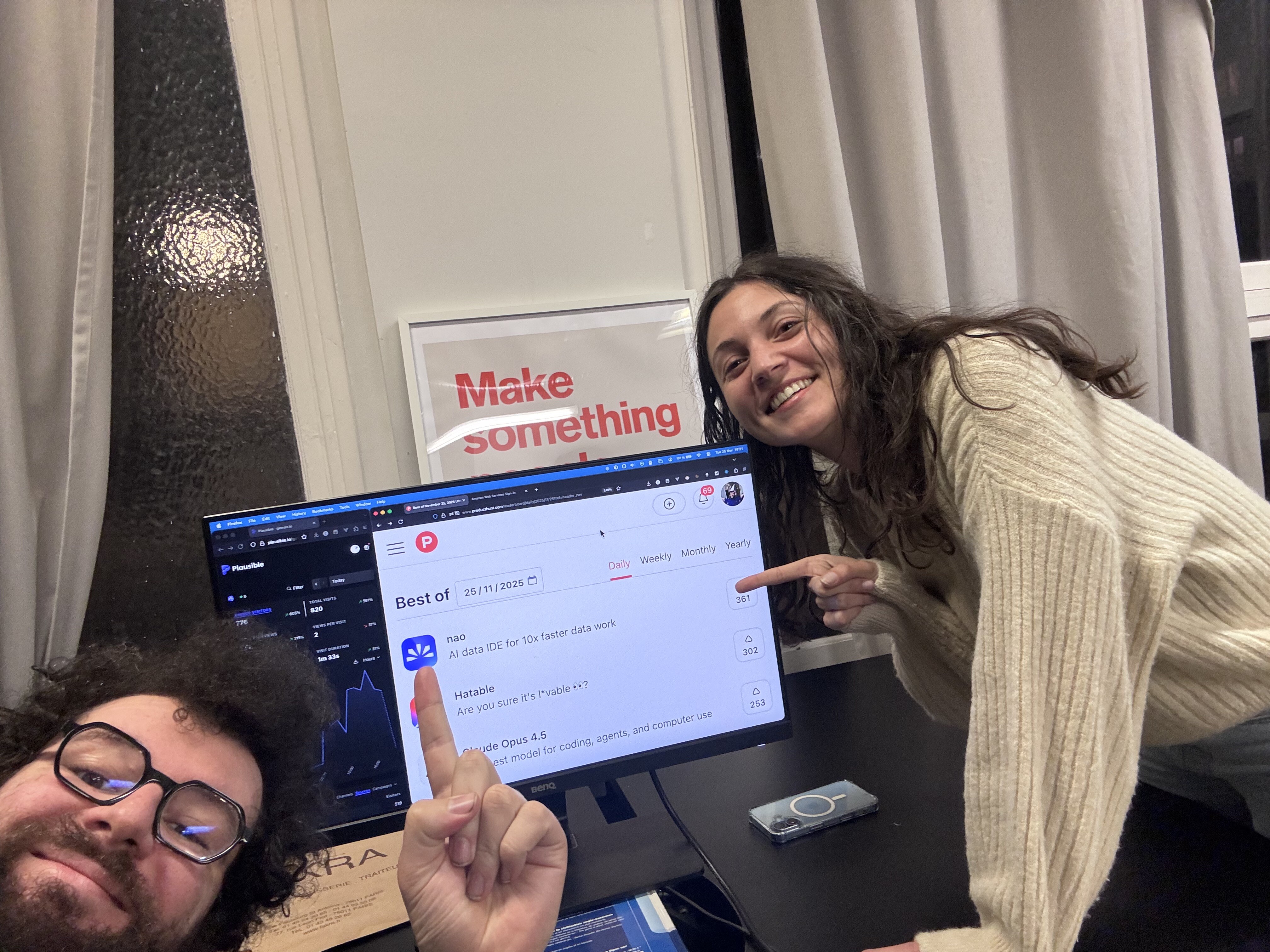
The number mattered, but Gouze's own inventory of success was about the sprint: major features shipped, feedback collected, affection felt, and a team pulling toward one date. A launch concentrates attention. It also reveals her style - earnest, measured, fond of an emoji, and alert to the comedy of trying to make everything perfect while the clock behaves like a clock.
The room she wants to change
In 2025, STATION F selected Gouze for its Female Founders Fellowship. She wrote about the moment a woman entrepreneur looks up from the computer and realizes she is the only woman in the room. Her response was pointed: “Let's make this fellowship program obsolete for the next generations!”
The line has a joke's snap and a systems person's ambition. Gouze's work on representation predates the fellowship. She helped with women-in-data events at BCG Gamma, built a Sunday data team with gender parity, and has volunteered with Elles bougent, encouraging schoolgirls to see technical careers as available to them. Earlier, while still a student, she tutored through ZUPdeCO.
Her advocacy and her product philosophy share a modest mechanism: make participation normal by changing the structure around it. One more role model changes what a student imagines. One well-documented metric changes what a colleague can ask. A system becomes trustworthy through small permissions, visible examples, and somebody maintaining the path.
Joins BCG Gamma and builds machine-learning systems for clients.
Moves to Sunday and builds its data function through rapid growth.
Co-founds nao Labs with Christophe Blefari.
Joins STATION F's fellowship and Y Combinator, then launches nao publicly.
Opens the analytics agent, publishes reliability studies, and takes context engineering on the road.
Company memory, with a pull request
nao now treats context as a file system: documentation, rules, models, and other knowledge that can be versioned, tested, and inspected. The open-source agent adds a chat interface, evaluation, and connectors; the commercial work adds the permissions, budgets, and governance a larger company needs. An MCP interface lets other agents use the same governed analytics layer. The product can change its interface without changing the argument.
Gouze is careful about where knowledge should live. If a definition belongs in dbt docs, keep it there, close to the model that changes. If a support process lives in Notion, maintain it in Notion. Sync the material into the agent, but do not create a ceremonial knowledge tomb no working person visits. Her phrase for that fate is wonderfully final: worthless.
The aspiration reaches beyond better chat. Gouze imagines company memory with an approval loop. When an agent discovers the right field after eight failed queries, that learning should survive. When a user corrects a definition, the data team should decide whether the correction enters shared context. The machine may remember; the organization still governs what counts as true.
This is why Gouze's path makes sense in retrospect without ever looking preordained. Business school taught her to hear the question. BCG taught her to build the model. Sunday taught her what growth does to a system. Founding taught her to call 80 people and change direction when the answer changed. nao gathers those lessons into one stubborn idea: an agent is only as useful as the company knowledge it can reliably inhabit.