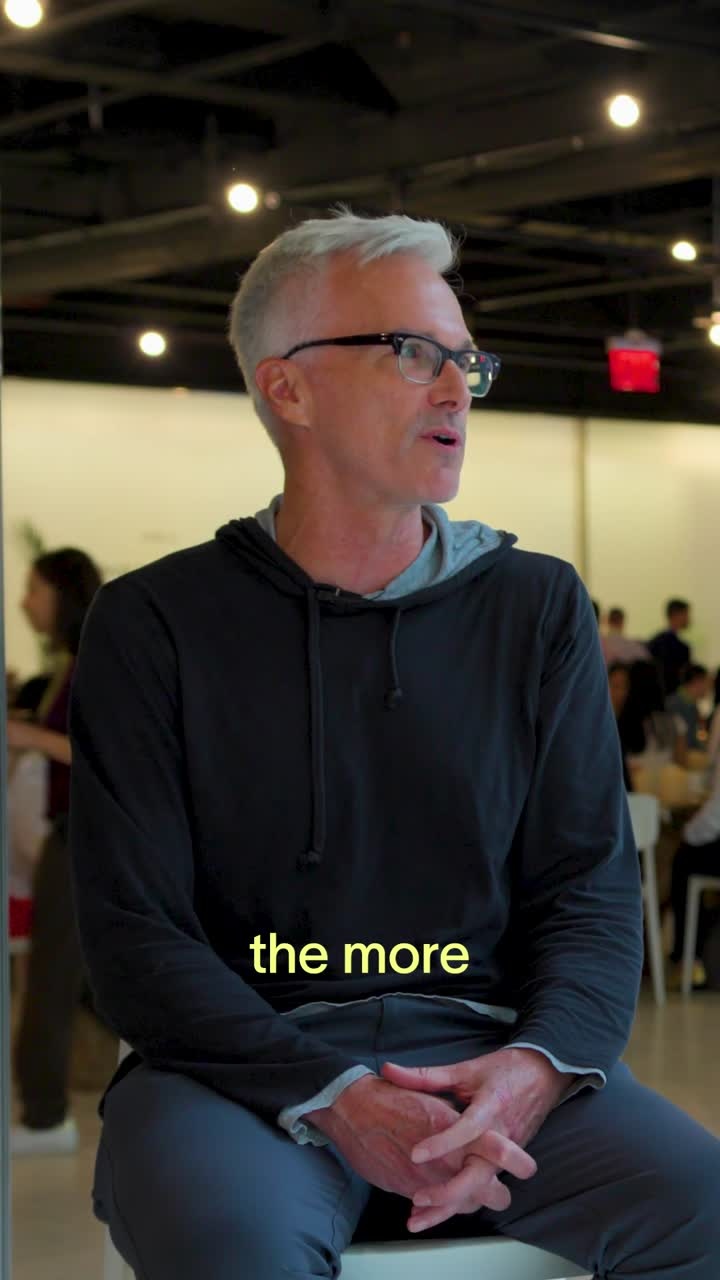
Chris Fenster had a peculiar response to a webinar about his own succession: he planned to avoid it. Someone else could explain what happened when the founder of Propeller Industries handed the CEO job to Raymond Nieuwenhuizen. Fenster had lived the transition. Watching it discussed in public seemed a rather extravagant second helping.
His explanation was disarmingly plain: “I love the former job and don't love the latter.” Founder and chief executive had occupied the same business card, but they had never been the same job. By 2024, he had recruited a successor. As executive chairman, he could stay with the company while leaving a role that had pulled him away from his strengths.
There is an agreeable lack of ceremony about this confession. Startup culture gives founders plenty of encouragement to become CEOs, and rather less permission to discover they prefer something else. Fenster's career offers a useful complication: a person can love building a business, understand its customers, and still find managing executives an increasingly poor use of his day.
A bicycle shop interrupted the plan
Long before there was a succession to arrange, there was a consulting job and the prospect of business school. Fenster, a Colgate graduate, went looking for an entrepreneurial detour. The detour was a San Francisco bicycle business called Start to Finish. He joined it, invested money raised from friends and family, and became a partner.
The attraction was tangible impact. In consulting, he had learned plenty; in the bicycle business, he could help make something that people outside the office actually recognized. He and his partner eventually sold the company to Trek. An experience intended to supply material for a business-school application had supplied a different career instead.
Success was a persuasive teacher, though hardly a complete education. His subsequent work included Swobo Clothing, Signature Wines and Bevology. The easy version of the story would have every venture improve upon the last. Fenster describes three consecutive failures before Propeller. The early bicycle exit gave him a taste for building; the disappointments that followed gave him a more demanding syllabus.
A stint at the Tides Center supplied another piece. The nonprofit handled finance and accounting for hundreds of other nonprofits. Here was an operating model he could recognize and adapt: shared financial resources serving many organizations. Propeller's eventual shape owed something to that experience, alongside the lessons he had learned as a startup CFO.
Stay long enough to see what happens
He founded Propeller in 2008. Its premise addressed an awkward gap. Young companies needed experienced financial judgment before they could justify employing an entire finance department. Buying isolated bursts of advice left another problem: the adviser could disappear between a fundraise and a board meeting, taking much of the context along.
Fenster wanted the relationship to last. Accounting provided the regular work that kept a team close to a business between those larger decisions. A forecast was more useful when the people preparing it also understood what had actually happened to the cash. Continuity made the next conversation better informed than the last.
By 2013, his work included teaching at BevNET's Beverage School, with more than 30 early-stage consulting CFO assignments behind him. The vocabulary around the business evolved. “Fractional” eventually became a familiar description of the market. Fenster has since argued that the word captures too little of the embedded relationship he wanted to build.
Sixteen years from founding Propeller to recruiting its next CEO.
That insistence on staying also explains why this is a people story. A company grows, hires its own leaders, and needs different help. In Fenster's model, the outside team can change shape around those people. The relationship survives because its purpose changes with the business.
The company grew. So did the job.
For Propeller's first eight years, Fenster and his partners shared management; nobody held the CEO title. In 2016, he stepped into the role as the firm invested in scaling. It was a reasonable decision. He wanted to learn the job. Experience would eventually teach him something more specific about his own fit.
The company was also becoming a larger undertaking. When Newlight Partners invested in August 2020, Propeller employed nearly 200 full-time people across six American offices and two international locations, serving more than 300 early-stage companies. Its clients had raised over $6 billion.
The investment was intended to support growth, technology and acquisitions. It also marked the move beyond more than a decade of organic development. The founder who had spent his time working through clients' financial problems now had a substantial organization to lead. The firm had grown around his work; his work had changed around the firm.
- 2008Founder
Shared management - 2016CEO
Scaling the firm - 2024Executive chairman
A successor takes over
The imagination inside the spreadsheet
Ask Fenster about finance people and he objects to the assumption that they lack imagination. In a conversation with Ramp's Dave Wieseneck, he described good financial professionals as entrepreneurial thinkers: people willing to challenge a prescribed outcome and work out another way to reach it. Constraints give their creativity a particular shape.
It is a useful corrective to the dreary caricature of the finance department as a collection of people paid to refuse things. Fenster also sees a tension between plentiful capital and resourcefulness. When money can be thrown at a problem, the incentive to devise a clever solution weakens. A larger budget can be a surprisingly efficient way to avoid a better question.
His consumer-brand work gives that question practical urgency. Growth consumes cash through inventory, payment delays and the cost of reaching new channels. A business can show an appealing sales line while requiring much more working capital than its founder expected. Success has expenses of its own, and several arrive before the customer's payment.
He pays attention to the less flattering numbers: retailer deductions, promotional spending, and margins that shift as a brand moves into grocery. His broader point is about visibility. A founder should be able to understand the financial consequences of the business being built, including the parts that would make an untidy pitch slide.
When the perfect hire meets the next company
People can be outgrown as quickly as systems. Fenster has written about a finance leader he calls Diana, a capable early hire whose company accelerated beyond the job she had joined. He tried to persuade her to stay under a new CFO. She wanted that title herself and chose to leave.
The story resists a convenient villain. The founder needed more experience; the employee had ambitions; the business kept changing. Fenster's observation is that a hire selected for one growth stage may be poorly matched to the next. Planning for the transition is kinder, and more useful, than treating every departure as a personal failure.
He extends the same scrutiny to job descriptions. A company that asks one person to combine operating judgment, technology expertise, transaction readiness and the courage to challenge a board has written quite a shopping list. His preference is to build a system of people and processes capable of supplying those qualities together.
“The best financial people are inherently creative.”
Chris Fenster, in conversation at OnRamp
The cheque comes with company
His writing about fundraising is equally interested in what happens after the celebration. Institutional money brings governance and guidance along with capital. Fenster calls that package the Faustian Bundle. The benefits can be substantial. So can the influence of an investor whose timetable and definition of success differ from the founder's.
In his account, repeated fundraising can raise the threshold for an acceptable exit until a perfectly respectable business no longer satisfies the arithmetic. He calls this the Risk Ratchet. Each larger round can narrow the outcomes that work for the people involved. The announcement number is only the beginning of the calculation.
He also describes a confidence vacuum: the space opened when a founder cannot explain the plan convincingly enough to retain others' confidence. His response emphasizes operational fluency. Know the numbers, understand the trade-offs, and arrive with a response to problems. A boardroom is a poor place to discover that everyone else has brought a strategy for your company.
A different technique needs somewhere to land
Fenster's interest in rebuilding systems reaches back to an unexpected classroom: high-school track. He ran the 400 meters and took up the high jump, learning the Fosbury Flop from Tom Farquhar, a physics teacher and coach. Decades later, he returned to that memory to explain his thinking about AI adoption.
The analogy concerns infrastructure. A new technique needs conditions that make it usable. In finance, that means trustworthy data, explicit processes and people who understand the exceptions. The appeal of a dazzling demonstration can obscure the effort required to make something work inside an actual company.
His personal Substack lets him pursue these arguments with more room for irritation and jokes. He questions software-industry language that presents delivering a finished service as a recent invention. The plumber already understood that the customer wanted working pipes. The fashionable vocabulary has arrived rather late to the appointment.
He has a commercial interest in the argument, of course. Propeller is a services business investing in technology. His position deserves to be read with that interest visible. It also follows a consistent concern across his career: the quality of the work depends on understanding the company, and somebody must remain responsible for the result.
A founder, with room to work
The 2024 handoff brought Nieuwenhuizen into the CEO seat while Fenster remained executive chairman. By late 2025, Propeller's data lake and intelligence engine were live. In August 2026, Fenster described those developments as part of a longer effort to turn accumulated client experience into infrastructure for the firm's next phase.
He continues to write, join interviews and discuss the decisions that founders find uncomfortable. The person who describes himself on Wellfound as an armchair cyclist has ended up spending a good deal of time explaining how businesses should change gears. At Propeller, he has made one of those changes himself.
There is something pleasingly practical about the result. He built a firm to give founders financial help that could evolve with them. Eventually, his own company required a different leader, and his own working life required a different allocation of time. He stayed, found someone to take the CEO job, and gave the founder room to work.
Keep the conversation going
- Chris Fenster on LinkedInWriting and conversations from Fenster
- Chris's SubstackPersonal essays on finance and technology
- Watch: Shelf Help with Adam SteinbergYouTube · Consumer-brand finance and the career behind it
- Watch: Finance leaders and AIYouTube · A conversation with Charlie O'Donnell
- Your Cap Table Is Your StrategyFenster's two-part argument, beginning with the system
- The Story Behind the StoryFenster on the evolution of Propeller
- Propeller IndustriesThe firm he founded in 2008