A cancer cell can be stubborn in a very specific way. Hit it with a drug that disrupts DNA replication and it may switch on a repair response. Keep the target on its surface, keep the treatment coming, and the cell can still find a route around the payload. Callio Therapeutics was built around a neat answer to that untidy biology: put the first drug and a blocker of the escape route on the same antibody, then deliver both to the same tumor cell.
That is the proposition behind CLIO-8221, the young company's lead antibody-drug conjugate, or ADC. The antibody is engineered from trastuzumab to recognize HER2, a well-established marker across breast, gastric and other solid tumors. Hanging from it are two medicines with complementary jobs. Exatecan inhibits topoisomerase 1 and creates replication stress. Berzosertib inhibits ATR, part of the signaling machinery a stressed cell can use to manage DNA damage.
The combination is logical on paper. Callio's task is to show that it is useful in people. Its Phase 1/2 trial began dosing in March 2026, roughly a year after the company emerged with $187 million in Series A financing. The study is recruiting adults with advanced HER2-expressing solid tumors in Australia and the United States, with expansion to China planned. For a company founded in 2025, the story has moved quickly from financing announcement to infusion chair.
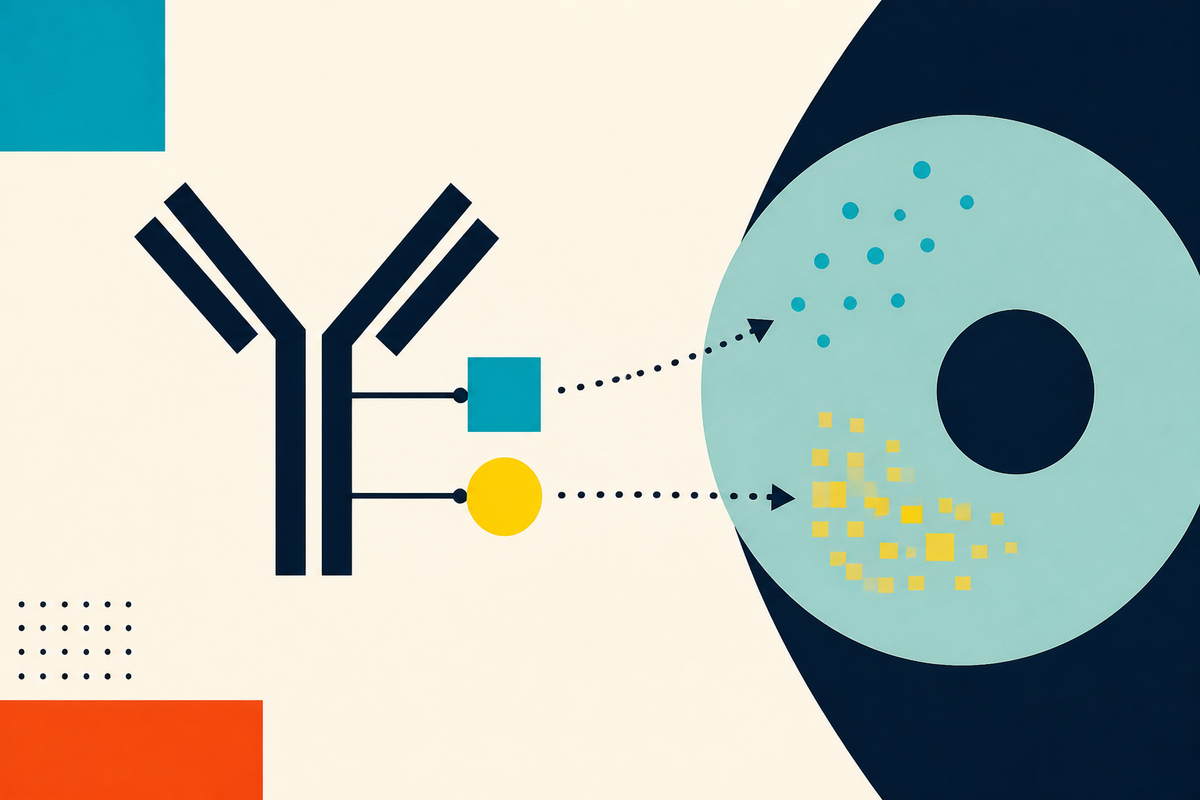
The combination regimen shrinks to one molecule
Oncologists already combine drugs. The problem is that two separately administered medicines do not necessarily arrive at the same tumor cells in the same amounts or at the same time. Their exposure in healthy tissue can also limit how much of either medicine a patient can tolerate. An ADC tries to change the distribution: an antibody seeks a target enriched on cancer cells, the whole construct is internalized, and a linker releases its payload.
Most approved ADCs carry one class of payload. Callio's platform is designed to attach two, with drug-to-antibody ratios and payload combinations that can be adjusted. The intended advantage is co-delivery. Instead of hoping that two systemic drugs overlap at the right place, a dual-payload ADC packages the combination around one targeting event.
The design has more going on than the number two. The 2026 ASCO trial abstract describes an Fc-engineered trastuzumab intended to reduce uptake through Fc-gamma receptors. It also describes a hydrophilic, protease-cleavable linker meant to curb nonspecific uptake. Those choices matter because attaching potent drugs to an antibody is a balancing exercise: keep the construct stable in circulation, release the payload after it reaches a tumor and avoid delivering too much toxicity elsewhere.
“Most patients eventually progress on treatment despite retaining HER2 expression.”Callio Therapeutics, CLIO-8221 program description
A success problem in HER2 cancer
Callio is entering a field transformed by trastuzumab deruxtecan, sold as Enhertu by AstraZeneca and Daiichi Sankyo. That single-payload HER2 ADC expanded the reach of targeted therapy and showed that even tumors with lower HER2 expression could respond. It also sharpened the next problem: many patients eventually progress, and some tumors remain HER2-positive even after the drug stops working.
CLIO-8221 keeps the familiar address and changes what arrives. Exatecan belongs to the same broad payload class that helped drive the recent ADC revival. The ATR inhibitor is the differentiator. Topo1 inhibition causes replication stress; ATR signaling helps organize the damage response. Callio aims to make the second payload sensitize a tumor to the first, including in disease that is insensitive or refractory to a Topo1-based ADC.
Preclinical data reported in the ASCO abstract are encouraging but remain preclinical. The candidate produced tumor regressions after a single dose in models with varied sensitivity to trastuzumab deruxtecan, including resistant and refractory xenografts. It was also described as tolerable in non-human primate studies. None of that establishes safety or efficacy in patients. Dose escalation exists precisely because plausible biology and animal data still have to survive human physiology.
The Phase 1 portion is designed to answer that foundational question. Investigators are escalating doses, reviewing safety through a monitoring committee and measuring pharmacokinetics, pharmacodynamics, immunogenicity, biomarkers and early antitumor activity. Optional expansion groups can add patients at selected dose levels. Phase 2 is designed to move into tumor-specific cohorts and optimize dosing if the earlier work supports it.
Born in Singapore, financed for the clinic
Callio did not start with an empty laboratory. Frazier Life Sciences created the company around technology and programs exclusively licensed from Hummingbird Bioscience, a Singapore biotech co-founded by Piers Ingram and Jerome Boyd-Kirkup. Hummingbird's former HMBD-802 became CLIO-8221. Related ADC programs and the oncology rights to the platform moved with it under a worldwide license involving equity, potential milestone payments and royalties.
The arrangement explains Callio's dual headquarters in Seattle and Singapore. It also explains how a new corporate entity arrived with a candidate close to clinical development. Frazier led the $187 million round; Jeito Capital participated significantly, joined by Novo Holdings, Omega Funds, ClavystBio, Platanus, Norwest, Pureos Bioventures, SEEDS Capital and EDBI. The money was sized to pursue clinical proof of concept for the HER2 program and a second, initially undisclosed ADC.
This is Callio's business model today: spend private capital to turn licensed platform science into proprietary clinical assets. It has no approved product, disclosed revenue or commercial customer. If the medicines work, value could eventually come through a pharmaceutical partnership, licensing transaction, acquisition or Callio's own commercialization effort. The company has not publicly fixed that route, and early clinical evidence will shape the options.
Small team, crowded field
Callio has about 19 employees by available company data, while LinkedIn places it in the 11-to-50 range. Its pitch rests partly on concentration of experience. Public biographies connect the team to Seagen, Genentech, Medarex, ProfoundBio, Silverback Therapeutics and Hummingbird. In July 2026 the company website listed Zachary Hornby as chief executive, following founding CEO Piers Ingram. Hornby previously led Boundless Bio and helped take Ignyta through a $2 billion sale to Roche.
The market around them is busy. Approved HER2 ADCs set a high clinical bar. Large drugmakers and specialist biotechs are exploring new targets, linkers, conjugation methods and payloads. A smaller group is now pushing dual-payload programs, including compounds from Innovent, Astellas and others. Some pair two cytotoxic mechanisms; some combine cell killing with immune stimulation or DNA-damage response inhibition. Callio does not own the category. Its distinction is the particular Topo1-plus-ATR pairing, the HER2 setting and a linker platform built for flexible payload combinations.
The competitive test will be more demanding than demonstrating that two payloads can be attached. Callio must show a usable therapeutic window, predictable manufacturing, a rational dose and activity that matters after existing HER2 treatments. It must also learn which tumors and biomarkers make patients most likely to benefit. “HER2-expressing solid tumors” is a broad starting gate, not necessarily the final market.
The practical difference from prescribing two separate drugs is control. CLIO-8221 fixes the payload ratio on each conjugate and ties both medicines to the same targeting and internalization event. That could reduce the mismatch created when one systemic drug clears faster, enters different tissue or reaches a dose-limiting toxicity before its partner. It also removes some flexibility: a clinician cannot independently lower one payload while keeping the other constant. Callio therefore has to choose its ratio before the drug reaches the clinic and show that the packaged combination works across variable patients and tumors. The platform's modularity helps the company design candidates; it does not make a finished candidate adjustable at the bedside.
What the next data can reveal
Callio's story is appealing because the diagram can be understood in a minute. One carrier. Two drugs. A tumor with a known response to stress. The caution is equally understandable: clever delivery systems can create new liabilities alongside new options. Two payloads may broaden activity, but they also complicate exposure, toxicology, analytical testing and manufacturing consistency.
The current trial should begin separating architecture from outcome. Safety will show whether the linker and Fc engineering produce the intended control. Pharmacology will show whether both payloads reach useful levels. Biomarkers may reveal whether ATR-pathway behavior or prior response to trastuzumab deruxtecan predicts benefit. Tumor responses, when mature enough to interpret, will indicate whether targeted co-delivery is doing more than making an elegant molecule.
For now, Callio occupies a precise place in the oncology market: a well-financed, clinical-stage test of dual-payload ADCs in the large and competitive HER2 landscape. Its customers are not hospitals ordering a finished medicine. They are investigators running a dose-escalation study and patients who have exhausted established options. The company's promise will remain conditional until their experience produces data.
That restraint makes the next chapter more interesting, not less. The platform thesis has escaped the slide deck. CLIO-8221 is in patients, where the two-payload idea will meet the only system complicated enough to judge it.