BREAKING GEA Group backs Caldera with 10M pound Series A FIRST ORDER NHS hospital buys a 10 MWh Storage Boiler TECH Warmstone stores heat at 500C from rock and scrap aluminium FUNDING 4.3M pound UK government grant for Fareham demonstrator SCALE Modular boilers from 5 to 100 MWh of stored heat BREAKING GEA Group backs Caldera with 10M pound Series A FIRST ORDER NHS hospital buys a 10 MWh Storage Boiler TECH Warmstone stores heat at 500C from rock and scrap aluminium FUNDING 4.3M pound UK government grant for Fareham demonstrator SCALE Modular boilers from 5 to 100 MWh of stored heat
Fareham, England · Clean Energy · Est. 2017

CALDERA

The heat battery that runs on yesterday's wind - stored in volcanic rock and scrap aluminium.

Thermal energy storage Industrial decarbonization Series A · GEA-backed
Caldera industrial Storage Boiler thermal battery technology
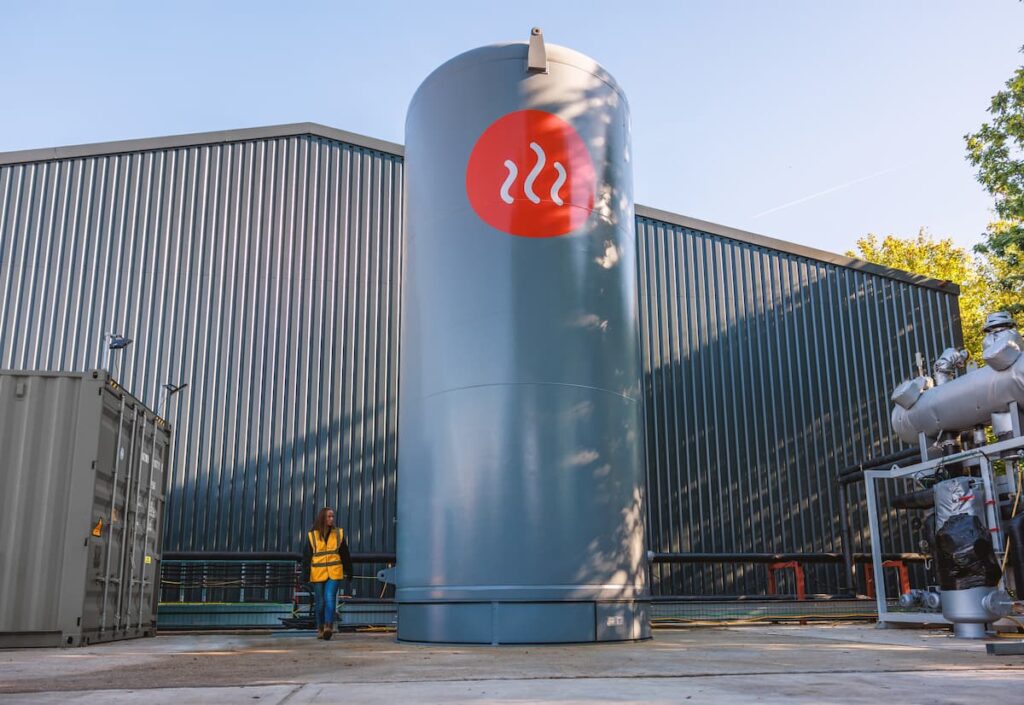
Caldera's Storage Boiler: a vacuum-insulated box that swallows cheap electricity at night and breathes out industrial steam by day. Less dramatic than a volcano. Roughly the same idea.
Who they are now

A factory in Fareham is melting rock so a brewery doesn't have to burn gas.

Inside a low building on Brunel Way, an engineering team is charging a block of stone and recycled metal with electricity until it glows at 500C. They are not doing this for theatre. They are doing it because somewhere a dairy, a distillery, or a hospital needs steam tomorrow, and the cheapest, cleanest way to make it is to store today's surplus renewable power as heat and hold onto it. That box is Caldera's Storage Boiler. The glowing core inside it is called Warmstone.

Caldera is a clean-energy company with around 35 people and an unfashionable obsession: heat. Not electricity, not hydrogen, not the parts of the energy transition that get magazine covers. Heat - the stubborn, invisible 20% of global emissions that comes from making things hot. They have decided that is the problem worth solving, and they have built a battery that stores it.

"Storage has to be phenomenally cheap to be worth putting in, and therefore you have to have the most aggressive cost targets."James Macnaghten, Co-founder & CEO
The problem they saw

Renewable electricity is wonderfully cheap, right up until you need it.

Here is the awkward truth the grid keeps trying to hide. Wind and solar produce power on their own schedule, which is rarely the schedule a factory keeps. At 3am the turbines spin and prices fall through the floor. At 9am, when the production line fires up, everyone wants power at once and the cheapest electrons have long since vanished. Batteries can shift some of that electricity by a few hours, but lithium is expensive and, when your end product is simply heat, it is also overkill.

Industrial heat sits at the center of this mismatch. Roughly a fifth of the world's greenhouse gas emissions come from heating things up - steam for food, hot water for pharma, process heat for manufacturing. Most of it still comes from burning gas, because gas is reliable and a boiler is cheap. Telling a factory to electrify is easy. Telling it to electrify without tripling its energy bill is the hard part.

"Industrial heat is roughly 20% of global emissions. The off switch had to be cheaper than the gas it replaces, or nobody would ever flip it."The bet, in one sentence

The conventional answer is a heat pump, and heat pumps are excellent - but on their own they still want power exactly when it is most expensive. What was missing was a way to decouple the two: buy electricity when it is cheap and green, deliver heat when the factory actually needs it. A thermos for the grid, essentially. Nobody had made one cheap enough to bother.
The founders' bet

Two engineers decided the answer was hot rock, not better chemistry.

In 2017, James Macnaghten and Guy Winstanley started Caldera on a contrarian premise. While the rest of the storage world raced toward exotic battery chemistries, they looked at the cheapest, most abundant, most fireproof materials they could find - volcanic rock and recycled aluminium - and asked whether those could hold energy instead. The aluminium conducts heat fast. The rock holds it. Together they became a storage medium that does not degrade, cannot catch fire, and is designed to last for decades.

Macnaghten, a Cambridge-trained engineer who had already spent years in energy R&D, was sufficiently convinced that the first full-size domestic unit ended up installed in his own home. There is a certain honesty to a founder who heats his own house with the prototype. If it had failed, he would have been cold.

"The cleanest industrial heat available might just be last night's wind, kept warm until morning."The Caldera premise

The clever part was never only the material. It was the insulation. Caldera wrapped its hot core inside a double-walled, vacuum-insulated shell - the same principle as the flask that keeps your coffee warm, scaled up to industrial size. The result loses less than 4% of its stored heat per day. You can charge it overnight and still be pulling steam out of it the following afternoon.

The product

Warmstone, and the boiler built around it.

Caldera's technology comes in one core idea and a growing family of sizes. Charge it with electric resistive heating - the same physics as a kettle element - and the Warmstone core climbs to around 500C. When heat is needed, the boiler draws it back out as hot water or steam up to roughly 200C, the temperature band where most industrial processes live. No combustion. No fumes. No hazardous waste.

Warmstonecore material

A thermal storage composite of recycled aluminium and volcanic rock, charged electrically and held in vacuum-insulated heat cells. Cheap, non-flammable, and built to outlast the equipment around it.

Industrial Storage Boilerflagship

A modular electric heat battery storing 5 to 100 MWh. Charges in about 2.5 hours when power is cheap, then delivers steam and hot water on demand - a drop-in replacement for the gas boiler it sits next to.

Domestic Warmstonewhere it started

The original ~100 kWh home unit: enough heat and hot water for a four-bedroom house through the coldest winter day, trialled in the Energy Systems Catapult Living Lab.

"It bridges the gap between variable renewable electricity generation and industrial process heat demand - a scalable, economically viable alternative to fossil fuel boilers."Kai Becker, GEA Group
The story so far

From a radiator to a hospital boiler room.

2017

James Macnaghten and Guy Winstanley found Caldera in Fareham, Hampshire.

2018

World-first heat-storage material made from volcanic rock and recycled aluminium.

2020

First full-size domestic Warmstone unit installed in the CEO's own home.

2021

Crowdcube raise of ~1.5M pounds from over 1,300 backers, smashing its goal.

2023

Awarded a 4.3M pound UK government (DESNZ) grant to build a full-scale industrial demonstrator.

2024

Industrial demonstrator reaches 1 MWe charging capacity.

2025

Closes a 10M pound Series A led by GEA Group; lands first commercial order - a 10 MWh Storage Boiler for an NHS hospital; exhibits at Hannover Messe.

The proof

The numbers behind the rock.

Caldera has spent more time chasing cost and physics than headlines. A few figures explain why a global engineering firm decided to write a cheque.

Funding raised by milestone
GBP, approximate, public sources (2021–2025)
Crowdcube '21
1.5M
DESNZ grant '23
4.3M
Series A '25
10M (GEA)
Bars scaled to the 10M pound Series A. Figures are approximate and drawn from public reporting; grant and equity rounds are shown together to illustrate momentum, not a single cap table.
500C
peak core storage temperature
<4%
heat lost per day, standby
5–100
MWh per modular boiler
~2.5h
charge time on cheap power
The mission

Make zero-carbon heat cheap enough that the choice is obvious.

Caldera's stated goal is plain: make sustainable, zero-carbon heat accessible and affordable for industry. The word that matters is affordable. Plenty of green technologies work in a lab and die on a spreadsheet. Caldera's whole design philosophy starts from the cost target and works backward - which is why the storage medium is rock and recycled metal rather than something rare and expensive.

The 2025 partnership with GEA Group, a global name in food, beverage and pharma processing, is the clearest signal that the spreadsheet now agrees. GEA did not just invest; it began pairing Caldera's storage boilers with its own heat pumps to offer factories all-electric heat between 100 and 200C. The first commercial customer was not a flashy tech firm but an NHS hospital - an institution that counts every pound and still decided the maths worked.

"The investment from GEA is a game-changing opportunity for our company and a strong endorsement of our technology."James Macnaghten, Co-founder & CEO
Why it matters tomorrow

Every factory still burning gas is a customer waiting to happen.

The grid is only going to get greener and more variable, which makes the gap between cheap power and constant heat demand wider, not narrower. That gap is precisely where Caldera lives. As carbon prices climb and gas stays volatile, the case for storing surplus renewable electricity as heat stops being an environmental argument and becomes a purely financial one - the kind that finance directors sign off without a press release.

There is a quiet irony in the company's name. A caldera is the crater left behind after a volcano blows its top - a violent event that leaves behind something stable and lasting. Caldera the company is doing the inverse: taking the calm, abundant materials a volcano leaves in the ground and turning them into stored energy that arrives exactly when a factory needs it.

Back in Fareham, the block of rock is still glowing. Only now there is a hospital waiting for the steam, a German engineering giant on the cap table, and a growing line of factories asking the same question: what if the boiler could stay, and only the carbon had to go? Caldera built the answer out of rock and scrap metal. The rest of industry is starting to notice.

"Stop burning gas. Start storing wind. The boiler stays; the carbon goes."Caldera, distilled
Spread the word

Share Caldera