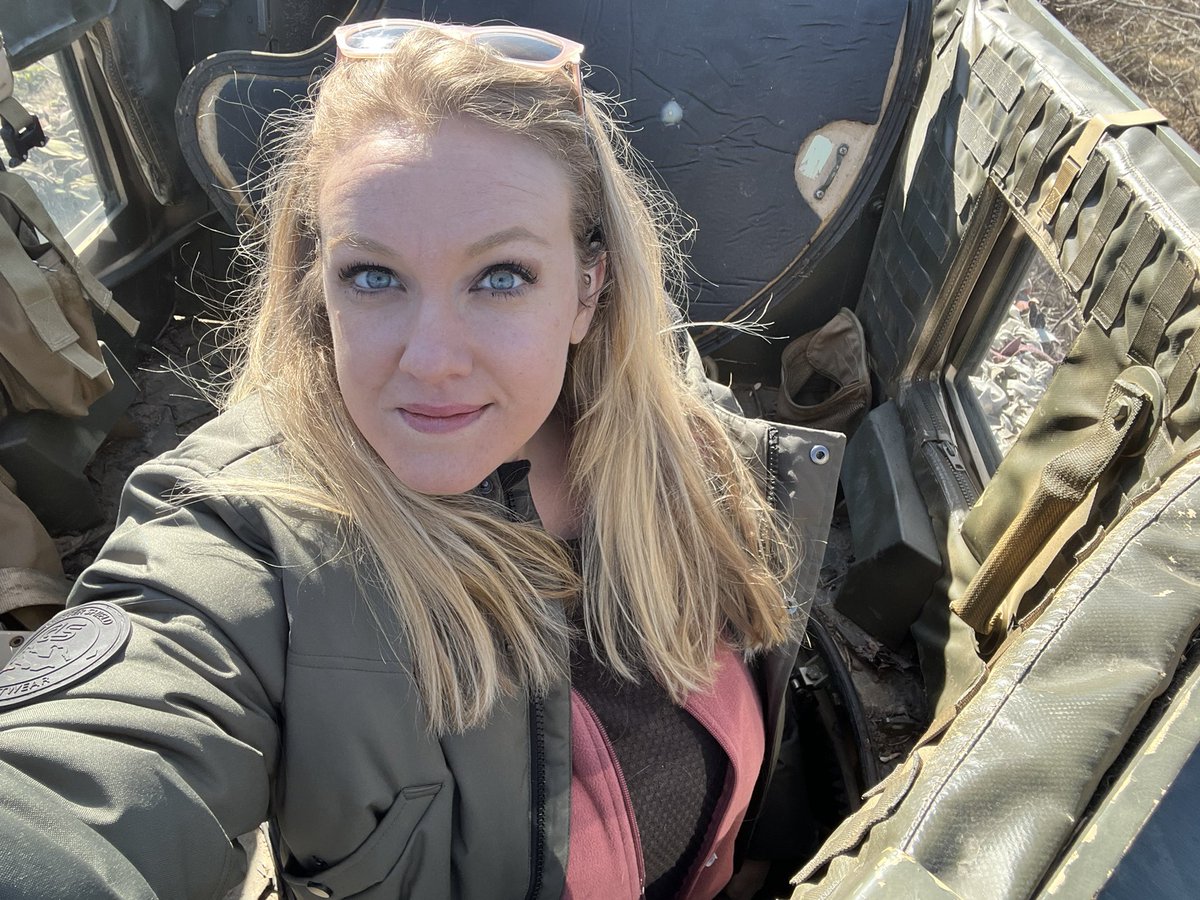
The Reporter Who Goes to the Scene
There is a certain kind of journalist who covers the military from conference rooms and press briefings - who files stories about Pentagon policy from a desk in Rosslyn, Virginia, surrounded by other reporters filing the same story. Caitlin Doornbos is not that kind of journalist. She is the kind who boards a flight to Kyiv while others are debating whether it's safe to go.
As Washington D.C. correspondent for the New York Post and a frequent contributor to Times Radio London, Doornbos covers national security, foreign policy, the White House, and Congress. That's the official job description. The unofficial one involves being present - at a secret weapons repair base in Ukraine, at a naval base in Japan, at the Pentagon the day of a major international crisis.
"I had to go to the scene," she said while accepting the Marie Colvin Award for Foreign Correspondence in February 2025, "to show our readers here in New York why this is a fight for democracy, this is a fight for the free world." The award, given by the Newswomen's Club of New York and named for the legendary Sunday Times reporter killed in Homs, Syria in 2012, is one of journalism's most serious recognitions of field courage. Doornbos earned it at 32.
"I had to go to the scene to show our readers here in New York why this is a fight for democracy, this is a fight for the free world."- Caitlin Doornbos, accepting the Marie Colvin Award, 2025
From the Kansas Plains to the Pacific Fleet
Doornbos grew up in Hutchinson, Kansas - flat horizon, oil economy, roughly 42,000 people. She studied journalism at the University of Kansas, where she ran the student radio station as news director and co-launched a political news program on university television. That early combination - radio timing, television presence, print instincts - explains something about how she operates across platforms today.
Her early career ran the local beat circuit: crime and breaking news at the Lawrence Journal-World, then breaking news at the Orlando Sentinel. In 2016, the Pulse nightclub shooting happened. Doornbos was part of the Sentinel team that covered it - work that earned the paper a Pulitzer Prize finalist nomination for Breaking News Reporting in 2017. It was a brutal story to cover. It was also formative. She learned what it meant to be present at the worst moment.
In 2021, she completed a Master of Defense and Strategic Studies at the University of Texas at El Paso. That degree signals something important: Doornbos didn't just want to cover the military. She wanted to understand it - the doctrine, the strategy, the geopolitical chess that drives deployments and alliances. Most journalists parachute into defense coverage. She built the foundation first.
That same year, she joined Stars and Stripes as their Indo-Pacific correspondent, based at Yokosuka Naval Base in Japan - home of the U.S. Navy's 7th Fleet. She would spend more than three years there, embedded in an environment where U.S.-China tension was tightening and every fleet movement carried implications. She covered those movements. She also embedded with the Royal Australian Navy and the Japanese Maritime Self-Defense Force - learning to operate across three different military cultures, three different command structures, three different ideas of operational security.
Sole Reporter at the Defense Department
In 2021, Stars and Stripes moved Doornbos to Washington as their Pentagon correspondent - the sole journalist representing the paper at the largest office building on the planet. The timing was not gentle. She arrived just as the U.S. was executing the withdrawal from Afghanistan, one of the most complex and scrutinized military operations in recent American history. She covered it.
Then Russia invaded Ukraine. She covered that too - not from Washington but from the field. Multiple embeds with Ukrainian forces. Battlefield dispatches filed from positions where the risk was real. Access to a secret weapons repair base that few journalists obtained. The kind of reporting that requires months of trust-building, not a press credential and a Zoom call.
In 2022, she moved to the New York Post as their Washington correspondent, expanding her beat to cover the White House, Congress, and federal agencies alongside her continuing national security work. The Post's readership is large, opinionated, and from New York - people who may know very little about what the 7th Fleet does or why a Ukrainian weapons depot matters. Doornbos makes those connections without condescension.
What the Marie Colvin Award Actually Means
The Marie Colvin Award is not a feel-good prize for writing nice things about difficult subjects. It is named for a woman who wore an eye patch, had covered nine different wars, and was killed in 2012 by a Syrian government rocket while reporting from Homs. The award ceremony was held at the New York Athletic Club in Manhattan in February 2025. Doornbos, at 32, became one of the youngest recipients in the award's history.
The citation recognized her Ukraine reporting specifically - the battlefield dispatches, the embedded access, the commitment to being physically present in a conflict zone while filing for a general audience. War reporting is a particular discipline. It requires technical understanding of military operations, cultural fluency, physical stamina, and the ability to file on deadline while surrounded by noise, danger, and grief. Doornbos has the academic credentials to understand what she's seeing, the experience to contextualize it, and the professional training to explain it clearly.
The Broader Lens: From Yokosuka to Islamabad
In April 2026, Doornbos reported from Islamabad, Pakistan, covering diplomatic negotiations and the country's potential role in Middle East peace discussions. Her dispatches noted something that rarely makes it into hard news copy: the warmth of Pakistani hospitality, the genuine excitement among ordinary people about their country's possible role in international diplomacy. "The hospitality of Pakistanis is so warm - more welcoming than I believe I've ever experienced," she wrote.
That observation says something about how Doornbos approaches the world. She is not parachuting into countries to extract conflict narratives and leave. She is observing, absorbing, and reporting with the kind of human texture that national security journalism often strips away in its rush toward geopolitical abstraction.
The thread running through all of it - from the Pulse nightclub in Orlando to Yokosuka naval base to Kyiv to Islamabad - is a commitment to being where the story actually is, and reporting what she actually sees. In an era of aggregation and commentary masquerading as journalism, that's rarer than it should be.
The Shape of a Career Built on Presence
Doornbos has covered crime, military affairs, foreign policy, war, diplomacy, the Pentagon, the White House, and Congress. She has filed from Kansas, Florida, Japan, Ukraine, and Pakistan. She has a master's degree that most defense reporters don't bother with and field experience that most academics will never have. The combination is specific and it shows in the work.
She came up through local news - the Lawrence Journal-World, the Orlando Sentinel - which means she knows how to make a story matter to someone who has never thought about U.S.-China naval competition or the logistics of a weapons repair base. That local news background is not incidental. It's the foundation on which the rest of the career was built: write for the reader in front of you, not for the expert in the back row.
The New York Post has 90 million monthly readers. Times Radio London has a British audience that is deeply invested in Ukraine and Atlantic security but may not know the difference between the 7th Fleet and the 5th. Doornbos serves both audiences - and does so from first-hand reporting that neither audience could replicate.
Still reporting. Still going to the scene.