Bruce Springsteen has spent much of his career singing about people who want to leave. They leave the factory, the family, the town, the good intentions, or at least the parking lot. A car waits in nearly every early song like a second chorus. Yet Springsteen's own great trick has been returning: to New Jersey, to the E Street Band, to the rooms where his characters still owe money and explanations. He made escape sound glorious, then devoted the next fifty years to asking where everybody thought they were going.
The nickname is The Boss, a bit of boardwalk bookkeeping that stuck because he once collected the band's pay and divided it among the players. It is also a comic fit for a writer whose best characters have almost no authority. They work at the pleasure of the foreman, the bank, the market, the family history. They have Friday-night nerve and Monday-morning terms. Springsteen gives them the wheel, but he never pretends the road is free.
His career, with all its stadiums and official medals, is easier to understand as a lifelong negotiation between two rooms. One holds the E Street Band, a crowd and the lovely social pressure of a count-in. The other contains a solitary writer, a cheap recorder and enough quiet to hear what the big arrangement might hide. Springsteen needs both rooms. Each keeps the other honest.
A loud noise from a shy kid
He was born in Long Branch in 1949 and raised in Freehold, New Jersey, in a family where money was tight and adult life arrived early. He has described his younger self as shy and his early home life as chaotic. Guitar solved two problems at once. It gave his hands a job and his presence a volume knob. Once he could make a loud noise in a gym full of dancers, invisibility became optional.
His mother, Adele, helped with the equipment. After he had been knocked sideways by Elvis Presley on television, she eventually borrowed money to buy him a Kent electric guitar. His father, Douglas, supplied a more complicated inheritance: the clothes, silences and disappointed working life that Springsteen would study in song. The son did not become a factory worker. He became exacting enough to build factories out of sound.
Local bands led to the Castiles, the Upstage club in Asbury Park, an audition for Columbia talent scout John Hammond and a 1972 record deal. The first two albums displayed a writer who seemed determined to fit the entire Jersey Shore into every verse. The songs had saints, hustlers, switchblades, arcades and more syllables than some municipalities. They were vivid. They did not sell much.
“I went into rock'n'roll music to create order out of my life.”Bruce Springsteen
By the third album, ambition had acquired a deadline. Born to Run was worked and reworked until drums sounded like doors slamming three streets away and saxophones seemed to know the address. In 1974, critic Jon Landau had written that he had seen rock and roll's future and it was Springsteen. The line became advertising copy. Landau became a co-producer, then manager and confidant. One overheated sentence turned into one of rock's longest professional conversations.
Born to Run arrived in 1975 and put Springsteen on the covers of Time and Newsweek in the same week. He was suddenly famous as the future, which is a difficult occupation with poor hours. The record offered scale, but its decisive move was close observation. Mary fixes her hair. Wendy climbs in. The screen door slams. The grand idea of escape enters through ordinary hardware.
When the room got smaller
Then came the useful refusal. After Darkness on the Edge of Town and the sprawling River, Springsteen went home with a four-track cassette machine. In a rented Colts Neck house, he recorded a set of demos populated by drifters, killers, state troopers and people staring into the consequences of their choices. The E Street Band tried the songs. The studio tried to improve the tape. Nothing improved the feeling.
Nebraska was released in 1982 with its distance, hiss and loneliness intact. It is tempting to romanticize the little machine, but the machine was merely the room's honest witness. The impressive decision was commercial: after learning how to make a large record, Springsteen recognized the authority of a small one.
Two years later he released Born in the U.S.A. The album produced seven Top 10 singles, turned a rear view into an album cover and made Springsteen recognizable in places where New Jersey was only an idea. Its title track also supplied a career-long warning about choruses. The arrangement sounds triumphant; the verses follow a veteran abandoned by the country that sent him away. People heard the flag in the snare drum and sometimes missed the person inside it.
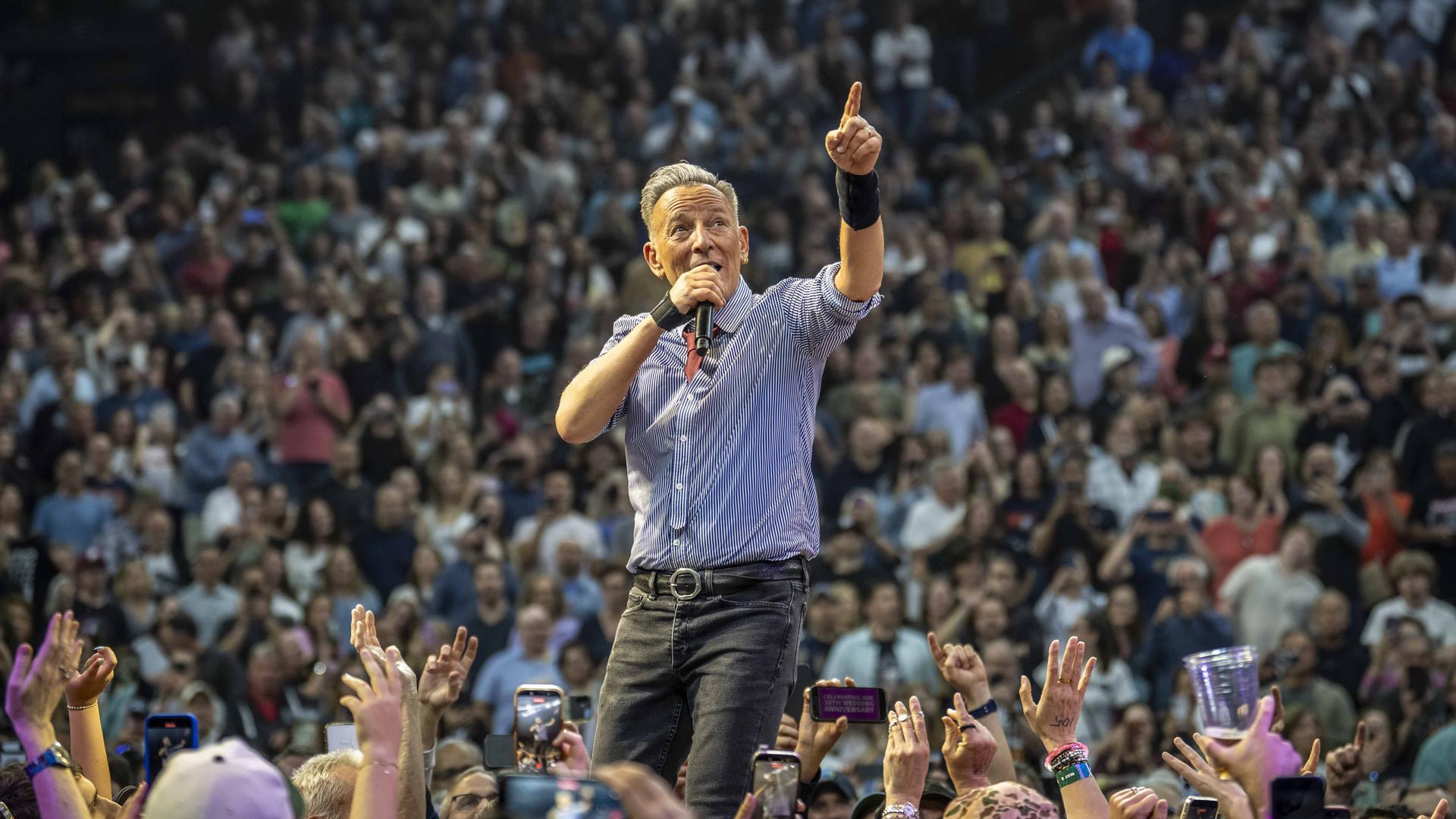
This is where the two rooms begin talking clearly. The quiet one protects the detail. The loud one makes the detail public. The finest E Street shows do not erase that difference; they stage it. A whisper becomes a count-in. Private grief becomes a sound several thousand strangers can carry together for four minutes.
E Street is a civic arrangement
A long-running band is part orchestra, part family business, part weather system. Springsteen has toured with pianist Roy Bittan, bassist Garry Tallent, guitarist Steven Van Zandt, drummer Max Weinberg and a changing, expanding E Street company across decades. The late Clarence Clemons, whose saxophone became one of the band's governing voices, also became Springsteen's great stage foil: two friends turning fellowship into theater.
Their endurance matters because the songs are arguments about connection. The characters want out, but they also want somebody in the passenger seat. Even the loneliest records keep imagining a listener. Onstage, the band makes that imagined community visible. Springsteen conducts it with hand signals, jokes, set-list changes and the confidence of a person who has spent decades learning exactly how loose a sturdy structure can become.
“You can change a life in three minutes with the right song.”Bruce Springsteen
His subjects widened with the years. The Ghost of Tom Joad looked toward migrants and the working poor. The Rising tried to find communal language after September 11. The Seeger Sessions borrowed an older American songbook and gave it a brass-band bustle. Western Stars went west in search of orchestral pop and fading performers. None of these projects required him to stop being from Freehold. They required Freehold to become a point of view rather than a fence.
Politics followed the characters. Springsteen campaigned for presidential candidates, sang with Pete Seeger at Barack Obama's 2009 inaugural celebration and later recorded an eight-part podcast with Obama about race, work, fathers and the unfinished national story. His political speech can be blunt. His songs usually do something more difficult: they give a person a name, a job and a reason before asking the listener for judgment.
The archive is still arguing
Springsteen published a memoir in 2016, then adapted its stories into Springsteen on Broadway. The theater reduced the rock apparatus to voice, piano, guitar and autobiography. It also let him tease his own mythology. The fellow forever singing about getting out of New Jersey, he noted, still lived minutes from his hometown. Escape had become less a destination than a useful dramatic engine.
Born to Run, the memoir, turns a public mythology back into a first-person life.
Springsteen on Broadway makes an arena performer accountable to a single room.
Renegades places Springsteen in conversation with Barack Obama.
Tracks II reveals seven complete albums left off the official road.
A new center at Monmouth University gives the archive a public home.
The recent archival work makes the same point on a larger scale. Tracks II: The Lost Albums gathered seven unreleased projects and 83 songs made across 35 years. These were not a handful of failed sketches. They were alternate routes: country, border tales, orchestral pop, loops, filmic atmosphere. Nebraska '82 finally brought the long-rumored full-band sessions into daylight. The official career turned out to contain several unofficial careers humming underneath it.
In 2026, the Bruce Springsteen Center for American Music opened at Monmouth University. The 32,000-square-foot building houses archives, exhibitions, research, interactive displays and a performance theater. It is a fitting institutional form for an artist who has always treated popular music as both entertainment and evidence. The old joke was that his mother's basement held more Springsteen material than anywhere else. The basement has acquired scholars.
And still, the point is not preservation alone. After the Land of Hope and Dreams American Tour, Springsteen announced a filmed Philadelphia finale in segments, placing a current argument beside the old catalog. Asked about the future in 2025, he did not offer a retirement speech. He wanted to keep going, he said, and to make records about subjects people had not heard him address.
That desire is the modest engine beneath the monuments. The awards are substantial: 20 Grammys, an Oscar, a Special Tony, Hall of Fame inductions, the Presidential Medal of Freedom. The sales exceed 140 million records. Yet the work keeps returning to a smaller test. Can a detail bear the weight of a country? Can a band turn an audience into neighbors? Can an old form still surprise the person making it?
Springsteen's answer has never been a clean yes. It is a count-in, an attempt and another night on the job. The car is still outside. Somebody is still deciding whether to leave. Somewhere between the quiet room and the public square, he is listening for the line that tells us what the trip will cost.