It builds robots that make a warehouse taller. The flat conveyor goes three-dimensional, and suddenly the same floor holds twice the packages.
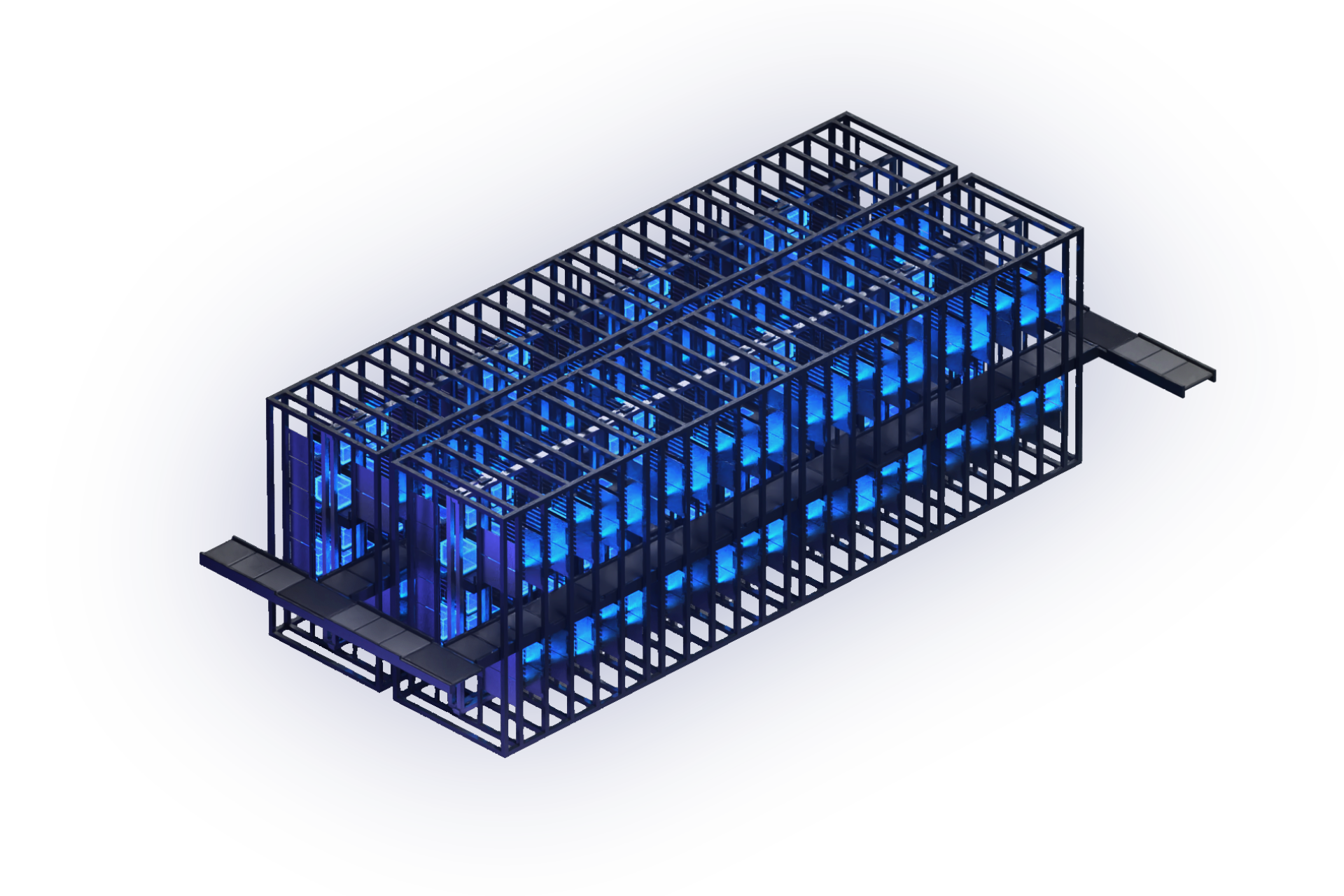
It is 4 a.m. at a delivery depot somewhere off a highway, and the trucks need to leave by six. In most buildings, this is the part where people run. Boxes everywhere, on the floor, on carts, sorted by hand under fluorescent light. At a facility running Boxbot, the boxes are not on the floor. They are stacked twenty-five feet up inside a steel gantry, and a machine is pulling them in the exact order the next van will need them.
Boxbot is a robotics company in Alameda, California. It makes an AI-driven storage system that takes the flattest, dumbest object in any warehouse - the conveyor belt - and turns it into something three-dimensional. Packages go in. The system stores them, sorts them, and hands them back in sequence. The footprint stays the same. The capacity roughly doubles.
That is the whole company in one sentence: density is the cheapest mile of last-mile delivery. Everything else - the software, the gantries, the sensor fusion - exists to deliver on that idea.
E-commerce trained everyone to expect the box tomorrow, sometimes today. What it did not do was make that box cheaper to move. The final leg of delivery - sorting, staging, loading the right parcels onto the right van in the right order - is the most expensive and most stubbornly manual part of the chain. Labor is tight. Buildings are expensive. Parcels come in every size from a phone case to a microwave, which is exactly the kind of mess that defeats most automation.
Carriers had two bad options. Build bigger buildings, or hire more people for shifts no one wants. Boxbot's bet was that there was a third option hiding in the vertical space above everyone's heads.
Boxbot did not start here. Founded in 2016 by Austin Oehlerking and Mark Godwin, it spent its early years as a stealthy self-driving last-mile delivery startup - one of many chasing the autonomous-van dream out of the Bay Area. There was a robot inside the van that handled the packages. That box-handling system was supposed to be a feature.
Then a funny thing happened. Customers kept asking about the box-handling robot and politely ignoring the self-driving van. The side project was the product. So in 2023 the company did the unglamorous, correct thing: it pivoted.
Killing your original idea because the market told you to is rarer than it should be. Boxbot stopped trying to drive the van and started building the thing that loads it - faster, denser, and without the 4 a.m. scramble.
Austin Oehlerking and Mark Godwin start Boxbot in the Bay Area, chasing autonomous last-mile delivery.
TechCrunch covers Boxbot as a quiet self-driving delivery startup. The package robot is still just a part.
Toyota AI Ventures leads the seed, joined by Pear, The House Fund and Artiman.
Boxbot productizes the warehouse platform and raises a $12M Series A led by Playground Global, with Maersk Growth and Toyota Ventures. Former UPS CFO Richard Peretz joins the board.
Boxbot sharpens its product story around the Boxbot System hardware and the Boxbot Operating System software, publishing density, uptime and throughput numbers.
Five lines that took roughly nine years to draw. The pivot in the middle is the one that mattered.
Boxbot ships two things that only make sense together: a modular robotic storage system and the software that runs it. The hardware is a gantry architecture that loads and unloads itself, hands-free, stacking parcels up to twenty-five feet high. It does not care if the next item is a paperback or a printer - it handles sizes from roughly six inches to nearly three feet on a side.
AI-powered dynamic storage with automated load/unload. Stores, sorts and sequences variable-size parcels in a dense vertical footprint at 250-4,000+ pieces per hour.
The brain. Real-time space allocation, sequence and inventory optimization, sensor-fusion monitoring and fault detection across the whole system.
One platform, many docks: last-mile delivery stations, air cargo, customs-bonded storage, and cross-dock buffering.
A storage robot is only interesting if it changes the math of a shift. In its pilots, Boxbot has reported the kind of gains that show up on a depot manager's whiteboard - not in a brochure. Loading is the headline: getting parcels onto a van in sequence, fast, is where the morning is won or lost.
The investors read the same numbers. Boxbot's $12M Series A was led by Playground Global and joined by Maersk Growth - the venture arm of the world's largest container shipping company - plus Toyota Ventures, Pear and Artiman. When Maersk and a former UPS CFO are in the room, the pitch has stopped being theoretical.
Boxbot describes its goal plainly: make logistics operations more productive, intelligent and resilient. The interesting word is resilient. A system that smooths the spikes - the holiday crush, the labor shortage, the one shift where half the staff calls in sick - is worth more than one that is merely fast on a good day.
The same platform that loads a delivery van can buffer a cross-dock, hold cargo at an airport, or sit inside a customs-bonded warehouse. Few robots get to clear customs. Boxbot designed one that does.
Return to that loading dock at the start of the shift. The trucks still need to leave by six. But the boxes are not on the floor anymore, and nobody is running. The wall of robots already knows the order. It has been working all night, quietly, stacking the next twelve hours into a footprint that did not get any bigger.
Online orders are not slowing down, buildings are not getting cheaper, and the people who used to do this work are harder to find every year. Boxbot is betting that the answer was never a bigger warehouse or a faster van. It was the empty space above everyone's heads, finally put to work.
Twenty people in Alameda, about $29.5 million raised, and one stubborn idea: the smartest part of last-mile delivery happens before the truck even moves. The depot at 4 a.m. is where they're proving it.