The instruction was simple: delete the data. XFER, an IT service provider, did what its client asked. Two weeks later came the less convenient instruction: bring it back. By then, according to Axcient’s published account, the files were gone from the server and XFER’s accessible data store. The first thing to fail in this particular disaster was the decision.
XFER recovered the last backup through Axcient’s AirGap archive, with help from support. There was no cinematic hacker in this story. There was a customer reconsidering an ordinary request. “We didn’t have to have that hard data loss conversation every MSP hates,” said XFER CEO Brandon Hartke. Anyone who has emptied a folder with confidence, then reconsidered, will understand the appeal.
- Axcient sells IT providers a way to back up systems, test recovery and keep client businesses running.
- Its x360 family covers server and endpoint recovery, Microsoft 365 and Google Workspace backup, and secure file sharing.
- Cloud, appliance and hybrid deployment let providers match recovery plans to different client environments.
- ConnectWise acquired it in 2024; an Australian backup data centre arrived in August 2026.
01 / The expensive collection
A managed service provider, or MSP, runs technology for other businesses. Its customers might have office servers, remote laptops, cloud applications and very different tolerances for interruption. Every exception is another thing a technician must remember when the phone rings.
In an Axcient case study, LANAIR Technology Group described having about 25 backup vendors. The collection brought separate training, support, retention rules and recovery procedures. Alvarez Technology Group described another nuisance: manually validating backups took hours each quarter. The firms turned to Axcient’s x360 platform to consolidate work. LANAIR reported reducing its vendor stack to seven in that account, while Alvarez reported gross margins of at least 35%, typically nearer 50%, on its Axcient stack.
Those are selected customer reports published by the seller, rather than a forecast for the next buyer. Still, the mechanism is persuasive. A service business earns money from its people’s time. A cheap license can become an expensive habit if it brings a new procedure, another console and an afternoon of detective work.
LANAIR’s account in Axcient’s joint vendor-consolidation case study. A reported stage in its consolidation, not a universal customer outcome.
02 / The backup that has to boot
The x360Recover product protects systems through image-based backups. It sits in the business continuity and disaster recovery market: the job includes preserving data and getting useful computing back after an interruption. Alternatives buyers may evaluate include Datto, Acronis, N-able Cove and Veeam. Axcient’s distinguishing pitch bundles recovery architecture, automated verification and deployment choice around the MSP’s daily work.
Its Chain-Free design starts with a full backup and continues with incremental ones. Axcient’s technical documentation says a pointer-array algorithm keeps recovery points independent, with the data in a form that can be virtualized. A recovery point does not depend on a long sequence of earlier incremental backup files. That removes chain consolidation from the maintenance routine.
It is a subtle feature with a practical consequence. The operator should have fewer dependencies to reconstruct under pressure. Independent recovery points do not make every possible failure disappear; they change which pieces must cooperate to recover a particular moment.
AutoVerify tackles a separate question: does the saved system actually start? It automatically virtualizes backups and checks integrity. The green check mark for a completed job becomes more useful when backed by a boot test. Axcient also offers AirGap protection, which separates deletion requests from the deletion machinery. The XFER episode shows why a pause between intention and destruction can be valuable.
“I’m spending a quarter of the time now than I was before”
Ryan Keele, CIO, Midwest Computech / Axcient-published backup support testimonial
The next step is Virtual Office, a temporary cloud environment for running recovered systems. ConnectWise’s explanation of its runbooks describes automated instructions for which machines start, their order, their resources and their dependencies. A copied server is useful. A copied server that can reach the other machines it needs is considerably more useful.
03 / Clouds still have geography
Axcient gives providers two principal x360Recover deployment routes. They can send backups directly to cloud storage without a dedicated backup appliance, or keep an appliance on site. Providers can bring suitable hardware and use their own cloud or data centre, as well as Axcient’s. That flexibility matters when clients have different budgets, networks and recovery deadlines.
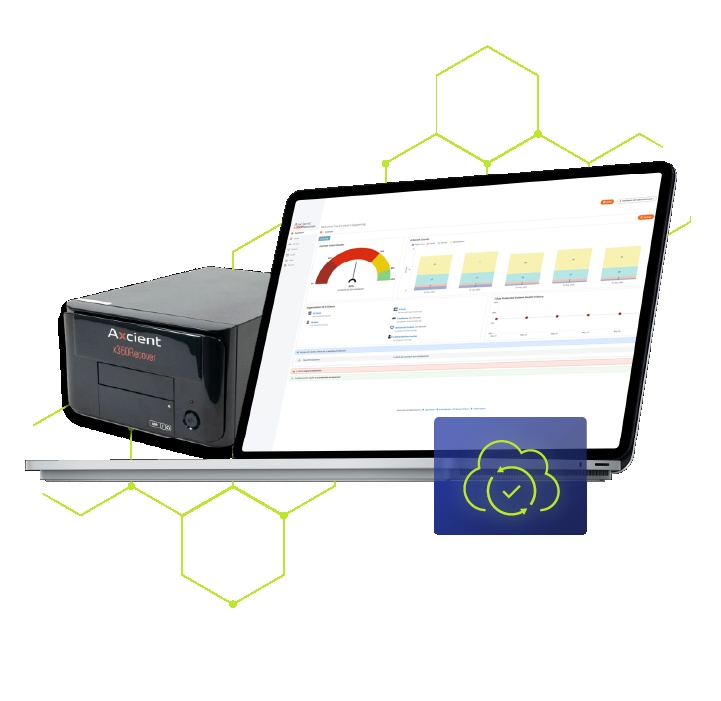
Direct-to-Cloud also has an optional Local Cache: backup block data kept on a local USB or NAS device to accelerate recovery. The arrangement is pleasingly practical. A business can prefer cloud backup and still value nearby data when it needs a large restore. Hardware-free backup does not repeal the distance between a server and its replacement.
Axcient advertises a 15-minute recovery point objective and a recovery time objective below one hour. The first describes how much recent work a recovery plan aims to lose; the second describes how long restoration should take. They are objectives to validate against a particular deployment. A sprawling application estate, slow connection or untested dependency can make a brochure’s clock a poor guide to the customer’s afternoon.
04 / Who pays for the quiet work?
x360Cloud covers another surface: Microsoft 365 and Google Workspace data. It provides backup, search, restore and audit functions, including full-text SmartSearch. A provider can locate a lost item and restore it without treating every incident as a full infrastructure emergency. x360Sync adds secure file synchronization and sharing under an MSP’s brand, making the portfolio partly about everyday access as well as disaster recovery.
The commercial unit is the provider’s managed service. In its September 2024 partner letter, Axcient described a monthly charge per protected system or user, with cloud storage pooled at MSP level and month-to-month contracts. Providers can bundle that protection into client agreements. Storage is subject to fair-use terms; hardware and additional services belong in the cost calculation.
The useful comparison therefore includes more than subscription prices. Count appliance purchase or lease, maintenance, initial deployment, verification work and recovery labor. Then compare that total with the time a standardized process saves. Integration with PSA and RMM tools can also bring alerts, ticketing and billing into the provider’s existing workflow. Fewer places to look can mean fewer things to overlook.
05 / Two family trees, one larger owner
The name has a complicated ancestry. eFolder began in 2002. Justin Moore founded the original Axcient in 2006. They merged in July 2017, bringing together recovery software and eFolder’s Replibit, Anchor and Cloudfinder portfolio. Kevin Hoffman became CTO of the combined business. The merger helps explain why a company known for recovery also sells cloud application backup and file collaboration.
Money had already shaped the route to market. In 2015, Axcient raised a reported $25 million financing round that included significant debt financing from Silver Lake. Part of the money supported SaaS:FLO, a program paying resellers upfront for subscription sales. The company was trying to make a recurring service compatible with a sales organization accustomed to collecting its margin immediately.
ConnectWise acquired Axcient in September 2024. The accompanying partner letter reported more than 5,000 partners and promised continuity in billing, contracts, distribution and open integrations. Those promises mattered because a provider standardizing on one vendor is also concentrating its dependence on that vendor.
By August 2026, ConnectWise had announced an available Australian x360Recover data centre with SOC 2 Type II certification. Partners could choose Australian backup storage. The same announcement described a recently released integration connecting ConnectWise SIEM with recovery. Local residency and a shorter path from security response to restoration are concrete developments to assess alongside the acquisition’s promises.
06 / The rehearsal worth copying
A buyer can borrow Axcient’s central question before signing anything. Choose a business process, define its acceptable interruption and recover it in a rehearsal. Check whether the system starts, whether its application works, whether users can connect and how long the entire exercise takes. Record the labor as carefully as the stopwatch.
Automation needs that context. A boot screenshot cannot establish that every business transaction works. A retained copy cannot satisfy every compliance obligation on its own. Cloud recovery still needs connectivity, permissions and a route back to normal operations. Where a workload requires recovery behavior the deployment cannot deliver, a different architecture may be the better purchase.
Axcient’s appeal rests on making the routine work repeatable: preserve useful recovery points, test them and plan the order of the return. XFER’s customer changed its mind. The backup had enough patience to accommodate it. For a business waiting on its files, that is a feature worth understanding.
Keep the recovery conversation going
Explore Axcient, x360Recover, x360Cloud and x360Sync.
Follow LinkedIn, X or Instagram. Browse the Axcient blog and Australian expansion announcement.
↗ Deployment video / Vimeo↗ x360Recover speed demo / YouTube