The General Partner who runs a Paris seed fund from a San Francisco apartment, writes a handful of checks a year, and tells founders to treat fundraising the way Apple does - as a job, not a moment.
OVNI is French for UFO. The firm calls its founders "aliens." Augustin Sayer, who co-founded it in 2022, splits his life across an ocean to find them.
On any given Tuesday morning, somewhere in San Francisco, a French venture capitalist is reading a deck from a Tel Aviv robotics team. His firm is headquartered in Paris. His partners are in the 1st arrondissement. He's three time zones away from his closest LP and nine from his accountant. This is the life Augustin Sayer chose, and it's working.
OVNI Capital writes only a handful of checks per year. The fund's name is a tell - OVNI is the French acronym for unidentified flying object. The firm calls its target founders aliens, a knowing wink at the kind of people who, in OVNI's own words, "burn the box down and reinvent what's possible." Sayer co-founded the fund in 2022 with Arnaud Laurent. By 2026, the portfolio has grown to 51 companies, raised more than a billion euros in follow-on capital, and is credited with creating over 10,000 jobs.
The thesis is small, sharp, and unfashionable in a market that rewards spray-and-pray. Back European founders with proprietary technology, a clear mission, and an international mindset from day one. Write checks between roughly $250K and $2M. Take fewer bets, with more weight behind each. Help the founders sell in the United States.
That conviction shows up in the kinds of companies OVNI looks at: AI cameras, software-defined satellites, industrial cybersecurity, ultrasound medical tech, energy transition, software-hardware convergence, tokenization of real-world assets, MEV blockchain infrastructure. It's a wide aperture deliberately tilted toward technologies that, if they work, change something structural about an industry.
Sayer's path to venture didn't run through Stanford GSB or a Sand Hill associate program. He started his career in 2008 at Lazard Frères in New York, sitting in the M&A group during the most chaotic year a young banker could pick. He then moved to Colony Capital, where he learned the rhythms of large-ticket investing.
And then he walked away. In 2015, Sayer moved to Mexico to launch a retail business. He ran it for two years. By his own account, he spent his banking bonuses earlier than that funding nearly twenty angel investments - a habit that, in retrospect, was the real warm-up for what came next.
When he returned to investing, it was at Newfund, a French-American venture firm where he led roughly 20 deals as a partner. Two stand out: FairMoney, the West African neobank now serving millions, and Umiami, the plant-based texture technology company turning soy and wheat protein into something that behaves like an actual chicken breast. They share a pattern - bet on hard problems that, if cracked, defend themselves.
Then came the launch of OVNI in 2022, alongside Arnaud Laurent. They put a flag in Paris, then opened a second flag in San Francisco. Sayer holds the second flag.
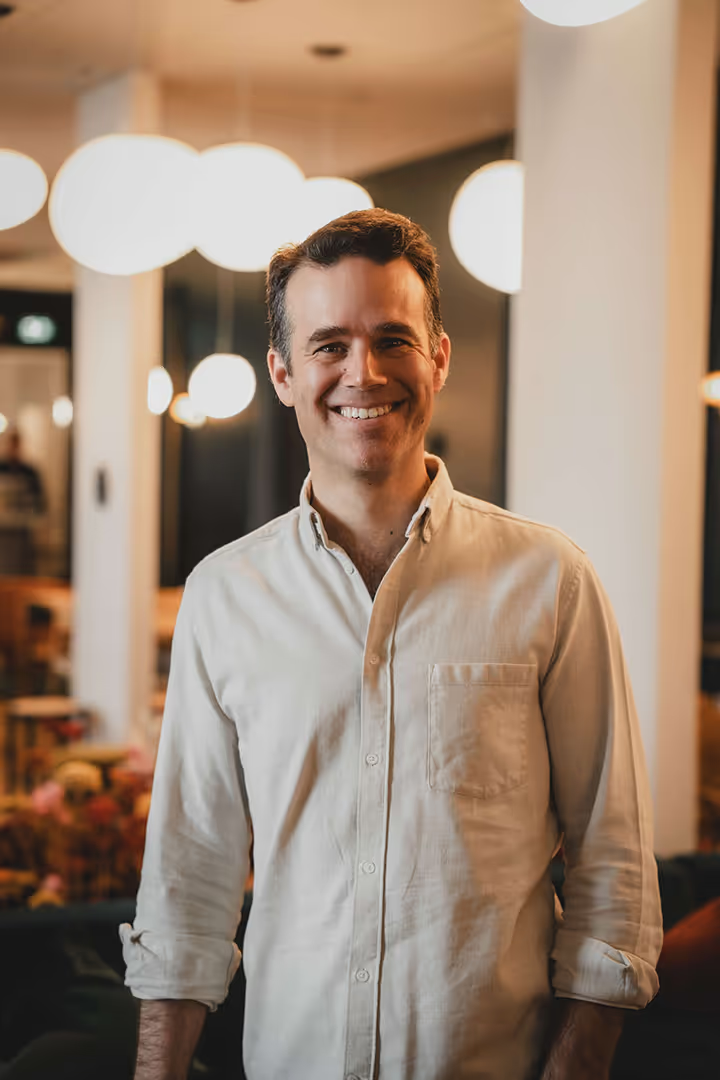
No one expected us here, but here we are. We are all in to get you where you're going, and we'll give everything for you to win. — OVNI Capital, team statement
OVNI's LP base reads like a guest list. Founders of billion-dollar companies. Global corporate CEOs. The kind of people Sayer can phone when one of his portfolio companies needs an enterprise pilot in a city they've never operated in.
OVNI's investment criteria fit on a Post-it. The discipline is in refusing to add a fourth.
Not a wrapper. Not a workflow on top of someone else's model. Something the team built that competitors can't quickly copy. Europe's engineering talent makes this possible.
Sayer wants founders who can finish the sentence "the world is broken because…" without needing a deck. The mission is the thing that survives the first three pivots.
Build in Europe, scale internationally. Most of the founders OVNI funds already think in dollars, sell in English, and treat their home market as a launch pad, not a ceiling.
That Apple line is the one Sayer reaches for when he talks to seed-stage founders. The point isn't that a five-person startup should hire a treasury department. The point is the mental model. Most founders treat fundraising as an event - a sprint, a roadshow, a relief when it closes. Sayer wants them to treat it as a function. Start preparing the Series A the day the Seed lands. Keep the dataroom living. Keep the relationships warm. Don't go cold for a year and then resurface asking for money.
OVNI deliberately staffed itself with people who've competed, failed publicly, or run a project on adrenaline. The reasoning: founders trust people who've sweated.
Before he was ever a GP, Sayer turned his banking bonuses into roughly twenty angel checks. He learned to invest with skin in the game, not OPM.
The Mexico years sound like a footnote, but Sayer has said they reset his understanding of what founders actually deal with day to day. It's hard to be a precious investor after you've done inventory.
OVNI's geography is part of the pitch. European founders who want US access don't need to relocate. Sayer is already there.
OVNI - Objet Volant Non Identifié. The brand is a joke that turned into a thesis: back the founders nobody else is mapping.
While larger funds spray, OVNI writes a small number of checks per year. Each one gets attention. Each one is supposed to matter.
Backing the impossible to make it inevitable. — OVNI Capital tagline
The conventional story about European deep tech is a sad one. Brilliant engineers, no risk capital, talent drains to California, repeat. OVNI's wager is that the story is finally bending. Europe's engineering schools still produce the best per-capita technical talent in the world. Costs are lower. Government R&D credits are real. And the founders who do start companies tend to be obsessive about the tech, because the tech is the only edge that travels.
What's been missing is the bridge. A European pre-seed founder who wants to land US enterprise customers used to need to move. OVNI's pitch is that you don't have to - the firm will be your American foothold. Sayer being in San Francisco is the proof point.
The bet is also generational. The first wave of European seed funds was built around French and German angels who wrote €100K checks into local SaaS. The second wave, OVNI included, is built around the assumption that Europe can produce category-defining companies in hardware, climate, defense, and AI infrastructure - the kinds of companies that, in the prior decade, were considered too capital-intensive or too slow for venture to touch.
It's a contrarian position. It might also be the most obviously correct position of the next ten years. Sayer is patient enough to be early.
"If we're not investing in ventures that have some societal transformation - why work in this business?"
"Apple has 70 people working full-time on their equity and debt team."
"No one expected us here, but here we are. We are all in to get you where you're going."