Cement is a useful antidote to the romance of entrepreneurship. It comes in bags. It has to arrive. Somebody has to pay for it. Before Ashutosh Jha became a venture investor in Santa Monica, he built a company around this admirably unglamorous material. The origin was close to home: his father, who worked in building materials, described the trade’s procurement and financing problems. Jha began considering what an online buying channel could change.
He had studied information technology and attended entrepreneurship programs abroad. The family conversation supplied something an education cannot simply award: a particular problem, in a particular trade, with people already spending money to endure it. His proposed answer became cemX, a marketplace for buying cement across brands.
The attraction was practical. Small buyers lacked some of the purchasing advantages available to large dealers. Prices and intermediaries complicated the journey from supplier to customer. Bringing orders online offered a way to make that journey more transparent. There is a pleasing lack of mystery here. A builder needs material, a seller has material, and the business has to make the meeting worth both their time.
Jha launched cemX in Bihar in June 2019. It put him on the selling side of the questions he would later ask founders: who wants this, how do they buy it, and what makes them return? A bag of cement leaves little room for an elegant answer that fails on delivery.
The first idea needed too much looking after
Before cemX, there was Knockstarter, an entrepreneurship community. Jha’s early ambitions had taken him to a European Innovation Academy program in Shenzhen, China. He then helped establish the community in Kolkata; it also reached New Delhi. For a young person interested in starting companies, assembling other would-be founders was a reasonable place to begin.
But travel exposed a difficulty. While attending a program at Harvard, he found himself chasing people from the United States to keep the community operating. He had expected it to function in his absence. Instead, it had come to resemble an event-management business, and he decided to close it. The experience makes a useful counterweight to the tidy version of a founder’s biography, where each earlier project is presented as a triumph in miniature.
After returning to Bihar, he investigated the cement idea by speaking to roughly 50 people. That sequence matters: interest in entrepreneurship, a community that proved demanding to run, a familiar industry problem, and conversations with potential users. The business took shape through those encounters rather than through a sudden discovery of a perfect market.
There is also a small lesson in the failed expectation. A venture can attract people and still depend too heavily on its organizer. An institution that needs its founder to supervise every detail from another continent has discovered something about its operating model. Jha’s later emphasis on systems and execution becomes more interesting against that early experience.
Bihar
Expert Dojo
Santa Monica
An online business with people at the counter
cemX combined a website with offline e-stores and dealers who could help customers place orders. That was a sensible admission about buying habits. Putting a transaction online does not require every customer to arrive online unaided. A local person explaining the process can be part of the product.
Sourav Chakraborty became Jha’s co-founder. Their connection began on LinkedIn, and a meeting in Kolkata to discuss a computer-vision research paper turned into a conversation about cemX. A technical discussion acquired a commercial second act. The two had attended the same undergraduate institution, although at different times.
The early dealer gathering in Sitamarhi produced a word-of-mouth order worth approximately ₹20,000, the founders later recalled. It is the sort of number that rarely makes a grand investor presentation. Yet it is wonderfully concrete: somebody heard about the service, trusted a recommendation, and bought something.
Another obstacle was credit. Small contractors could remain attached to expensive procurement arrangements because those arrangements let them pay later. The founders described a partnership with ZestMoney to offer installment purchasing. A cheaper price alone could leave the customer’s actual constraint untouched. Buying convenience had to account for payment convenience too.
Jha also described leading more than 20 people at his cement business. Strategy, hiring, operations and supervision came bundled together. His subsequent work with startups therefore carries a specific operating background: a marketplace where software had to accommodate dealers, buyers and an existing trade. The interface was only one piece of the business.
After the investment, the audit
At Expert Dojo, Jha’s responsibilities expanded from evaluating companies to helping run the organization. His published career history places him in a senior venture associate role in January 2023, followed by chief of staff and head of strategy that June. By December, he had become partner and head of portfolio. He became general partner of the India-focused fund in August 2024.
Those roles move through different distances from a startup. Screening asks whether a business belongs in a portfolio. Strategy asks how the investment organization should work. Portfolio management asks what happens after the agreement has been signed. It is that last distance, close enough to inspect the machinery, that gives his professional account its character.
Jha describes conducting an audit immediately after investment and working with founders on tailored business strategies. The emphasis is on identifying growth opportunities and improving execution. In his account, the investor’s job continues after the congratulatory announcement, when a company still needs customers, decisions and a workable plan.
He also serves as an angel investor with HBS Angels and as an entrepreneur-in-residence for investments at Harvard Alumni Entrepreneurs. The latter includes bringing founders and investors into an investment series. These are relationship-building roles, with repeated contact rather than a single pitch as their basic unit.
Look at the progression and the distance from cemX narrows. Jha has changed sides of the fundraising conversation, but operations remain central to the work he describes. The questions now arrive from multiple companies. Each needs its own answer, however convenient a universal playbook might be.
- AuditReview the business after investment
- IdentifyFind specific growth opportunities
- ExecuteWork with founders on a tailored strategy
The bridge has paperwork
On April 11, 2025, the Expert Dojo Indo-US Investors Conclave scheduled Jha to deliver the welcome remarks. Its agenda gathered government representatives, family offices and venture investors before an India fund announcement later that afternoon. A bridge between markets has a fairly prosaic construction schedule: introductions, discussions, announcements, and enough time for people to speak face to face.
The following day, news of Expert Dojo’s $100 million global fund described $15 million earmarked for India. Jha was leading the firm’s India effort. The announced plan included initial investments of up to $100,000 and potential follow-on support tied to growth milestones. These were plans for deploying capital, with a sequence of decisions still ahead.
The local structure was part of the point. The proposed India vehicle would use a Category II alternative investment fund structure, helping the firm participate as a domestic investor. Jha explained the attraction in terms of flexibility and competitiveness. Moving money across borders brings procedural questions along with entrepreneurial ones.
His explanation at the launch concerned what the fund structure would let the firm do. It was a workmanlike argument for an industry fond of describing bridges as though they appear through force of enthusiasm. The legal and financial arrangement influences who can participate and how an investment can happen.
The India-US connection gives Jha’s career geographic continuity. He began by organizing commerce within an Indian trade. His investment work now concerns founders reaching across markets, and investors finding a structure through which to back them. The scale has changed; access remains a practical problem.
“A local fund allows us more flexibility and makes us more competitive.”Ashutosh Jha · April 2025
Taking the chair, staying near the work
In July 2025, Jha became CEO of Expert Dojo while retaining his India general partner responsibilities. The announcement came alongside a change in founder Brian Mac Mahon’s work: a closer operating role at portfolio company Matchbook AI. Leadership at the investment firm and direct involvement in a portfolio business were being rearranged together.
That pairing helps explain the character of Jha’s appointment. The firm was emphasizing deeper involvement with selected companies, including a private-equity element alongside venture investing. Its public language placed execution at the center of the model. Jha’s experience in portfolio oversight fitted that direction.
His own description of the ambition is longer-term. He wants to build an India-US venture connection, support companies entering new markets, and develop geography-specific funds. His personal site sets a $1 billion assets-under-management goal for 2030. A goal belongs in the future tense, where it can be judged against the work required to reach it.
There is a difference in timescale between that aspiration and a founder’s immediate problem. A fund can discuss 2030 while a startup needs to decide its next route to customers. Jha’s public account holds both in view: fund strategy on one side, go-to-market help and follow-on fundraising on the other. The credibility of the large plan depends on the smaller decisions.
Even the CEO title leaves an operational question hanging in the air. Can close support be organized across a portfolio and across countries? An investor who promises participation acquires obligations of time and attention. The job is to make those obligations fit inside an institution that can keep doing the work.
Assets under management goal on Jha’s personal site.
Local knowledge, international plans
In conversation with Dharma Dialogues host Shutapa Paul, Jha discussed decentralized venture investing, local networks and scout-led sourcing. The argument is straightforward: startups operate across cultures and markets, so the investment process needs people close to those settings. Local knowledge can change what an opportunity looks like.
The same discussion addressed a complication of easier outreach. More polished cold messages do not automatically make good opportunities easier to identify. Warm introductions and trusted relationships still help investors distinguish useful approaches from a growing volume of messages. Opening a door and deciding whom to meet are different tasks.
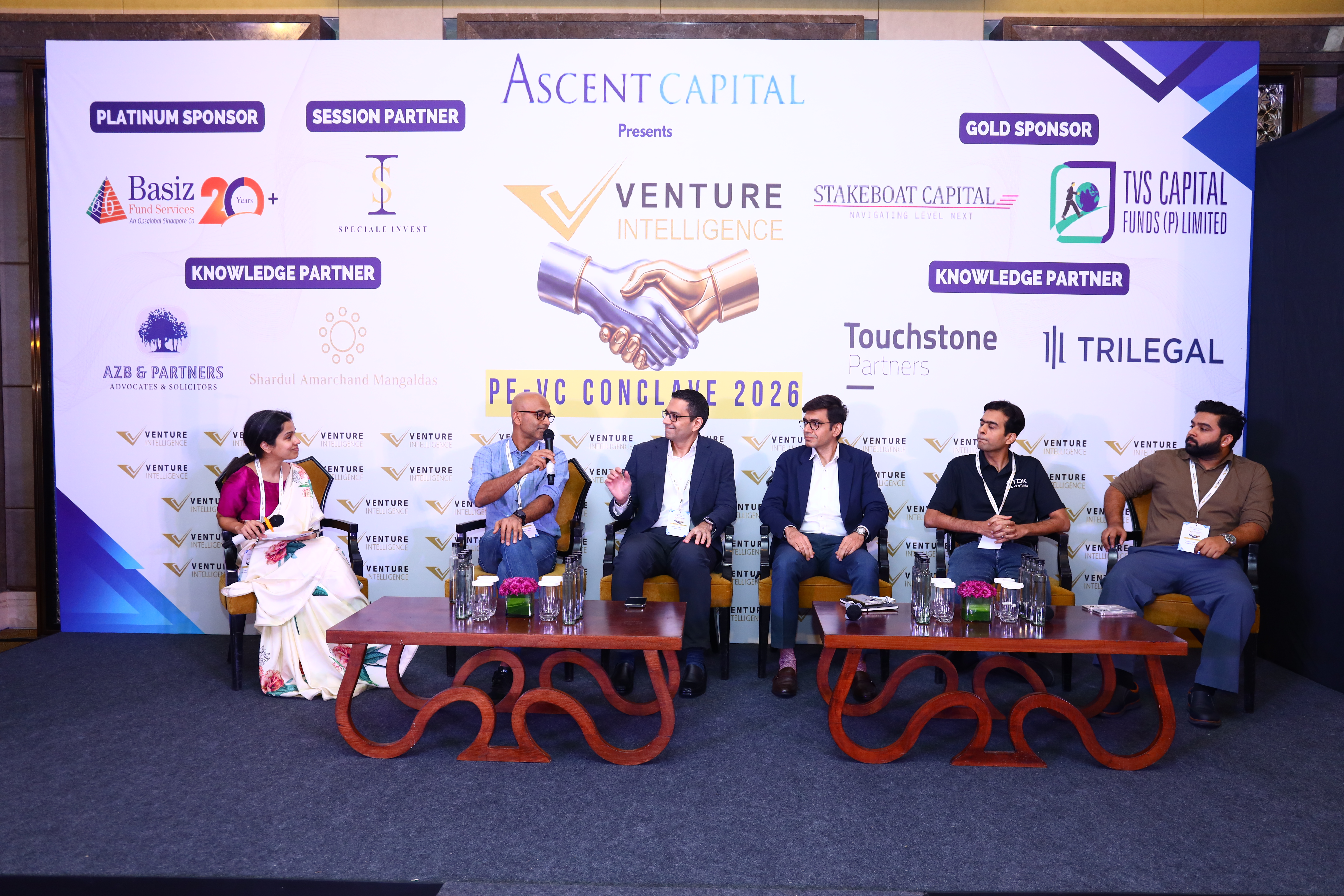
By June 3, 2026, Jha was participating in the Venture Intelligence PE-VC Conclave in Bengaluru, on a sectors-focused panel moderated by Deepa Rekha. Alongside investors from BII, TDK Ventures, Multiply Ventures and Eight Roads, he was back in the rooms where investment priorities are argued over. The cross-border project still involves showing up.
Expert Dojo’s current website describes the business as a permanent technology holding company that acquires, operates and turns around digital assets. That language extends the operating emphasis visible in Jha’s earlier portfolio work. It also makes the institutional problem more explicit: how to stay involved with businesses over time.
The cement story gives all this a useful starting point. A family complaint became a commercial question. Conversations became a marketplace. Later, investments became operating responsibilities. Jha’s career keeps returning to the stretch between an idea and the people who must make it function. There is plenty of room for ambition there. There is also a delivery to arrange.