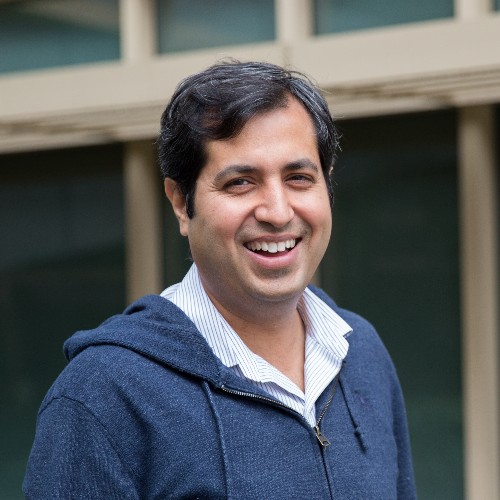
Ashish Kapoor's company sells something you can't bolt onto a robot or photograph on a factory floor. It's an idea with a platform attached. The pitch is blunt: the robots are already arriving - humanoids, arms, quadrupeds, drones, wheeled carts - and they're arriving faster than anyone can make them useful. What's missing isn't more hardware. It's a brain that travels between machines.
That brain is called GRID, the General Robot Intelligence Development platform, and it is the reason General Robotics exists. The tagline reads like a dare: “Any robot. Any AI skill. One intelligence grid.” Plug in more than forty kinds of robot, pull from more than forty pre-trained skills, and have something working in under fifteen minutes. A single instance, the company says, can field 25,000 robot requests at once.
“General intelligence emerges from rich composition of robot skills, not just larger models.”
That last line is the whole argument, and it cuts against the prevailing wind. While much of the industry races to build one ever-larger model that swallows all of robotics, Kapoor bets on composition: many small, interpretable skills stitched together by code, like a sentence built from words. It's a quieter thesis. It's also a more honest one for anyone who has watched a robot fail in a way no monolithic black box could explain.
The company started life in 2023 under a different name, Scaled Foundations, born directly out of a research paper. In May 2025 Kapoor posted the change to the world himself: “Scaled Foundations is now General Robotics. We're building general-purpose intelligence for every robot, across any scenario in the physical world.” Same mission, sharper name.
From a paper to a company
The paper was “ChatGPT for Robotics.” When the rest of the world discovered large language models could write essays, Kapoor and his collaborators asked whether they could write instructions for machines instead - turning plain language into the code a robot runs. It landed at exactly the right moment, and it gave a non-technical person a way to tell a robot what to do without learning to program one. Scaled Foundations was the attempt to turn that flash of research into infrastructure.
Investors noticed early. The seed round drew Khosla Ventures and E14, the fund tied to the MIT Media Lab where Kapoor earned his doctorate. By late 2025 the company had been picked for the Microsoft for Startups Pegasus Program. In April 2026, Accenture invested to push physical AI deeper into manufacturing and logistics. Along the way the founders found themselves in unexpected rooms - meeting Singapore's Minister for Law at a demo day, supporting a call for a national robotics strategy at a Congressional Robotics Caucus.
A safety obsession that predates the hype
Long before “AI safety” became a conference circuit, Kapoor was building it into the plumbing. His research at Microsoft circled the same question again and again: how do you let a machine make mistakes without anyone getting hurt? His answer was simulation - rich, near-realistic worlds where a robot can fail ten thousand times in an afternoon and learn from every one. General Robotics carries that instinct forward, with built-in mechanisms for interpretability and what the company calls blame assignment: when something goes wrong, you should be able to point at the skill that broke.
It is, in the end, a continuation of one long project. Kapoor has spent two decades teaching things that move how to be intelligent and safe - and insisting those two words belong in the same sentence.