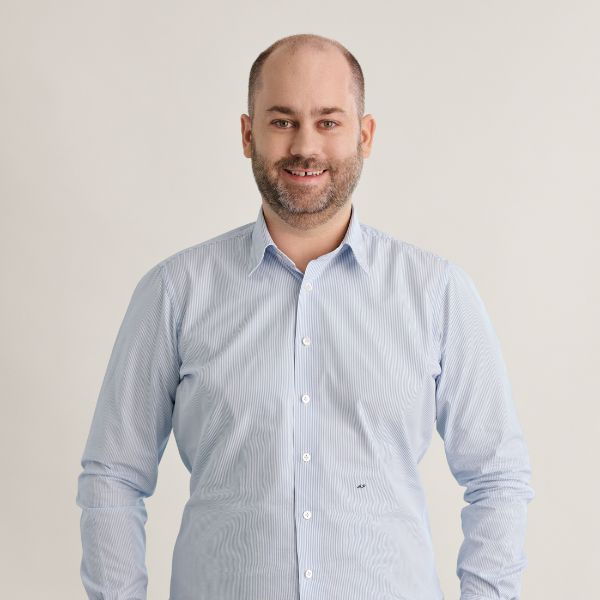
Co-Founder & CEO / Prose
Arnaud Plas
He runs 40 miles a week and calls it problem-solving. The problem he keeps chasing: why your shampoo was built for a million strangers instead of for you.
He runs 40 miles a week and calls it problem-solving. The problem he keeps chasing: why your shampoo was built for a million strangers instead of for you.
In a Brooklyn building on Grand Street, a machine waits to mix a bottle of shampoo that does not exist yet. It will not exist until someone, somewhere, finishes an online quiz about their scalp, their water, their goals, and clicks buy. Only then does the formula get made. This is the whole bet of Prose, and Arnaud Plas has staked roughly a decade of his life on it being the right one.
Plas is French, a long-distance runner, and a recovering big-beauty executive. He spent years inside the CPG machine watching companies guess at people in groups - dry hair here, oily there, curly over there - and sell them the closest approximation off a shelf. He found the guessing maddening. The technology to do better existed. The will, inside a legacy giant, did not.
So in 2017 he left to build the will from scratch. Prose now sells more than 10 million bespoke products, has run over 6 million consultations, and - the part that makes other direct-to-consumer founders sit up - turned a profit in 2023. In a category littered with venture-funded brands that scaled into losses, Plas built one that pays for itself.
The trick was reversing the order of operations. Most beauty companies make a million units and then go hunting for buyers. Prose finds the buyer first, learns who they are, then makes the thing. It sounds obvious. Almost nobody does it, because the supply chain to support it has to be invented, not bought.
Plas did not arrive in beauty-tech through a TechCrunch pipeline. He arrived through laundry detergent, French skincare, and a side business selling construction hardware with his dad.
The career started at Henkel, the German consumer-goods company, where Plas worked across home care before drifting toward the parts of the business that touch the body - skincare, body care, hair. Somewhere in there, in 2010, he and his father launched an online shop selling construction hardware across Europe. It was not glamorous. It taught him how an e-commerce supply chain actually behaves when a customer hits the button.
Then came L'Oreal. He managed L'Oreal Paris skincare brands in France as a group manager, then crossed the Atlantic to become VP of Digital & E-commerce Strategy, charged with dragging L'Oreal USA's digital operation into the present. It was a serious job at a serious company. It was also, by his own telling, where the itch became unbearable.
The constraint was structural. A company that has spent a century perfecting mass production is not built to make one bottle at a time, no matter how badly a customer might want it. Plas concluded the only way to build a product for an individual was to build a new company around the individual - the consultation, the formulation, the supply chain, all of it - rather than retrofit an old one.
He pitched the idea to a L'Oreal colleague, Paul Michaux, over drinks. The plan: change the relationship between salon clients and the prestige brands that talked at them. Michaux signed on as head of product. Chemist Catherine Taurin, with 35-plus years of custom formulation behind her, became the R&D backbone. Nicolas Mussat, met through an early investor, came in as CTO. Prose launched in December 2017 with one stubborn goal: the best hair possible, made to order.
Cuts his teeth at Henkel across home care and personal care categories.
Co-founds an online construction-hardware business with his father, selling across Europe.
Rises at L'Oreal: skincare group manager in France, then VP of Digital & E-commerce Strategy leading L'Oreal USA's digital transformation.
Launches Prose with Paul Michaux, Catherine Taurin and Nicolas Mussat. Goal: the best hair possible, one formula per person.
Prose raises a Series C; total funding climbs to roughly $75 million.
Reaches profitability and launches skincare; net sales pass $140 million.
Named a BeautyMatter NEXT Entrepreneur of the Year finalist; Prose projects about $160 million in net sales.
Prose's whole architecture is a refusal of the warehouse. Instead of guessing demand and manufacturing into inventory, a customer's order triggers the formula. Software runs the mixing. The result is less waste, less dead stock, and a product that belongs to exactly one person.
Plas logs 5 to 6 runs a week, around 40 miles, and treats the miles as dedicated thinking time. The mindset shows in the business: he is fond of saying you have to sequence your efforts rather than chase everything at once.
His favorite piece of advice came from investor Kirsten Green: build a good company, and it will naturally become a big one. Prose tripled revenue three years running by doing exactly that - growth as a consequence, not the goal.
Profitability in 2023 was not luck. Plas expanded into skincare - a category customers had been asking for - while tightening operations and manufacturing. The new category and the discipline arrived together.
The company began as a conversation between two L'Oreal colleagues over drinks, plotting to upend how salon clients relate to prestige brands. The branding came later, shaped post-seed with agency Red Antler.
Plas has joked that, lacking much hair of his own, he has all the time in the world to obsess over everyone else's. The man perfecting the world's haircare is not its best customer.
Before bespoke beauty, he ran an online construction-hardware shop with his father. The unglamorous schooling in shipping, returns, and supply chains turned out to be the perfect prep for a made-to-order factory.
Plas frames the ambition larger than hair. He wants to prove that truly customized products - made for one, scaled by software, kept sustainable and climate-neutral - can out-compete the mass-produced default that has run consumer goods for a century. Prose is the proof of concept. The category, if he is right, is everything.