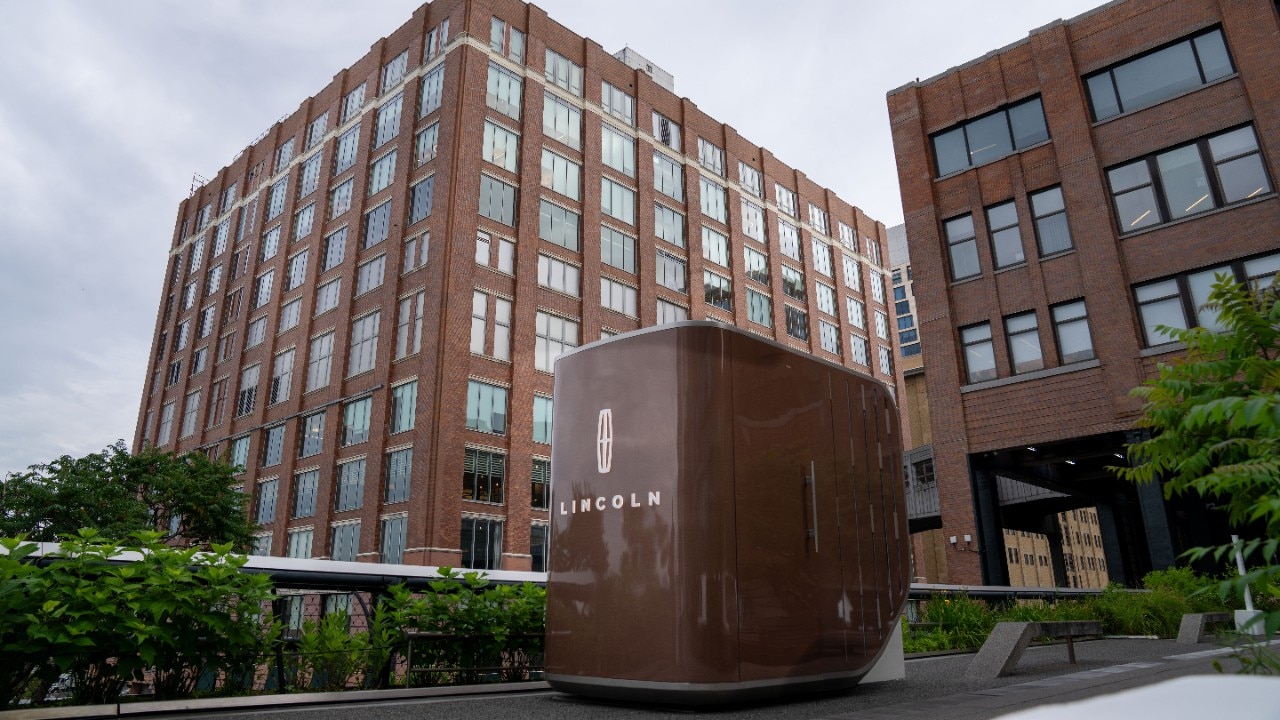
On a summer weekend in New York, a small bronze-colored room appeared above the traffic. It sat on the High Line near 14th Street, surrounded by brick, steel, leaves and people who had somewhere else to be. The Lincoln badge on its side suggested a car company, but there were no wheels, no road and no sales floor. The invitation was simpler: take five minutes.
The installation, called The Sanctuary: By Lincoln Rejuvenate, brought an in-vehicle experience into public space. Inside a parked Lincoln, Rejuvenate coordinates seat positioning, massage, climate, ambient lighting, audio and digital scent. On the High Line, the idea stood on its own. It offered calm as something visitors could walk into.
Anika Salceda-Wycoco, Lincoln’s communications director, introduced the project in a Ford feature in June 2026. Her line about its purpose is precise: “It’s designed to do more than just help you slow down for a minute; it’s meant to create a shift in your mood.” A complicated stack of vehicle systems became a familiar human outcome. The technology stayed intact, but the language moved closer to life.
The road to the headquarters
Salceda-Wycoco’s route to Dearborn did not begin with luxury vehicles. It began with communications training and agency work. She studied at Brent International School and the University of Asia and the Pacific, completing a communications program with an integrated marketing communications focus. Her early career included two years as a supervising account manager at Eon in Manila and a year managing integrated marketing communications for Publicis Malaysia in Kuala Lumpur.
In February 2009, she joined Ford Philippines. The market gave her a dense education in what communications work looks like when a global manufacturer meets a local audience. There were vehicles to introduce, dealers to open, reporters to brief, online communities to grow and dates that could not drift. She advanced to assistant vice president for communications before leaving the country role in June 2013.
Agency + Ford PH
Publicis
Ford ASEAN
Ford + Lincoln
A title can flatten this kind of work. The period reads more clearly through the moments around it. In 2012, when Ford prepared to sell the Mustang in the Philippines, Salceda-Wycoco supplied the useful facts: orders would begin in July, first deliveries would arrive in September, and the year would be busy. At a new Ford Cainta dealership, she explained how the company’s quality, green, safe and smart pillars had been built into a retail design standard. One statement handled anticipation. The other connected architecture to strategy.
The voice on the radio
The less polished moments reveal the job too. On a 2012 Ford Focus media drive around Krabi, Thailand, a group of automotive journalists discovered that the new hatchback’s suspension and mountain roads made an entertaining pair. Their pace began to stretch the organized procession. Then Salceda-Wycoco’s voice arrived over the radio: “Car Number 4, keep the convoy intact.”
It is a small scene, but it contains the whole discipline. An automotive launch is part theater, part classroom and part logistics exercise. The journalists need enough freedom to experience the product honestly. The company needs safety, timing and a coherent day. Someone has to watch both. Communications is often described as message craft. In practice, it also means noticing when Car Number 4 is pulling away.
In July 2013, Salceda-Wycoco moved to Thailand as Ford’s ASEAN communications manager. By November she had moved again, this time to Michigan and Ford’s communications and broadcast organization. Manila had taught the specificity of a market. Bangkok widened the frame to a region. Dearborn placed her near the center of a company whose products, engineering decisions and public obligations travel around the world.
Luxury changes its vocabulary
Her Lincoln work arrived as the language of luxury was changing. Traditional signals still matter: material quality, visual proportion, quiet cabins and attentive service. But software, large displays, driver-assistance systems and connected features added a new translation problem. A customer should not need an engineering diagram to understand why a feature belongs in a premium vehicle.
Lincoln’s answer has leaned toward sanctuary. The word connects hardware to atmosphere. It makes a seat function part of rest, a display part of ease and a cabin part of the time between obligations. In 2024, Salceda-Wycoco publicly celebrated the Lincoln Nautilus earning a place on WardsAuto’s 10 Best Interiors and UX list. Her emphasis was the team and the total interior experience, including its pillar-to-pillar screen, materials and thoughtful features.
That team orientation repeats in her public posts. She has welcomed designers, praised collaborators and highlighted work rather than presenting communication as a solo performance. It fits the structure of the job. A vehicle story is assembled from many disciplines: design gives it form, engineering makes it real, software changes how it behaves, dealerships bring it to customers and communications decides how the pieces become legible together.
There is continuity here with her earlier dealership work. A showroom is communication made physical: where the doors sit, how the customer moves, which materials are touched first and whether the promised brand experience survives an ordinary Tuesday afternoon. In Cainta, Salceda-Wycoco connected a new retail format to Ford’s four public pillars. At Lincoln, the frame has shifted from a dealership standard to a broader ownership experience, but the central test is similar. A statement cannot live only in advertising. The space, product and service have to say the same thing.
A product story you can enter
The Sanctuary installation is a useful endpoint for the journey because it collapses several layers of Salceda-Wycoco’s career into one object. It is a physical environment, like the dealership design she discussed in Cainta. It is a product demonstration, like the drives she managed in Southeast Asia. It is a brand statement, built around Lincoln’s view of comfort. And it is a public invitation that asks almost nothing from the audience except a few minutes of attention.
The underlying Rejuvenate experience has plenty to explain. It offers five- and ten-minute sessions, selected themes and a coordinated response across several cabin systems. Yet the public installation did not lead with a checklist. Its form carried the message. New York supplied speed, noise and motion. Lincoln supplied a room that paused them. The contrast did the work.
Bringing the experience to the High Line also changed who could understand it. A vehicle feature normally waits behind a showroom door or an owner login. The installation let pedestrians encounter the premise before considering the product. This is the practical advantage of a demonstration that travels beyond its native container: it widens the audience without diluting the idea. Visitors did not need to know trim levels, system names or model-year changes. They only needed to recognize the value of a pause.
Salceda-Wycoco wrote that more than half of Navigator and Nautilus clients with access to Rejuvenate had tried it, while more than one-third used it frequently as a personal moment of calm. Those figures matter because they connect brand language to observed customer behavior. Sanctuary is not only a mood board. People are pressing the button.
The craft of keeping the meaning
Across Manila, Kuala Lumpur, Bangkok and Dearborn, Salceda-Wycoco has worked with different media systems, customer expectations and cultural references. Her LinkedIn profile describes a passion for marketing communications, branding and corporate reputation. It also lists English, German, Spanish and Tagalog. Languages are a revealing detail for someone whose career depends on preserving meaning while changing form.
Her progression also offers a grounded model for an international career. It did not skip the operational layer. Before global responsibilities came account management, product dates, local reporters, dealership openings and convoy discipline. The broad perspective grew out of specific assignments. Each move added scale without removing the need to understand the room.
That may be why the five-minute pause feels like an appropriate current chapter. It is polished, but not abstract. Visitors can step inside. Customers can activate a version in their vehicles. The promise is modest enough to test for themselves. There is no need to claim that a car can transform a life. It can adjust the seat, soften the light, change the climate, play the audio and give a person a little time back.
For a communications director, that restraint is part of the craft. Modern cars contain more technology than most owners will ever name. Modern luxury contains more signals than a logo can carry. The job is to choose the human thread and keep hold of it, from the engineering room to the launch, from the press drive to the customer, from a cabin in Dearborn to a small sanctuary above a New York street.