Poverty · Work · Opportunity
Angela Rachidi
She reads the fine print of food-stamp error rates and turns it into testimony that moves bills.
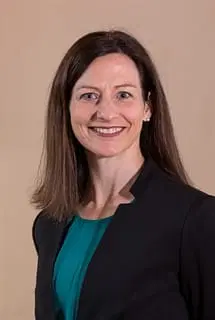
// The competitor at the witness table. Same focus she once brought to second base.
She reads the fine print of food-stamp error rates and turns it into testimony that moves bills.
Angela Rachidi spends her days inside the parts of American life most people only meet on a form. SNAP eligibility tables. Earned income tax credit phase-ins. The exact wage at which a working parent loses more in benefits than they gain in pay. She is the senior fellow and Rowe Scholar in opportunity and mobility studies at the American Enterprise Institute, and she has built a career on a single, stubborn thesis: a safety net works best when it pulls families toward work, not away from it.
That thesis did not arrive from a seminar room. It came from nearly a decade inside New York City's social-services machinery, where she rose to Deputy Commissioner for Policy Research and Evaluation at the Department of Social Services. She watched the programs from the inside - the caseloads, the cliffs, the gap between what a policy promises and what it does. Then she went and got a PhD to explain it.
Today she testifies before House and Senate committees, writes for Reason and FEE, and turns up in the footnotes of nearly every serious fight over SNAP, child care, and the Child Tax Credit. She does it from Middleton, Wisconsin - studying federal policy from a few states outside the Beltway, which may be exactly the point.
The existing Child Tax Credit follows a proven strategy for increasing work, reducing poverty, and investing in children's long-run success.— Angela Rachidi, Senate Finance Committee testimony
Poverty is easy to invoke and hard to study. Rachidi studies it the unglamorous way - program by program, rule by rule.
Her core question is deceptively simple: do the programs meant to help low-income families actually move them toward stable work and rising income, or do they quietly hold them in place? She digs into the Temporary Assistance for Needy Families block grant, the Child Care and Development Block Grant, SNAP, and the two great levers of the tax code - the Earned Income Tax Credit and the Child Tax Credit.
She is skeptical of a no-strings child allowance. Her argument is not that families don't need money. It's that how the money arrives matters - that a credit tied to work has, in her reading of the evidence, a long record of lifting both employment and children's later outcomes, while an unconditional transfer risks trading short-run relief for long-run dependency.
On SNAP, she calls it an important program with significant flaws - one that reduces hunger but, in her telling, can blunt the climb toward self-sufficiency. In 2026 she has been tracking the program's overhaul under the One Big Beautiful Bill Act: new state-level restrictions on what benefits can buy, and stiffer penalties for states whose error rates run high.
It is wonky terrain. Rachidi's gift is making it legible - translating a benefit cliff or an error-rate threshold into a plain sentence a senator can repeat.
Most poverty scholars arrive at the data through a university. Rachidi arrived through a caseload. She joined New York City's Human Resources Administration in 2002 as an analyst and stayed roughly a decade, climbing to Deputy Commissioner for Policy Research and Evaluation at the Department of Social Services - the office responsible for measuring whether the city's enormous social programs actually worked.
That vantage point is rare in her field. She didn't read about benefit cliffs and administrative churn; she ran the evaluations that exposed them. Between government stints she worked as a project director at ICF International's applied social research division, and later did research as a senior figure at Mathematica, the firm that built much of modern program evaluation. The result is a scholar fluent in both the spreadsheet and the front-line reality behind it.
When she joined AEI in 2016, she brought that fluency with her. She is not a commentator who picked up poverty as a topic. She is a practitioner who left the agency to study the system whole - and who can tell you, from memory, where the paperwork and the policy diverge. It is why her testimony tends to land: she has seen the thing she is describing.
She did the homework the hard way - building a full government career while earning a doctorate at night.
She grew up in Lancaster, a Wisconsin town of roughly 3,900 people about 80 miles southwest of Madison. The country's leading safety-net scholar learned what work and family cost long before she had a dataset for it.
At UW-Whitewater she was named all-conference four times and all-region twice at second base from 1995 to 1998. In 2019 she entered the school's Athletics Hall of Fame - and still keeps up with old teammates.
She balances national policy fights with life as a mother of four in the Madison area, working from Middleton, Wisconsin - far outside the Beltway by design.
SNAP is an important program that reduces hunger - but it has flaws that make it less effective than it could be, and in some cases harmful to upward mobility.— On reforming food assistance, 2026
Rachidi's politics are free-market, but her method is empirical. She is not interested in whether a program sounds generous. She wants to know what it does to the next paycheck.
That makes her a useful kind of irritant in the poverty debate. When advocates propose replacing the work-linked Child Tax Credit with an unconditional child allowance, she is the one asking what happens to employment three, five, ten years out. When a SNAP reform promises savings, she's the one checking whether it also helps a family climb.
Her answers don't always please her own side either. She'll defend program spending that works and criticize cuts that simply shift cost onto the poor. The throughline is consistency, not ideology: design benefits so that earning more never leaves a family worse off, and so the path off assistance is a path, not a wall.
It's the rare policy stance you can summarize on a napkin and still defend in a 40-page report. She does both.
Her influence shows up less in headlines than in hearings. As the Child Tax Credit moved back to the center of national debate, Rachidi was a recurring witness - before the Senate Finance Committee in 2023, before House committees in 2025 - arguing that the credit's link to earnings is a feature, not an accident of history, and that swapping it for an unconditional allowance is a trade with a hidden long-term bill.
She makes the same case in plainer venues: podcasts, op-eds in Reason, essays for the Foundation for Economic Education, interviews on Wisconsin Public Radio. The medium changes; the argument doesn't. Help families, yes - but build the help so it rewards the next hour of work rather than punishing it. For a debate that often runs on slogans, she keeps dragging it back to the evidence.