Company Dossier · Blockchain Data Infrastructure
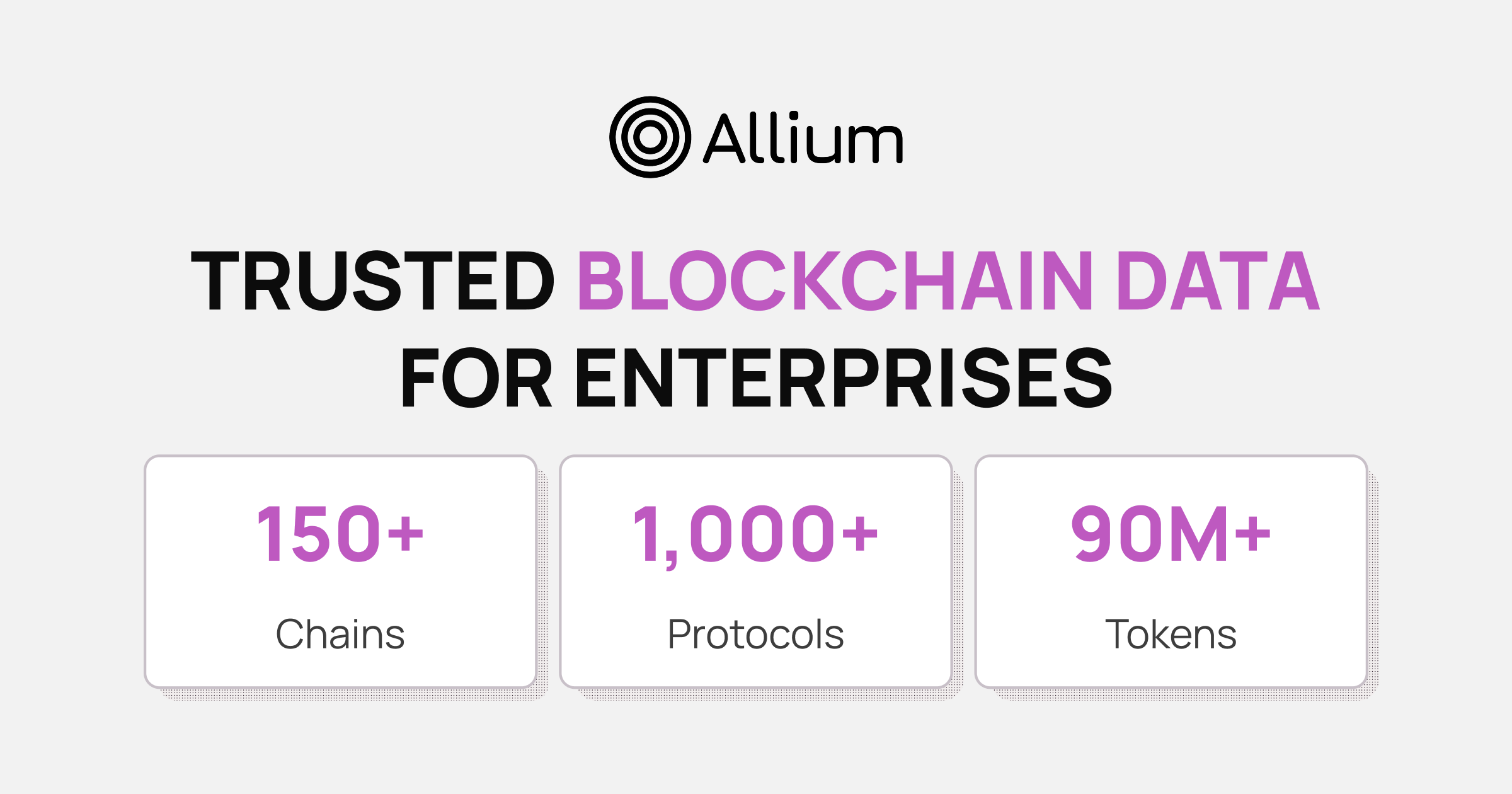
Allium's own scoreboard, photographed mid-brag: 150+ chains, 1,000+ protocols, 90 million tokens. The whole pitch on one card - the messy part is everything that happens behind it.
Allium
The plumbing nobody sees and everybody needs: clean, query-ready data pulled from the chaos of 150+ blockchains. The system of record for on-chain finance.
Crypto
Fintech
Data Infrastructure
Series A
B2B SaaS
New York · Singapore
The Scene
Open a Visa dashboard. You're already reading Allium.
Somewhere right now a treasury analyst at a payments giant is watching stablecoins move in real time - billions of dollars settling across a dozen public blockchains, each with its own dialect, its own quirks, its own way of being almost-but-not-quite consistent. The numbers look effortless. They are not. Underneath that tidy chart sits Allium, the company that spends its days arguing with raw blockchain data so its customers never have to.
Allium is a blockchain data infrastructure company headquartered in New York, with a second home in Singapore. It takes the public ledgers of the crypto world - notoriously open, notoriously unreadable - and turns them into something a finance team can actually query. Visa, Stripe, Coinbase, Phantom, Grayscale and MetaMask are paying for it. That is an unusual guest list for a company most people have never heard of.
"Allium exists to drive trust and transparency in blockchain, to help people understand and build with full confidence."
Ethan Chan · Co-founder & CEO
Blockchains promised transparency. What they delivered was honesty without legibility - every transaction visible, almost none of it readable. Allium's bet is that being able to see data and being able to use it are two entirely different businesses, and only one of them is worth paying for.
The Problem
The ledger is public. The truth is buried.
Here is the inconvenient secret of blockchain data: it is all there, and it is all useless. A single transaction arrives as hex-encoded bytes referencing smart contracts you have never seen, denominated in tokens with eighteen decimal places, occasionally rewritten when a chain reorganizes itself and quietly changes its mind about what happened. Multiply that by 150 networks that agree on almost nothing, and you have an honest record that no human can read.
For years the standard answer was to hire a team of engineers to babble at the blockchain full-time - decoding contracts, normalizing tokens, handling reorgs, rebuilding pipelines every time a new chain launched. It was expensive, it was fragile, and it produced numbers nobody could fully trust. Auditors do not love "trust me, our internal script says so."
"Blockchains gave the world perfect transparency and zero legibility. Allium sells the second one."
YesPress · on the gap Allium fills
The problem compounds with stakes. When a bank reconciles on-chain mints and burns against its off-chain ledger, "approximately right" is not a category that exists. When a regulator asks where the money went, a screenshot of a block explorer does not constitute an answer. Someone had to make blockchain data boring - reliable, standardized, auditable. Boring is the hardest thing to build.
The Founders' Bet
Two data engineers who'd already done this once
Ethan Chan and Cheng Han Lee did not come to crypto as believers; they came as plumbers. Both had spent years building real-time data and machine-learning pipelines at the kind of companies where pipelines breaking is a fireable offense - Meta, Poynt, Primer. Chan led machine-learning and data infrastructure at Primer; Lee ran payments and cloud systems at Meta and Poynt. They knew, in their bones, what well-behaved data was supposed to feel like.
So when they looked at blockchain data in late 2021, they did not see a religion. They saw a mess they recognized - and a market that would pay handsomely to never look at it again. The bet was contrarian in a quietly sensible way: while much of crypto chased tokens and speculation, Allium would build the unglamorous infrastructure layer underneath all of it. Pickaxes, not gold.
Headquarters
New York, USA
Latest Round
Series A (Jul 2024)
Field note: The company is named after the plant genus that includes onions and garlic - things defined entirely by their layers. Whether that was intentional commentary on blockchain data, the founders have wisely never confirmed.
"They didn't bet on crypto going up. They bet on crypto getting complicated. So far, undefeated."
YesPress · on the founding thesis
The Product
One schema to rule the chaos
Allium ingests raw activity from 150+ chains, decodes thousands of smart contracts, handles the reorgs, normalizes the tokens, and hands it all back in a schema that is easy to query. The hard engineering disappears; what is left is a clean table and a fast answer. Customers can take that data however suits them.
Developer APIs
Low-latency, real-time APIs delivering decoded, normalized data for high-performance applications.
Explorer
A query and visualization workspace for research, accounting and analytics over historical and live data.
Real-Time Streaming
Live event streams that survive blockchain reorgs and arrive with very low latency.
Datashares
Curated datasets delivered straight into your own warehouse or data lake, such as Snowflake.
Allium AI
An AI-native layer that writes blockchain queries from plain-language questions.
Allium Terminal
An institutional analytics product for tracking on-chain finance, stablecoins and market activity.
The genius is in what the customer never touches. No hex. No reorg logic. No 3 a.m. page when a new chain ships a breaking change. Allium absorbs the entropy and ships the order.
"150 chains in. One schema out. Everything painful happens on Allium's side of the wall."
YesPress · on the product
The Story So Far
A short history of making data behave
2021
Founded. Ethan Chan and Cheng Han Lee leave the world of big-tech data pipelines to fix blockchain's legibility problem.
2022
$5M seed. Kleiner Perkins and Amplify Partners back the unglamorous infrastructure thesis.
2024 · July
$16.5M Series A led by Theory Ventures.
Tomasz Tunguz joins the board. Total raised reaches $21.5M.
2024
Visa Onchain Analytics Dashboard launches on Allium data; named to The Generalist's "Future 50."
2025
The Information's 50 Most Promising Startups. Coverage expands past 150 chains and 1,000 protocols.
2026 · March
$273B stablecoin supply recorded across public chains via Allium and Visa data - a 40x rise since 2020.
The Proof
The receipts are the product
Infrastructure companies live or die by who trusts them, and Allium's customer list reads like a roll call of institutions that cannot afford to be wrong. Visa runs its public stablecoin dashboard on it. Stripe and large stablecoin issuers reconcile on-chain mints, burns and transfers against their off-chain ledgers with it. Coinbase, Phantom, Uniswap, Grayscale and MetaMask round out a list weighted heavily toward the people who get audited.
Stablecoins grew up in public
Fiat-backed stablecoin supply on public chains (per Allium & Visa data)
A 40x climb in six years. The kind of curve that turns a "nice to have" data vendor into critical infrastructure.
Why this chart matters: when the thing you measure grows 40x, the act of measuring it credibly becomes a business. Allium happened to be holding the ruler.
"You can tell who actually trusts a data company by who lets it touch the numbers regulators will read. Allium's list is full of them."
YesPress · on the customer roster
Behind the names sit petabytes of processed data and a streaming stack built with partners like Confluent and Snowflake. The numbers themselves became a marketing channel: in 2025, adjusted stablecoin transaction volume reportedly hit $10.9T - closing in on Visa's own $14.2T in annual payments. Allium had the figures because Allium had the pipes.
The Mission
Make on-chain finance auditable
Allium's stated goal is to become "the system of record for on-chain finance." Strip the slogan and it means something concrete: a future where a stablecoin balance, a DeFi position or a wallet's history can be looked up and trusted the way a bank statement is trusted today. Not because someone vouches for it, but because the data is standardized, reconciled and reproducible.
The culture pushing this is deliberately intense - "Pro Athlete Mindset," "Extreme Ownership," "High Agency," "Strong Opinions, Loosely Held." Read uncharitably, it is startup boilerplate. Read in context, it is what you want from the people responsible for the numbers a payments network publishes to the world.
"Trust is not a feature you ship. It's the residue of a thousand reconciliations nobody saw."
YesPress · on the mission
Why It Matters Tomorrow
The plumbing decides what gets built
If stablecoins keep rivaling card networks, if tokenized assets move from pilot decks to balance sheets, if regulators keep asking sharper questions - then the bottleneck stops being the blockchain and starts being the ability to read it. Whoever owns that reading layer owns a quiet, durable position underneath the whole industry. Allium is making a serious run at being that layer.
The risk is the same as the opportunity: infrastructure is invisible until it fails, and competitors like Dune, Nansen, Flipside and Chainalysis are circling the same ground. Winning means being the default, not the alternative - the name nobody mentions because everyone assumes it.
So return to that treasury analyst, still watching stablecoins settle in real time. A few years ago that view did not exist; it would have taken a team of engineers and a leap of faith. Today it is a tab in a browser, refreshing quietly, trusted enough to publish. The chaos of 150 blockchains is still down there, exactly as messy as ever. Allium just put a clean pane of glass over it - and decided that selling the glass was the whole business.
"The chaos didn't go away. Allium just made it someone else's problem - specifically, its own."
YesPress · the closing line
By The Numbers
The cap table, lightly annotated
Seed (2022)
$5M · Kleiner Perkins, Amplify
Series A (2024)
$16.5M · Theory Ventures (lead)
Board Addition
Tomasz Tunguz, Theory Ventures
Category
Blockchain data · B2B SaaS
Competitors
Dune, Nansen, Flipside, Chainalysis
Spread the word
Know someone who thinks blockchain data is easy? Send them this.
Go Deeper
Links & sources
Read more
Note: Figures are drawn from public reporting and Allium's own published data as of mid-2026. Some metrics (revenue, exact headcount) are approximate.