The odd thing about knee replacement is that the surgeon’s work can be finished before the patient’s ordeal has properly begun. The operation has a scheduled ending. Pain, inconveniently, keeps its own calendar. Allay Therapeutics has built a company around that mismatch: local anesthetics tend to be measured in hours or days, while the difficult stretch of recovery can run for weeks.
The short version
- The product: ATX101, an investigational dissolvable implant containing the local anesthetic bupivacaine.
- The bet: release medicine at the knee surgical site over weeks, with less need for opioid rescue medication.
- The state of play: FDA Breakthrough Therapy designation and a U.S. Phase 2b registration study do not amount to product approval.
A patient coming home with a new knee is expected to move, bend and begin rehabilitation. A pain plan that fades after two or three days can leave the most demanding part of that work to a collection of repeat doses. Opioids can help, but their systemic effects and risks make them an imperfect answer. Allay’s proposal is almost stubbornly literal: place pain medicine where the surgery happened, then meter it out as recovery proceeds.
A clock hidden inside a polymer
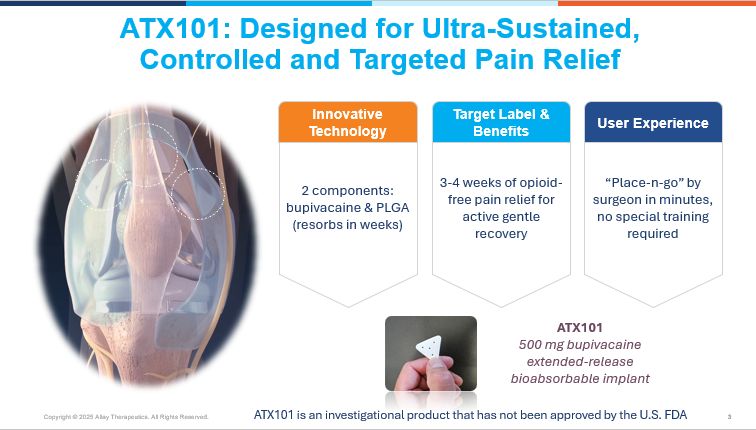
ATX101 combines bupivacaine, a long-used local anesthetic, with a bioabsorbable polymer. A surgeon would place the small implant at the knee surgical site at the end of a standard replacement procedure. Allay says placement takes minutes and requires no specialized training. Afterward, the material is designed to dissolve, ultimately breaking down into water and carbon dioxide.
The invention is in the timetable. According to Allay’s pipeline description, the implant releases about half of its bupivacaine in the first three to four days, when acute pain is strongest, and about 90 percent by day 14. The company alters the drug-polymer configuration and manufacturing process to change the amount released and the rate of release. That is the platform claim: if the pain curve changes, the medicine’s curve can change with it.
This is an important distinction in a field fond of announcing a new molecule. Allay’s lead drug is familiar. The company is trying to make its location and duration do the work. Its alternative is a post-operative toolkit of local injections, shorter-duration formulations, repeated medications and, often, opioids. In that comparison, a one-time implant must prove more than elegance: it has to improve pain control without introducing its own safety or workflow problems.
The first result, and the harder question
Allay surfaced publicly in 2021 with a small, open-label study in Australia. Twenty-two knee-replacement patients received ATX101 implants at different doses. The company reported two weeks of pain in the zero-to-mild range among patients at the 1,500 mg dose, along with lower opioid use than historical standard-of-care comparisons. It ended the study early after reaching what it regarded as useful data at that dose. It was an encouraging beginning; an open-label, 22-person study is also an invitation to run a tougher test.
That tougher test took time. A later exploratory Phase 2 dose-ranging trial enrolled 112 people. Allay said ATX101 showed clinically meaningful pain relief for up to four weeks against a bupivacaine active comparator, with less opioid use and improved functional activities measured as far as 60 days. Those findings helped win FDA Breakthrough Therapy designation in late 2024. The designation offers closer contact with regulators and possible review advantages. It is not an approval stamp.
“Pain management innovation has stalled for too long in the face of the enormous need created by the opioid crisis.”Adam Gridley, chief executive, at Allay’s 2021 launch
In February 2025, Allay began dosing patients in a larger, randomized, double-blind U.S. Phase 2b registration study. The planned 200-participant trial compares a 1,500 mg ATX101 dose with both placebo and a bupivacaine active comparator after total knee replacement. That design matters because it asks whether the implant beats an existing local anesthetic, not merely whether a knee heals eventually. Allay’s 2025 financing announcement anticipated results later that year and a Phase 3 study in 2026; those were plans stated at the time, not outcomes to assume.
Allay’s intended release schedule
What the company bought itself
Allay’s origin is unusual enough to explain its shape. It was founded in 2017 by The Foundry incubator and Lightstone Ventures’ Singapore fund, then acquired polymer innovator Orchid Medical in 2018. The combination points to an insight that is easy to miss: for a controlled-release medicine, materials expertise is part of the drug. The team now works across San Jose and Singapore, linking research, manufacturing and clinical development across two countries.
That operation has not been cheap. A $25 million Series B in 2019 was followed by a $60 million Series C in 2021. In June 2025, Lightstone Ventures and ClavystBio co-led a $57.5 million Series D, while HSBC Innovation Banking provided additional venture debt. The disclosed amounts are rounds of financing, not the price of an ATX101 implant or evidence of product revenue. Clinical development, manufacturing and regulatory work consume capital well before a hospital can buy a treatment.
The commercial path is taking shape through licensing. In 2023, Japanese drugmaker Maruishi Pharmaceutical obtained exclusive rights to develop and commercialize ATX101 and other implantable acute-pain candidates in Japan. The deal included an upfront payment and an equity investment, with possible milestone payments and royalties. In 2025, the territory expanded to South Korea and Taiwan. Maruishi also started an early safety study in Japan. Allay has therefore found a partner with a route into Asian operating rooms, even as the central U.S. clinical question remains open.
If ATX101 eventually reaches the market, the immediate professional users would be surgeons and hospitals; knee-replacement patients would live with the outcome, and insurers would weigh its cost against the rest of post-operative care. Allay has publicly named further programs for new formulations, injectables, a new indication and on-demand anesthetic delivery. Those programs describe a direction, not a shelf of available products.
The useful lesson in the knee
There is a generalizable idea here, even if ATX101’s clinical story is still being written. Start with the patient’s time horizon, then design the treatment around it. Allay looked at a weeks-long recovery and asked why the local medicine’s clock stopped so early. It brought a known analgesic together with polymer know-how, chose a surgical moment when placement would be possible, and tested progressively larger groups. The approach works only if a carefully controlled trial shows enough benefit and safety to justify the added implant and its cost.
This makes Allay’s story less about an abstract war on pain than about a calendar. On day one, almost any good anesthetic looks clever. The question is what happens when the patient gets home, starts physical therapy and discovers that the knee still has several weeks to say. Allay has built its business to answer that question with one placement and a slow release. The evidence that counts most will come from what patients can do during those weeks.
ATX101 is investigational and has not been approved by the U.S. Food and Drug Administration.