Before Aitana had an album called Cuarto Azul, she had a practical plan. Finish an arts baccalaureate. Sit the university entrance exams. Study design. Pop stardom was not so much pencilled into the calendar as waiting in the margins, where the most consequential doodles tend to live.
In July 2017, after those exams, she went to Madrid and auditioned for Operación Triunfo. Spain watched the 18-year-old from Sant Climent de Llobregat become one of the season’s most familiar faces. She finished second when the final aired in February 2018. Television loves a winner, but careers have a mischievous habit of ignoring podium order.
The duet “Lo Malo,” recorded with fellow contestant Ana Guerra, escaped the show and took on a life of its own. A solo deal with Universal Music Spain followed. Then “Teléfono” arrived that July and entered the Spanish singles chart at number one. The chorus was immediate; the title was a small comic prophecy. Aitana had spent months inside a television set, and now millions of phones were carrying her voice around.
Act I · The exit becomes an entranceSecond place, first principles
Reality television gives a young artist an audience before it gives her a catalogue. That is both a gift and a peculiar debt. Everyone knows your face; you still have to show them what belongs behind it. Aitana answered with work rather than mythology. Her debut EP Tráiler appeared in 2018, followed by the full-length Spoiler in 2019 and the Play Tour, which turned instant recognition into the slower education of nightly performance.
There had been a smaller rehearsal for all this. Beginning in 2014, she posted cover songs on YouTube. The videos did not come with an orchestra, stylists or a lighting plot. They did teach the basic bargain of internet-era pop: a camera is not merely equipment; it is one person waiting on the other side. The scale changed sharply after television. The bargain did not.
That same year, 2018, she published La tinta de mis ojos, a book pairing brief texts with her own illustrations. It is a curious early artifact: part notebook, part evidence that the art student had not been swallowed whole by the recording artist. Careers are often described as ladders because ladders make a reassuring diagram. Aitana’s looks more like a desk with several projects open at once. Some become records; one became a book; another, eventually, became a role on screen.
The collaborations also began teaching her how many versions of a pop song could fit the same voice. David Bisbal brought her into the sweep of “Si Tú la Quieres.” Morat, Reik, Cali y El Dandee and Sebastián Yatra connected her to different corners of Latin pop. A reworking of Katy Perry’s “Resilient” placed her in an English-language pop frame. These were not merely famous names arranged like ornaments. Each duet offered a different problem of tone: when to lead, when to answer, when to make two fan bases believe they had always belonged in the same chorus.
Her original design ambitions never quite vanished. They changed departments. Each album has behaved like a deliberately furnished room, with its own palette and rules. The first established a bright, polished pop vocabulary. 11 Razones, released in 2020, brought guitars forward and let pop-rock roughen the edges. Alpha in 2023 traded that room for the club - chrome, electronic pulse and songs designed to move even when their feelings did not.
Four records, four temperatures
This was not change for the sake of a fresh press photograph. It was a way to avoid becoming a tribute act to her own early twenties. “No me gusta repetirme,” she has said - I don’t like repeating myself. It may be the neatest manifesto in pop: short enough for a T-shirt, troublesome enough to build a career around.
The industry supplied its own running commentary. Spoiler received a Latin Grammy nomination for best pop vocal album in 2020; Cuarto Azul was nominated in the contemporary pop album category five years later. Between them came an MTV Europe Music Award for Spanish act, a Premio Ondas and collections of Odeón and LOS40 awards. Lists like these make a career look orderly, as though one trophy courteously followed another. The actual sequence was messier and more useful: write, release, tour, listen, change the sound, begin again.
“The people who love me say I’m very contradictory. I think it’s an adjective that defines me well.”Aitana, on the selves inside the songsAct II · A room painted blue
The private place that became public
Cuarto Azul, released in May 2025, is where the album-as-room idea became literal. Its 19 tracks are arranged around a symbolic refuge: a blue room to return to, take stock and become unobserved for a minute. For an artist introduced to Spain through a 24-hour television format, privacy is not an abstract luxury. It is architectural.
The record widened her circle of collaborators. Myke Towers, Danny Ocean, Jay Wheeler, Alaska and others enter the room; producers and writers including Gale and Nico Cotton helped alter its acoustics. Yet the organising image is simple enough for anyone to borrow. Most people have a place - real or invented - where the public self can be set down like an overpacked bag.
The album arrived alongside Aitana: Metamorfosis, a six-part documentary directed by Chloé Wallace. It also followed her acting debut as Candela in the 2022 Disney+ musical drama La Última. These projects complicated the oldest distinction in celebrity: where performance ends and the person begins. Aitana’s answer is not especially tidy. There are several Aitanas. The contradiction, she suggests, is part of the address.
Candela, her character in La Última, is an aspiring singer noticed in a bar. The premise sits so close to Aitana’s own public origin that it might have become a hall of mirrors. Acting changed the terms. A song permits three minutes of concentrated feeling; a series asks for continuity across episodes, marks and repeated takes. The role did not announce a departure from music. It let her try another kind of timing, with a character carrying the attention for once.
Then the blue room did something rooms are not expected to do. It expanded.
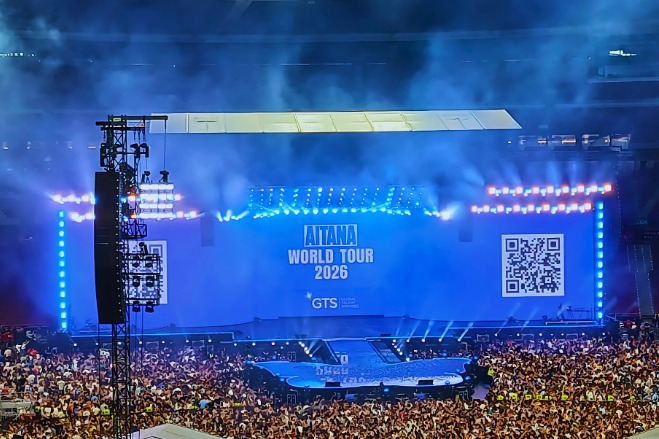
In July 2025, the Metamorfosis Season opened at Barcelona’s Estadi Olímpic Lluís Companys, followed by two nights at Madrid’s Metropolitano. The Madrid shows had already endured the sort of itinerary normally reserved for delayed trains. Originally announced for the Santiago Bernabéu in December 2024, they moved to June 2025, then changed venue and dates. The eventual concerts became a four-era retrospective performed on a butterfly-shaped stage.
The butterfly could have been too perfect a symbol. Fortunately, stadium machinery has a way of making metaphor sweat. Nearly forty songs, costume changes, dancers, guests, cues and thousands of voices must all land on time. Transformation is charming in theory. In practice, it needs a production schedule.
Act III · The room gets a passportA world tour, measured in return tickets
The Cuarto Azul World Tour began moving through Spain in 2026. September brought four nights at Barcelona’s Palau Sant Jordi and four at Madrid’s Movistar Arena, then two in Bilbao to close the Spanish leg. Gale, Ganges, Luzía, Chiara Oliver and Gara Durán were among the women invited to open the Barcelona and Madrid dates. The gesture made a large bill feel less like a procession of support acts and more like a wider pop conversation.
The blue route keeps unfolding
Next come Bogotá, Santiago, Buenos Aires, several Mexican cities, New York and Miami. Early 2027 dates carry the production back across the Atlantic to Lisbon, Milan, London and Paris. It is her first tour formally presented on this world scale, but the route also resembles an enlargement of paths already tested during the Alpha era, when she played across Latin America.
“Superestrella,” one of Cuarto Azul’s most durable songs, gives the tour a sly centre. The title sounds like a verdict delivered from outside. The song, and the record around it, is more interested in the person asked to live inside that verdict. By September 2026, the track had collected hundreds of millions of Spotify streams and a live edit on her official YouTube channel. Numbers measure repetition. They cannot quite measure recognition - the instant when a crowd hears an opening sound and supplies the rest.
Coda · Wet paint next doorAlbum five has already entered the chat
Aitana is not waiting for the tour to finish before sketching another space. Onstage in Madrid in September 2026, she confirmed that she and Puerto Rican singer-songwriter Gale were working on the next album. Gale’s fingerprints are already across Cuarto Azul, with writing credits on “Segundo Intento,” “La Chica Perfecta,” “Conexión Psíquica,” “Superestrella” and several more.
There is no announced title, track list or colour. That absence is refreshing. Pop encourages the audience to call wet paint a finished room. Here, the only firm detail is the collaboration and the intention to keep making music while the current chapter is still on the road.
The child who once proposed neurosurgery, the student who chose visual art, the runner-up, the YouTube singer, the actor, the author of an illustrated book, the stadium performer - none of these identities has entirely evicted the others. They overlap, occasionally argue and leave clothes on one another’s chairs. Aitana’s gift is not choosing a final version. It is making the contradictions useful.
Design, after all, is the art of deciding what a space permits. Her four records permit different things: polish, noise, dancing, retreat. The next one will move the furniture again. Until then, the blue room is on tour, its walls expanding each night to fit whoever has come through the door.