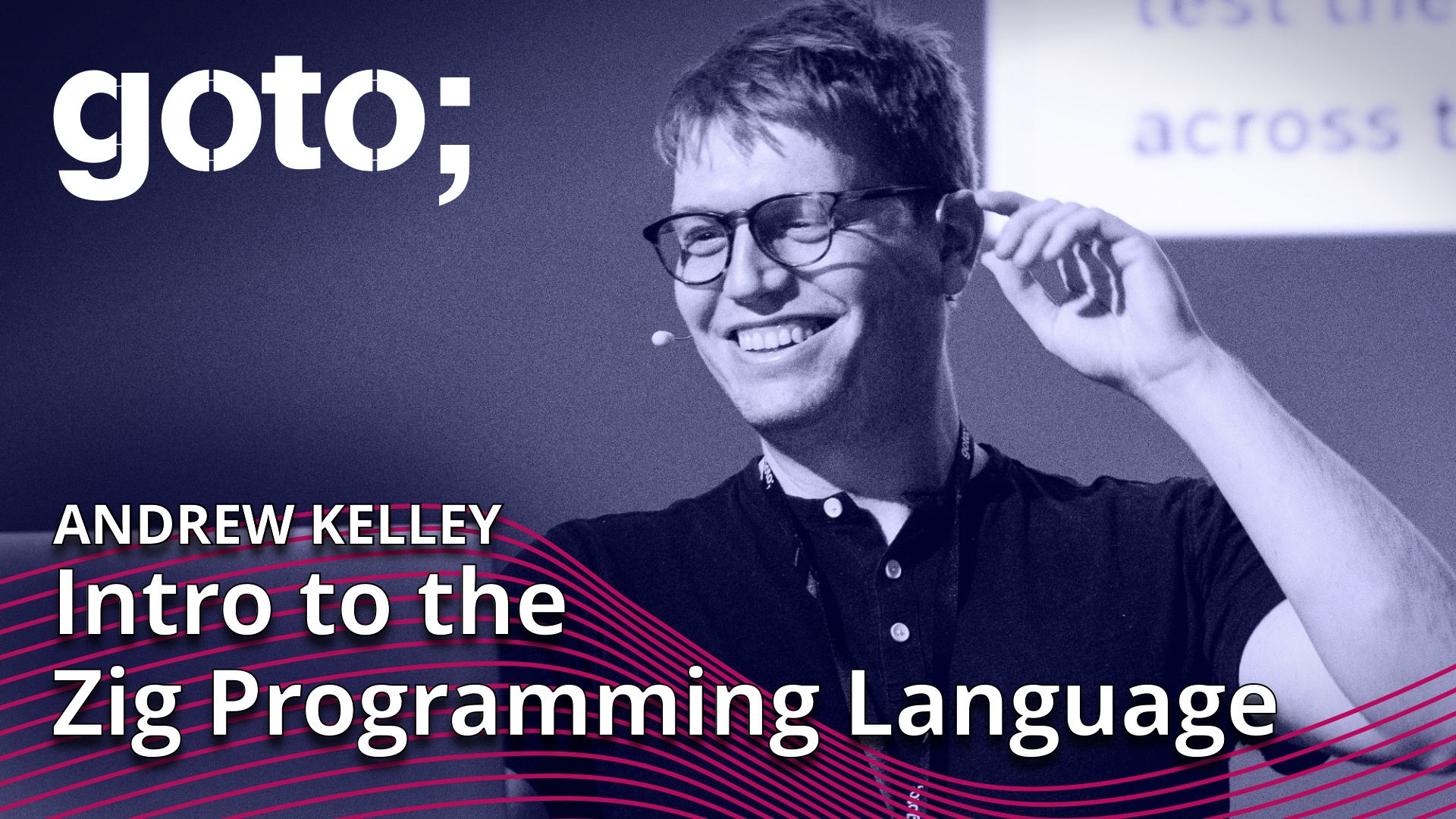
Here is a man who looked at C - the language that runs the world's infrastructure, that powers your operating system, your browser, your kernel - and thought: we can do this better. Then he quit his job.
Andrew Kelley is the creator of Zig, a systems programming language that has no hidden control flow, no hidden memory allocations, and absolutely no patience for the accumulated cruft of decades of backward compatibility. He is also the president of the Zig Software Foundation, a 501(c)(3) non-profit in Portland, Oregon, which is either an act of extraordinary idealism or extraordinary stubbornness, depending on which side of the donate button you sit on.
He started Zig in 2015 out of something most new programming languages share: irritation. C has been the lingua franca of systems programming since the 1970s, and it shows. It is powerful, portable, and absolutely determined to let you shoot yourself in the foot in creative new ways. Kelley wanted pragmatism. He wanted a language where the most natural way to write code would also be the most correct way to write code. He did not want to add garbage collection. He did not want to add operator overloading. He wanted, bluntly, less.
In 2018, with Zig still barely a language and not yet a community, he did the thing most sane people advise against: he resigned from a senior backend engineering position at OkCupid, a company with good pay, stability, and health insurance, to pursue Zig full-time on donations. "I quit my cushy job to live on donations to Zig," he wrote at the time, with the air of someone who has considered the odds and decided not to care.
That bet has compounded in unusual ways.
The most natural way to write a program should result in top-of-the-line runtime performance, equivalent to or better than C.- Andrew Kelley
The tension in Andrew Kelley's story is that he is a radical who hates complexity. He is a perfectionist who chose a language philosophy of doing less. When experts told him that compile-time code execution - comptime, as Zig calls it - was "a really dumb idea," he did it anyway. That feature is now one of the language's most powerful and most loved capabilities: the ability to run arbitrary code at compile time, enabling generic programming without a separate template system, enabling compile-time computed tables, enabling metaprogramming without macros. The experts were wrong. He knew they would be.
This is not arrogance. It is the particular self-assurance of someone who has thought very carefully about what they want and has decided that the opinions of people who have not thought as carefully are not binding. Kelley describes himself as "very blunt." His friends probably use different words.
Zig's design priorities read like a manifesto written by someone who has debugged too many midnight production incidents. First: pragmatism - does the language actually help you do the thing you are trying to do? Second: optimality - the fastest, most direct path. Third: safety - not enforced by the type system alone, but by making unsafe operations visible and intentional. Fourth: readability - because code is read more than it is written. There is no fifth priority. Kelley believes in short lists.
The real proof is in production. Bun, the JavaScript runtime that arrived in 2023 claiming to be three times faster than Node.js, is largely written in Zig. TigerBeetle, the financial transactions database built for safety and performance at scale, runs on Zig. Ghostty, a terminal emulator that has become a cult favorite among developers, uses Zig. These are not toy projects. They are the kind of software that processes real money and serves real users who notice when things slow down.
None of this happened because Kelley chased trends or attended the right conferences. It happened because he was right about what was missing, and patient enough to wait for the world to notice.
The Zig compiler builds itself in under 10 seconds. For context: most language compilers take minutes to compile themselves. This is not an accident - it is a design goal that Kelley has treated as a performance commitment since the beginning.
The Childhood Restriction
Andrew's parents limited his computer time to one hour a day. He admits this made him "very sneaky." Reader, it probably also made him very efficient.
The OkCupid Exit
In 2018, Kelley resigned from a comfortable senior engineering role at OkCupid. No safety net. No corporate backing. Just Zig, a donation button, and a manifesto.
The Expert Rejection
Language experts told him comptime was "a really dumb idea." He implemented it. It became Zig's defining feature. The experts have been quiet about this since.
The Platform Exit
On August 23, 2023, Kelley left Twitter AND Reddit on the same day. Not one platform. Both. He cited toxic incentives and corporate enshittification with the precision of someone who had drafted the post in advance.
In 2020, Kelley formalized the experiment by founding the Zig Software Foundation, a 501(c)(3) non-profit. The choice of structure is revealing. He did not start a company. He did not raise venture capital. He did not structure Zig to have an exit. He chose the non-profit path deliberately, to ensure that the language would be governed by its community rather than by quarterly returns.
This is unusual in a world where most successful programming languages are backed by corporations with interests that do not always align with their users. Rust has the Rust Foundation; Python has the PSF; both are non-profits. But both emerged from projects already large enough to attract institutional support. Kelley chose the non-profit structure from the beginning, when Zig was still a language that most people had not heard of.
By 2024, the bet was paying off visibly. Synadia Communications and TigerBeetle pledged a combined $512,000 to the ZSF over two years - the largest institutional commitments the foundation had received. Record numbers of GitHub issues and pull requests were filed. The x86_64 self-hosted backend delivered 5 to 50 percent wall-clock improvements. The compiler that builds itself in under 10 seconds was building more software than ever.
In 2025, Kelley announced the migration of the entire Zig project from GitHub to Codeberg, a European non-profit code hosting platform. The reason? GitHub's interface had become "bloated, buggy JavaScript," and its embrace of AI code generation ran contrary to Zig's policy of disallowing LLM-generated contributions to issues, pull requests, and comments. It is the kind of principled, inconvenient decision that most organizations would quietly avoid. Kelley announced it in a blog post.
Optimality may be sitting in the driver's seat, but safety is sitting in the passenger's seat, wearing its seatbelt.- Andrew Kelley on Zig's priorities
Informal proof correctness of a simple system beats formal proof correctness of a very complex system.- Andrew Kelley
The Zig Zag newsletter is where Kelley brings all of this together - the philosophy, the pragmatism, the updates on compiler performance and foundation finances, the thinking about what systems programming should look like. It is a newsletter for people who care about the machinery underneath the software, written by someone who has spent a decade deciding what that machinery should look like.
What makes Kelley an unusual figure in tech is the consistency. He does not switch positions when it becomes inconvenient. He does not add features to Zig because investors want to see growth. He does not stay on platforms that he believes are architecturally incentivizing the wrong behaviors. He is irritatingly coherent.
Portland, Oregon is a reasonable place to be quietly radical. Andrew Kelley builds games in his spare time - five browser-playable games, real-time strategy and platformers, with source code available. He built Groove Basin, a music player server with a web interface, years before Zig existed. He gives talks at conferences, writes long blog posts, and hosts a community at Ziggit. He does not appear to be interested in fame. He is interested in getting things right.
The world has a long history of people who decided that a dominant paradigm could be improved and then built something better. Kelley is somewhere in that tradition, at the inflection point between "promising language that a few serious engineers love" and "infrastructure that the next generation of critical software is built on." Given the trajectory, that second description is arriving faster than most expected.
A language that builds itself in ten seconds. A community that does not use AI to file issues. A foundation that chose non-profit from the start. These are decisions. Every one of them made deliberately, by someone who decided early on that his time was finite and the only sensible use of it was building things that would last.
| Project | What It Does | Why It Matters |
|---|---|---|
| Bun | JavaScript runtime (Node.js alternative) | 3x faster than Node.js; went viral on launch |
| TigerBeetle | Financial transactions database | Built for safety at extreme scale; also a ZSF donor |
| Ghostty | Terminal emulator | Cult favorite among developers for speed and design |
| Mach | Game engine toolkit | Native graphics and audio in Zig |
| pg_turso | PostgreSQL compatibility layer | Production database infrastructure in Zig |
At the end of the day, all that really matters is whether the language helped you do what you were trying to do better than any other language.
The most natural way to write a program should result in top-of-the-line runtime performance, equivalent to or better than C.
Optimality may be sitting in the driver's seat, but safety is sitting in the passenger's seat, wearing its seatbelt, and asking nicely for the other passengers to do the same.
Informal proof correctness of a simple system beats formal proof correctness of a very complex system.
Programming language experts told Andrew Kelley that compile-time code execution was "a really dumb idea." He implemented it anyway. Comptime is now one of Zig's most celebrated features - enabling generics, metaprogramming, and compile-time computations without a separate template system.
His parents restricted his computer access to one hour per day as a child. He says it made him "very sneaky." It also, presumably, made him exceptionally efficient with whatever time he did have - a trait that shows up in a compiler that builds itself in ten seconds.
In August 2023, Kelley left Twitter and Reddit on the same day. His reasoning was characteristically precise: Twitter promotes extreme content through algorithmic design, and Reddit had betrayed its community by restricting API access to extract value for AI training. He did not rage-quit. He explained his reasoning in a public post and moved on.
In 2025, when Kelley announced the migration of Zig's development from GitHub to Codeberg, he cited GitHub's AI features as contrary to Zig's policy. Zig disallows LLM-generated content in issues, pull requests, and comments. It is one of very few major open-source projects with a formal no-AI-contributions policy, enforced by migration to a platform that does not embed AI into the workflow.