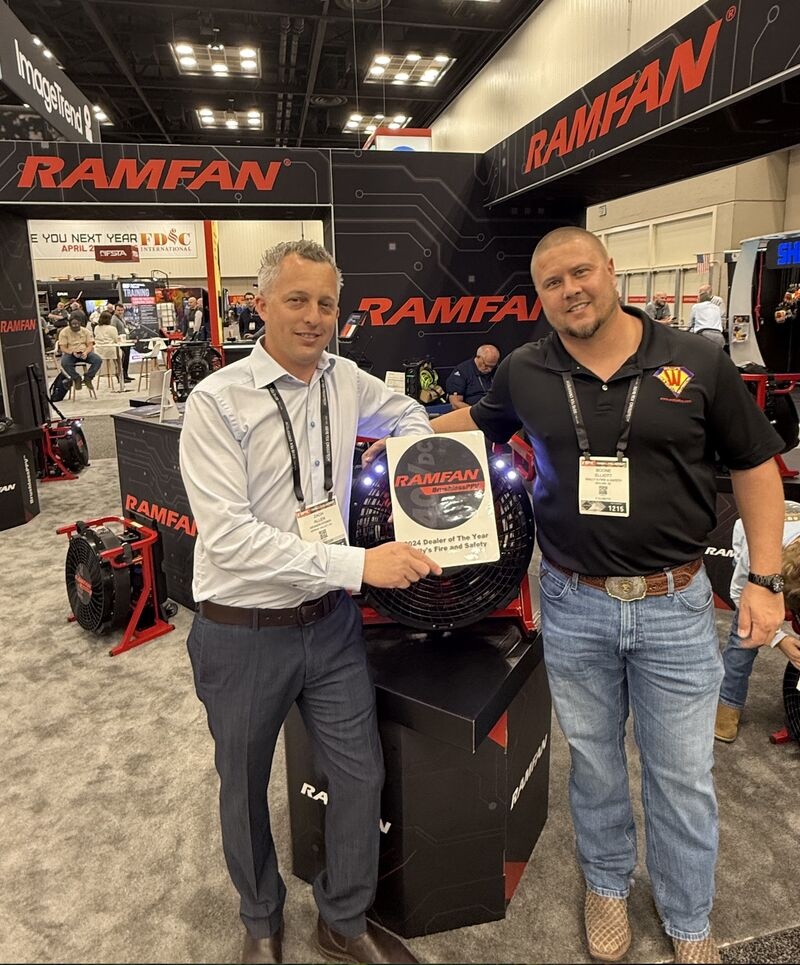
At FDIC 2025, Zach Allen stood beside a ventilation fan with a dealer award fixed to its front. The recipient was Wally’s Fire and Safety of Mullins, South Carolina, RAMFAN’s 2024 Dealer of the Year. In the photograph, two people hold the award while the equipment occupies the middle of the frame. It is an unusually useful picture of a business relationship: the product, the seller, the recognition, all within arm’s reach.
Allen is the founder and CEO of Bloom Capital, the family-owned investment firm that presents itself as an evergreen owner of businesses. He is also a director of Euramco Group, whose equipment businesses include RAMFAN. The two roles give his public career its particular shape. He talks about the duration of capital, but much of the visible work concerns the decidedly tangible business of making equipment, finding distributors and supporting customers.
An award on a fan makes a modest opening for an investment story. There is no ceremonial bell to ring, and a portable ventilator is unlikely to develop a taste for champagne. Yet the scene provides a better entrance into Allen’s working world than a photograph of a boardroom. Here, a business has to travel through somebody else’s hands before it can do its job.
Before the investment vocabulary, the equipment
By December 2017, Allen was already speaking for Euramco as vice president of sales and operations. When the company hired Curt Johnson to lead North American sales, Allen emphasized both technical capability and the dealer network. Johnson had worked at Tempest Technology, another equipment business. The appointment brought an experienced industry operator into a company developing battery-powered ventilation products.
“Euramco’s future depends on leading the way,” Allen said in that announcement. The rest of his statement connected advanced equipment with trusted relationships. Put those priorities together and a recognizable operating brief emerges: improve what the company builds, then improve how it reaches the people who use it. Neither task can be completed merely by announcing the other.
His connection to the industry extends beyond selling to it. A 2023 German-language advertorial identified him as a firefighter since 2013 and as an investor in industry projects since 2018. An author biography in Gulf Fire described more than fifteen years in Euramco’s operations and sales leadership. These overlapping responsibilities place him inside the commercial and practical conversations around fire equipment, rather than at their distant financial edge.
A battery changes the whole conversation
In a 2021 discussion of ventilation equipment, Allen described Euramco building its own battery packs, circuit boards and brushless motors. He traced the W50Li fan to 2017 and the EX150Li to 2019. The details mattered because battery-powered equipment involves more than substituting one power source for another. Charging, control electronics and the ability to change a battery become part of the product’s usefulness.
“In the last five years, the biggest thing in fans is the battery-powered units,” he observed. There is something pleasantly unromantic about that sentence. It describes a market through the object that changed, with no attempt to make a ventilation fan sound like a social movement. The fan still has to move air. The work around it becomes more complicated.
Allen also appeared as a voting member of the AMCA 240-22 Review Committee in a 2024 article about testing positive-pressure ventilation fans. The standard addresses how performance is measured, including battery runtime. Participation in that process adds another dimension to his equipment career: a manufacturer’s claims need a common measuring language if customers are to compare products meaningfully.
The distinction is useful when thinking about his wider business interests. A product can be new, and a sales pitch can be enthusiastic, while the customer still needs a dependable answer to an ordinary question: how will this work for us? Standards make that question less dependent on whoever happens to have the most persuasive brochure.
An editorial map of the responsibilities in Allen’s equipment work.
The local partner in a global business
Allen’s comments on British distribution show an executive willing to identify a gap. When Euramco appointed Wolf Safety as its exclusive UK distributor for hazardous-location RAMFAN ventilators, he described an established presence in the North Sea oil and gas sector alongside a shortage of local support. European headquarters on the continent had not supplied the proximity that British customers needed.
Wolf brought a local business with its own history in hazardous-area lighting. The partnership joined related equipment categories and gave Euramco a route to service as well as sales. Allen’s explanation made geography a practical matter. A company can operate internationally and still be inconveniently far away when a customer needs help.
In May 2020, Euramco announced another UK partnership, this time with emergency-vehicle manufacturer Venari Group for firefighting ventilation equipment. Allen pointed to shared priorities around quality and performance. “It’s important to have like-minded partners,” he said. The language was straightforward, but the underlying selection was specific: a business already working in emergency vehicles would help carry ventilation technology into the same professional setting.
These partnerships help explain why the dealer-award photograph belongs in his story. Distribution is a recurring subject in Allen’s public work. The companies, markets and products change; the task of finding someone capable of representing the equipment locally persists. The distance between manufacturer and customer needs people in it.
A retrofit, then a wider argument
In June 2021, Allen’s byline appeared on Bloom’s announcement of Kraken Power’s firefighting-vehicle refit systems. The proposal used lithium-battery systems configured for individual vehicles from standardized components, with an authorized installer network across North America. It approached electrification through equipment already in service, rather than requiring every department to begin with a newly built vehicle.
That announcement is a useful bridge between his equipment work and Bloom. It combines a technical change with installation, distribution and the economics of a customer’s existing fleet. A refit must make sense inside something that is already owned. The customer has a vehicle, a budget and a job to complete; the innovation has to fit all three.
Earlier that year, in an essay arguing for an independent Magirus, Allen surveyed firefighting-vehicle manufacturers across Europe, China and North America. His interest extended to ownership, industrial capabilities and the possibility of a business operating across major markets. The essay was an argument about a possible direction for the industry, rather than an announcement that he had bought the manufacturer.
By September 2025, he was writing explicitly about consolidation in fire apparatus. He argued that concentration among manufacturers and constraints on independent builders had consequences for municipal buyers. Whatever the merits of each industry claim, his position was clear: ownership arrangements belong in a discussion of the equipment that communities can purchase, the choices available to them and the time involved.
“It’s important to have like-minded partners.”Zach Allen, on the Venari partnership, 2020
The owner’s clock
Bloom’s September 2025 founding essay gives Allen’s answer to the question of time. He describes a family-owned firm able to hold businesses for decades, with stewardship as its organizing principle. “Leave it better than you found it,” is one of his stated rules. The aspiration is an enterprise that continues to invest in its own operation while producing returns.
The firm’s portfolio stretches across agriculture, public safety, water, power and transport. Its published lineup includes Ranch PRO and the Hay. businesses, Southern Aerials, XFDirect Asia, Amaar Water, Kraken Power and Gajah Mada Ferries. That combination can initially read like several different shopping lists. Bloom arranges them around the services that allow communities and commerce to function.
The portfolio presentation also acknowledges a practical tension: investors may need liquidity while an operating company needs continuity. Bloom describes structured windows for partial liquidity and a distinction between enduring enterprises and ventures that can provide liquidity events. These are descriptions of the firm’s intended structure, not a performance record or a promise that every project has reached completion.
The tree imagery Bloom uses is almost irresistible for a firm with that name. Still, the interesting part is the allocation of responsibility beneath the metaphor. Some businesses are meant to endure; others can develop, change or fall away. Allen’s public argument places the obligation to think through those differences with the owner.
Agriculture · Public safety · Water · Power · Transport
Back to water
The equipment career continues alongside that investment philosophy. In August 2025, Euramco named Nathan Calabrese regional sales director for the eastern United States. Allen, identified as a director, linked the appointment to expansion in product capabilities and sales channels. Once again, the story involved giving a technical business people who could carry its work into the market.
Then came a return to an older industrial task. Euramco’s August 17, 2026 announcement introduced NOMAD as its global firefighting pump brand, with a formal introduction scheduled for AFAC26 in Melbourne. The company described a development path through ASEAN and Australia, drawing on its experience with rotating machinery, power electronics and equipment controls.
Allen summed up the destination as “reliably moving water.” That is a compact ambition for a business with a long list of technologies available to it. Pumps, fans and batteries each invite an impressive specification sheet. The operating task remains stubbornly physical. Something has to move, something has to supply power, and someone has to be able to use and maintain the system.
Seen across these episodes, Allen’s career has a recurring rhythm: a product develops, a partner or manager joins, and the organization prepares to support the next stage. Bloom gives that rhythm a financial vocabulary built around longer ownership. The fan with the award attached offers a smaller, more concrete version. A product and a relationship share the frame, and both need to keep working after the photograph is taken.
Follow the work
Explore Allen’s businesses, writing and industry conversations.