Company Profile / Fashion-Tech
z-emotion
Seoul's quiet rebellion against the fashion sample room - dressing avatars in clothes that behave exactly like the real thing.
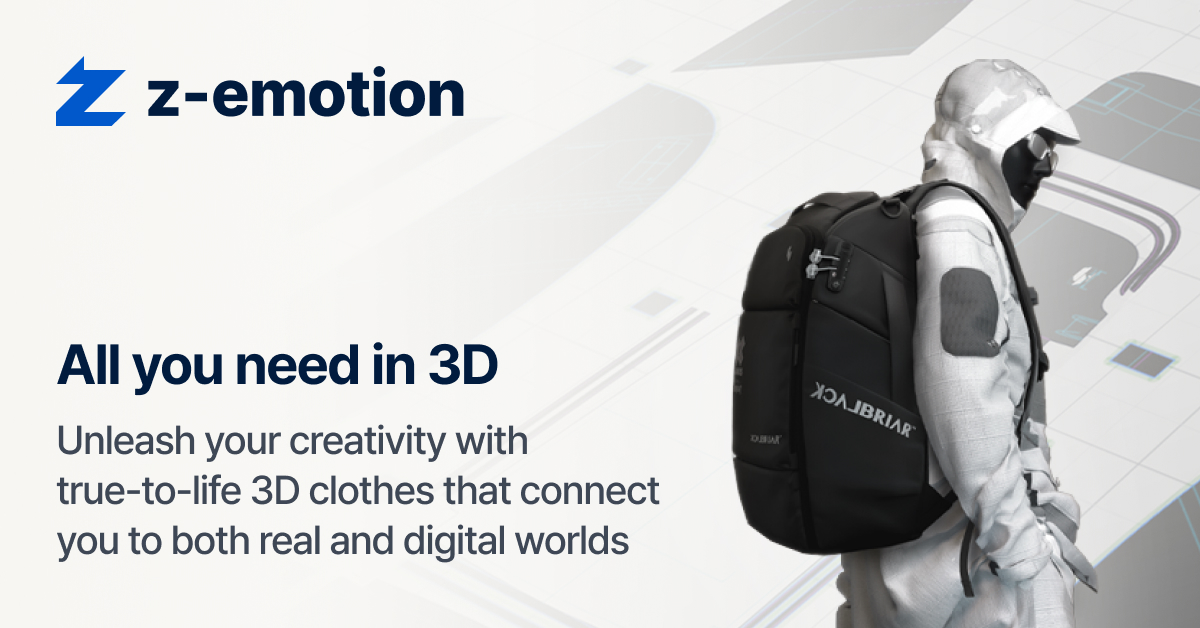
The pixels know how silk falls. That took a decade.
Seoul's quiet rebellion against the fashion sample room - dressing avatars in clothes that behave exactly like the real thing.
Who they are now
Somewhere in Seoul, a designer drags a virtual seam across a screen and a jacket falls into place - sleeves wrinkling, hem swaying, the collar catching light like wool actually catches light. No scissors. No muslin. No three-week wait for a sample to ship from a factory. The garment exists, fully, and it was never real to begin with.
That designer is using z-weave, and the company behind it is z-emotion: a fashion-tech firm of roughly thirty people that has spent the better part of a decade on a single, slightly absurd-sounding promise. Make digital clothing so convincing that the industry stops bothering with the physical kind, at least until the very end.
z-emotion sells software, not clothes. Its tools - a CAD program, two plugins, a cloud library, a virtual try-on engine - sit in the workflows of fashion brands, game studios, and online retailers. The common thread is simulation: cloth that drapes, stretches, and creases according to physics rather than guesswork. It is the unglamorous engine room beneath a very glamorous industry.
The problem they saw
Here is the awkward truth of apparel: before a garment is sold, it is made many times over as a sample. Each one is cut, stitched, photographed, shipped between continents, critiqued, and remade. The process burns money, weeks, and fabric - and a large share of those samples never become products at all. They are simply the cost of finding out whether an idea works.
The fashion industry knew this was wasteful. It also knew that 3D design tools existed. The trouble was that most of them produced clothing that looked like clothing in a video game from 2009 - stiff, plasticky, vaguely wrong in a way nobody could fully explain. A designer could tell, instantly, that the fabric was lying.
That gap - between a 3D model and a believable garment - was the whole problem. Close it, and digital samples could replace physical ones. Leave it open, and 3D stays a novelty. z-emotion decided the gap was a physics problem, not an art problem. And physics, it turns out, was something its founder already knew intimately.
The founder's bet
Dongsoo Han did not come from fashion. He came from graphics. With a master's in computer science from the University of Pennsylvania and more than twenty-five years in 3D simulation and gaming, he spent part of his career at AMD's GPU technology group, where he built something oddly specific: hair that moves. His simulation work became TressFX, the technology that gave Lara Croft the first genuinely playable head of hair in a video game. He has the book credits to match - co-author of GPU Pro 5 and GPU Pro 360.
Simulating hair and simulating cloth are, mathematically, cousins. Both are about thousands of connected points reacting to gravity, motion, and collision in real time. Han's bet was that the same engineering that made virtual hair believable could make virtual fabric believable - and that fashion, drowning in samples, would pay for the difference.
He had tested the idea before. Prior to z-emotion he founded ZelusFX and built the Zelus Engine, an avatar system. z-emotion, started in 2017, pointed all of it at one industry. The wager was less about fashion's taste and more about its math.
The product
z-emotion's logic is that a digital garment should not be trapped in the tool that made it. Design it in z-weave, then send it to a game engine, a render farm, an online store, or a metaverse avatar. The product line is built around that portability.
The flagship. A 3D garment CAD tool with a proprietary simulation engine that turns flat patterns into true-to-life clothing in seconds.
A cloth-simulation plugin for Autodesk Maya, dropping garment physics straight into animation and VFX pipelines.
Real-time cloth simulation inside Unreal Engine - for games, virtual production, and anything rendered live.
AI-driven virtual try-on, so shoppers and brands can see a garment on a body before it physically exists.
A cloud-based 3D asset library to store, manage, and share garments and avatars across a team.
An intuitive studio for characters, garments, accessories, and AR collectibles - introduced in 2023.
The milestone reel
Dongsoo Han points his simulation background at the fashion industry's sample problem.
The 3D garment design software goes public, promising end-to-end digital fashion.
Latest reported funding round, with strategic investors including LG Electronics, NAVER, HTC, and Shima Seiki.
A new design studio extends z-emotion from garments into characters, AR, and collectibles.
A major release and Unreal Engine webinar push deepen the pipeline-integration story.
The proof
A simulation claim is easy to make and hard to sell. z-emotion's evidence is in who chose to stand near it. Its cap table reads less like a typical seed round and more like a strategy memo: LG Electronics, NAVER, HTC's Vive, and knitting-machine giant Shima Seiki - hardware, internet, VR, and manufacturing, each with a reason to want fashion to go digital.
The integrations tell the same story from the technical side. z-emotion connects to Autodesk Maya and Unreal Engine, scans real fabrics through Vizoo, and sizes avatars on Alvanon body forms. Its garments have dressed avatars on ZEPETO, and its technology has been associated with project work for brands at the level of Louis Vuitton and Nike - the merge point, as Autodesk put it, between gaming and the fashion business.
// Illustrative comparison of a physical vs. 3D garment sample workflow - directional, not audited figures
The mission
z-emotion describes its purpose plainly: simplify 3D garment creation for fashion, gaming, and e-commerce, and help the apparel industry through its digital transformation. Stripped of the jargon, the ambition is structural. Today, a garment becomes digital only after it is physical - scanned, photographed, recreated. z-emotion wants to flip that order, so the digital version comes first and the physical one is produced only when it is genuinely needed.
Lately the company has leaned into AI: virtual try-on driven by machine learning, and synthetic datasets for training models on how clothing sits on a body. Dressing a real model is, after all, a slow way to teach a computer what a sweater looks like. The simulated wardrobe doubles as a teaching set.
Why it matters tomorrow
The fashion industry is not short on hype about going digital. What it has been short on is tooling that designers actually trust - cloth that drapes correctly, files that move between programs, an engine fast enough to keep up with a creative process that changes its mind every five minutes. z-emotion is not the only company chasing this; CLO, Browzwear, Style3D and others are in the same race. But its lineage is unusual. Most of its rivals grew up in apparel. z-emotion grew up in graphics, and it shows in the physics.
Whether the industry fully flips to digital-first remains an open question, and a small Seoul company will not settle it alone. What z-emotion has done is narrow the gap between a 3D model and a believable garment to the point where the difference stops being obvious.
Which returns us to that designer in Seoul, dragging a seam across a screen. A jacket falls into place, the wool catching light the way wool does. A decade of simulation work is hiding inside that single, ordinary-looking motion. No scissors, no muslin, no three-week wait. The garment exists - and the fact that it was never real is, increasingly, beside the point.
The rabbit hole
Watch it move