That is the premise Yichen Shen has spent a decade turning from a physics paper into a product line. He is the founder and CEO of Lightelligence, an MIT spinout that treats light as the medium of computation rather than just the wire that carries data between chips.
The idea has academic roots that are unusually traceable. In 2017, while finishing at MIT, Shen co-authored "Deep learning with coherent nanophotonic circuits," a cover paper in Nature Photonics. It argued, and demonstrated, that the linear-algebra heart of a neural network could run as interfering beams of light on a silicon chip. The science came first. The company came second, the same year.
Shen earned his PhD in Physics from MIT in 2016, working under Marin Soljacic and John Joannopoulos on the seam where nanophotonics meets artificial intelligence. He was born in Hangzhou, China, and his recognitions stacked up early: Forbes 30 Under 30, MIT Technology Review's 35 Innovators Under 35, and later a World Economic Forum Young Global Leader title in 2022.
He explains the bet without jargon. "We precisely control how the photons interact with each other inside the chip," he has said. "It's just light propagating through the chip, photons interfering with each other. The nature of the interference does the mathematics that we want it to do." Because interference does not burn watts the way switching transistors does, the chips run cool, and that is the whole economic argument.
When he wants the non-physicist version, he reaches for cars. Electronic computing, he says, is the gasoline engine. Photonic computing is the electric motor. The implication is not subtle - one of them is the legacy technology, and he is betting on which.
Lightelligence did not stay a single clever chip. The company shipped PACE photonic processors, with the newer PACE 2 packing more than 40,000 photonic devices and supporting a 128x128 matrix operation. It launched Hummingbird, billed as the world's first optical network-on-chip, and Photowave, an optical interconnect that took Best in Show at the 2023 Flash Memory Summit. In 2025 came LightSphere X, an optical interconnect aimed squarely at stitching GPU supernodes together.
The throughline is the bottleneck everyone in AI hardware now obsesses over: not raw compute, but moving data fast enough to keep the compute fed. Copper interconnects sweat and stall. Light does not. Shen's portfolio quietly migrated from "compute with light" toward "connect everything with light," following the market to where the pain actually is.
His forecast is the kind founders get held to. He has predicted that optical chips will climb from under 1 percent of intelligent computing to more than 30 percent within five years. It is a number designed to sound implausible until it isn't.
As a researcher he is prolific - roughly 40 peer-reviewed papers, including first-authored work in Science and Nature Photonics, and on the order of 20 US patents. That body of work is less a CV flourish than the raw material the company keeps mining for products.
He did not build it alone. Lightelligence was founded in 2017 alongside his MIT physics advisor Marin Soljacic, with Huaiyu Meng - another MIT doctorate - as chief technology officer, and Spencer Powers, an MIT Sloan MBA, rounding out the early team. The founding cast reads like a physics department that decided to incorporate.
The company's stated values have the slightly contradictory ring of a research lab that has to make payroll: "Open yet Focused," "Courageous but Humble," "Imaginative and Pragmatic." Its mission is blunter - turn cutting-edge thinking into real-world solutions - which is the polite way of saying the hard part is not the idea, it is the manufacturing, the yield, the packaging, and the software stack that has to wrap around a chip that computes in a way no compiler was designed for.
That software problem is real. A photonic processor only earns its keep if existing AI workloads can target it without a rewrite, so the company has worked to make its hardware play with frameworks like TensorFlow. The early demonstrations handled exactly the tasks the 2017 paper promised - speech and image recognition - the building blocks that prove the math holds up outside a simulation.
The capital followed the physics. Lightelligence raised through successive private rounds - a Series A, then growth rounds, then a Series C - drawing in a mix of marquee technology investors as it scaled from prototype to product. The funding paid for the unglamorous middle of a deep-tech company: fabrication partners, test rigs, and the years between a paper and a part you can put in a server.
In 2026 the experiment met the public markets. Lightelligence listed on the Hong Kong Stock Exchange, described in coverage as the world's first AI photonic-computing stock - a strange milestone for a technology that, a decade earlier, lived mostly on a whiteboard in a physics building. The debut drew heavy demand, the kind that turns a quiet research bet into a number on a screen that updates every second.
Strip away the funding rounds and the awards and what is left is a fairly simple, stubborn thesis. The transistor has been the unit of computing for half a century, and it is running into physics - heat, power, the cost of pushing electrons through ever-smaller wires. Shen's wager is that the next gains come not from making the electron's job easier but from handing part of the job to light. It is a wager that sounded eccentric in 2016 and sounds, increasingly, like infrastructure.
He is still early in the story by his own clock. If optical computing really does claim a third of intelligent compute, the man who insisted photons could do arithmetic will have been right at exactly the moment it stopped being interesting to argue about. If it doesn't, he will have built some of the most beautiful chips nobody needed. Either way, he is the one holding the beam steady.
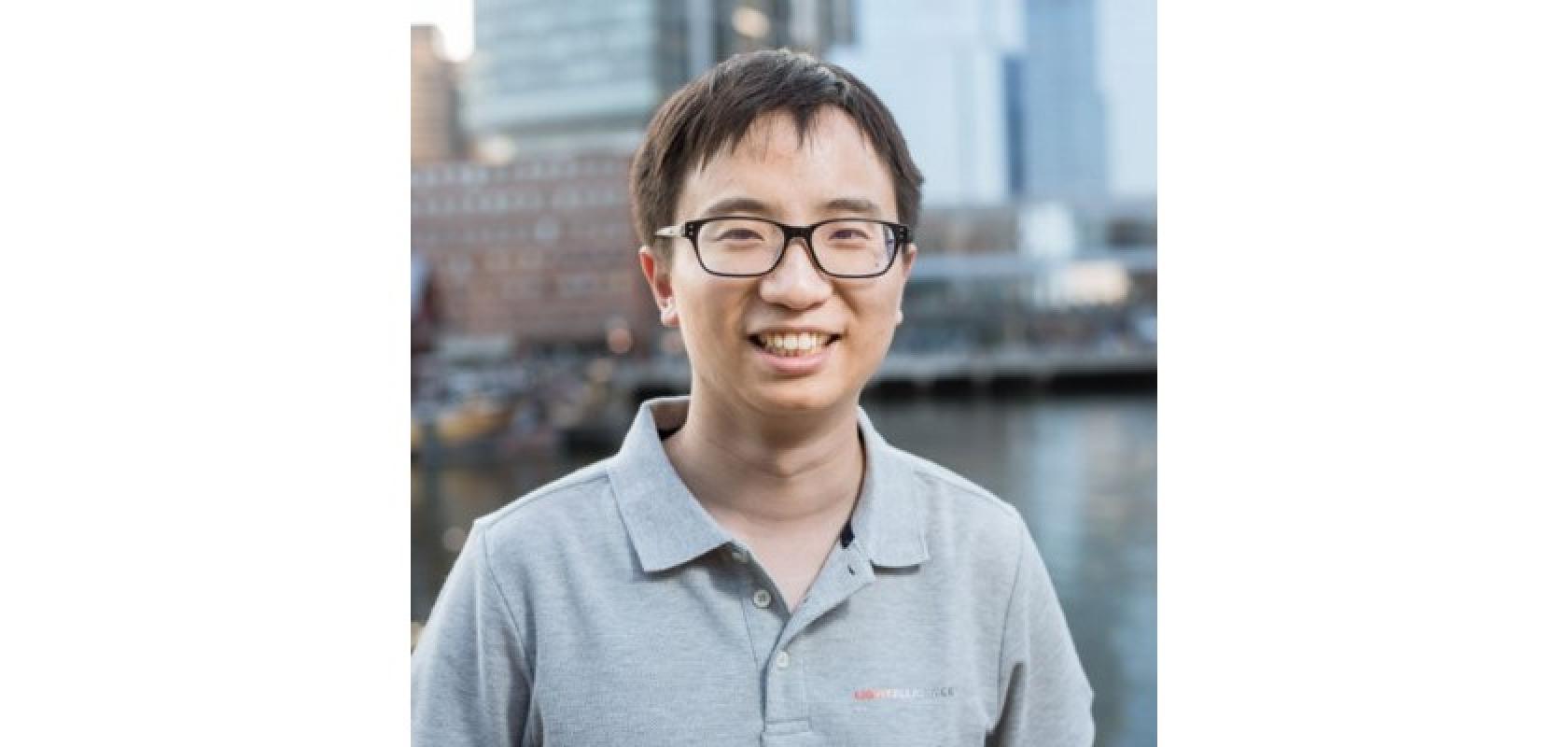 Yichen Shen, mid-stride between physics and silicon.